
Château d’Ainay-le-Vieil
Former owner

Key facts
ProtectionClassé MH
Classé monument historique: the highest level of heritage protection in France, decided by the national government. Any work on the protected parts needs state approval and is supervised by the state heritage services.
About
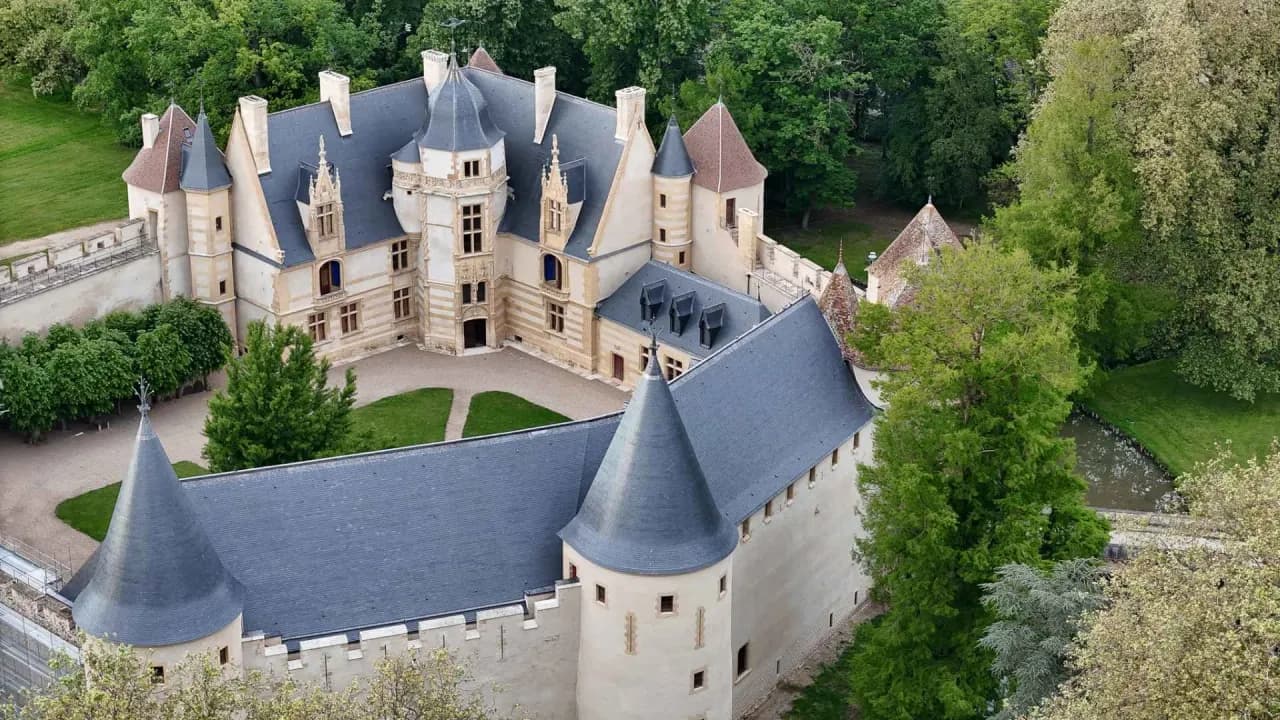
Bought in 1467 by the Chevenon de Bigny family, Ainay-le-Vieil has never left their descendants, and its salons trace French history through family marriages, from the Colberts to the duchesse de Tourzel. Behind nine towers and water-filled moats, this octagonal fortress in the Cher, never taken, hides a Flamboyant Gothic residence from the reign of Louis XII. Open to the public since 1954, it is being fully restored over six years by Arielle and Hervé Borne.
Ainay-le-Vieil owes its fortress to Philippe des Barres, a vassal of the Bourbons, who had it built in the 13th century. The château later passed to the Sully and Culan families, then to Jacques Cœur, the great merchant and royal financier. It follows the royal model developed under Philip Augustus: an octagonal plan and nine round towers, seven of them pierced with arrow slits and two flanking the gatehouse door. The fortress was never taken.
Ainay's entrance keeps its full defenses, with a drawbridge over moats that still hold water. The portcullis was worked from one guardroom and the drawbridge from another, a double control meant to prevent betrayal. Through the murder holes, defenders dropped not water or oil, both too precious, but quicklime or excrement. According to the family, that is where the French verb "emmerder" comes from: literally "to cover in crap," today simply "to annoy." Water has surrounded the two rings of walls since at least the 10th century. It flows through canals, moats and ponds, and its overflow feeds the village mill and washhouse.
On December 14, 1467, Charles Chevenon de Bigny, minister of the royal stables under Louis XI, bought Ainay-le-Vieil. The vellum deed is still at the château, and the estate has never left his descendants since. His son Claude, governor of the Bastille, built the Renaissance residence. His grandson Gilbert, grand chamberlain to Catherine de' Medici, built the chapel and created the water gardens.
Ainay's upper courtyard brings together two lord's residences. The medieval one, against the ramparts, held kitchens and storerooms, with the hall of justice upstairs. The prison and the dungeon are still at the foot of the towers. The residence built under Louis XII was designed for comfort, with wider windows. Its decoration is Flamboyant Gothic, the last and most ornate phase of the Gothic style, but the Renaissance already shows in the curved imperial dome of the main tower and in two Italian-style loggias. Above the door, the carved tympanum spells out the feudal order: the Bigny arms, a dog for loyalty, an angel holding the arms of France, and the Virgin and Child. The family motto runs with them: courage ennobles and exalts men.
For the visit of Louis XII and Anne of Brittany, Ainay-le-Vieil's grand salon received a carved fireplace, one of the finest in the region. At the bottom, the shield of France, circled by the collar of the Order of Saint Michael, stands out against a scatter of lilies and ermines. It sits between the king's L and the queen's A, beneath the golden rose granted by the pope. At the top, the Visconti serpent, the same one on Alfa Romeo grilles, recalls the king's claim to the Duchy of Milan, inherited from his grandmother Valentina Visconti. The crosses of Anjou recall his claim to the Kingdom of Naples. In the center, two dolphins twist their tails into a tree where a parrot perches, a symbol of the discovery of America.
The chapel at Ainay-le-Vieil, the work of Gilbert de Bigny, opens through a monumental Renaissance doorway carved with Venus and Vulcan. It makes you wonder whether the room first served another purpose. High on the walls, Charles and Claude de Bigny pray with their wives, facing the altar. The stained glass is by Lécuyer, whose work can also be seen in Bourges Cathedral.
The lower band of paintings, scenes from the life of Christ, is attributed to Jean Boucher, a 17th-century painter, and his workshop. They resurfaced a few years before 2024, in a restoration that sometimes meant removing ten layers of paint. In the center of the coffered ceiling, the hand of God holds a globe that turns in the same direction as palm fronds bent by the wind. The family reads it as the rotation of the Earth championed by Galileo, a sign of the Bignys' independent thinking.
The Colberts came to Ainay-le-Vieil through the marriage of Marie de Villefranche, heiress to the château, and Auguste de Colbert, a magistrate and private chamberlain to the pope. With him came the mementos of a family that has given some 150 members to the service of France since the 17th century. First among them is the great Colbert, minister to Louis XIV, represented here by a bust by Coysevox and a miniature by Petitot.
The three Colbert brothers, all Napoleonic generals, loom large. Auguste, killed in Spain at 32, appears in a portrait by Gérard that Napoleon gave to his widow. At the siege of Acre, wounded while shielding Murat, he had lost his pistols, and Bonaparte sent him a new pair. Édouard received his from Murad Bey, leader of the Mamluks. His chain mail, stained with blood at Waterloo, is displayed near Auguste's chapka, a lancer's cap. In the Gothic Revival billiard room, paintings by Lalauze, a pupil of Detaille, recount their feats of arms. One shows Édouard at the Carrousel in Paris during the Hundred Days, Napoleon's return to power in 1815. When the Emperor scolded him for being late, he answered: "Sire, we waited for you far longer than that."
Another marriage brought mementos of the royal family to Ainay-le-Vieil. Jeanne de Bigny, the last of her name, married Edmond de Villefranche, a great-grandson of the duchesse de Tourzel. Governess to the children of Louis XVI and Marie Antoinette, the duchess was the only person outside the royal family in the carriage during the flight to Varennes. The queen gave her an amber locket with a fossil spider trapped inside, the only jewel she wore in the Temple prison. Pauline, the duchess's daughter, became lady-in-waiting to Madame Royale, the king's daughter, who gave her a gold lyre. It is a music box that plays Bon voyage, monsieur Dumollet.
Edmond de Villefranche joined the navy as a sailor and rose to captain. He left a cabinet of curiosities brought back from his campaigns, with mandarin buttons and a Tibetan ivory prayer rattle. His daughter Marie ran the estate remarkably well and took up photography. Her pictures have been shown in an exhibition at the château.
The gardens of Ainay-le-Vieil layer three periods. The water gardens, made of islands, date from the Renaissance, including the "carré en l'isle," a square island 120 meters (394 feet) on each side. Abandoned during the French Revolution, the estate was revived in the 19th century by the marquis de Bigny, who created a landscape park, while the botanist Léonce de Lambertye turned the square into a kitchen garden. After the storm of 1985 destroyed much of the park, the family planted a rose garden of 160 old roses. Then, in 1997, came the chartreuses drawn from Lambertye's designs: open-air rooms linked by arches, conceived as a series of microclimates to ripen fruit. Together they tell how French gardens evolved.
Ainay-le-Vieil opened to the public in 1954, at the initiative of Jeanne, daughter of Auguste de Colbert, and her husband Géraud d'Aligny. With the owners of Meillant and Culan, they created the Route Jacques Cœur, one of the first tourist routes in France. Their children kept it open, then their granddaughter Arielle Borne, who took it over with her husband, Hervé Borne.
"What my grandparents, my uncles and aunts, my mother did […] we want to keep it going, keep sharing this heritage that matters so much to us and to France."
Arielle Borne, owner, 2024
When the couple arrived, Ainay badly needed restoring. They wanted a complete job, cellars to roofs, courtyard side and park side alike, and split it into six yearly phases: the two halves of the Renaissance residence, then the two halves of the feudal residence, the ramparts, and finally the gatehouse and the fixed bridge.
"We divided the château into six parts like a cheese, we cut the château into six and decided to do the work in six years."
Hervé Borne, owner, 2024
By 2021, the Renaissance residence had its plaster and roofs back.
"We're already very happy to see Ainay getting back its beautiful majesty, which it never lost. But now it's getting its color back, and a lovely youthfulness."
Arielle Borne, owner, 2021
In 2024, the fifth year of the program, work at Ainay focused on the ramparts and two medieval towers. The roofs keep two materials on purpose: flat tiles for the medieval roofs that survived intact, slate for the Renaissance and 19th-century roofs. All the windows now have small panes in the spirit of the 18th century. The last phase, the gatehouse and the fixed bridge, was scheduled for the following year.
In 2024, the château welcomes visitors and offers vacation rentals, bed-and-breakfast rooms, a restaurant and event spaces. The former stable, now the Salle des Archers, hosts weddings on 220 square meters (2,370 square feet) of oak parquet. The restored tack room welcomes school groups.
For future owners
Dreaming of a château like this one?
The founder of So Châteaux has visited more than 500 châteaux in France. He takes no commission on château sales, so he can tell you what he really thinks about any property, completely independently.
See how we help buyersDid You Know?
An ancestor named Colbert
The owners count Jean-Baptiste Colbert, the great minister to Louis XIV, among their ancestors.
Gallery
Frequently Asked Questions
For its round fortified enclosure, flanked by towers.