
Château d'Haroué
Architect

Key facts
ProtectionClassé MH
Classé monument historique: the highest level of heritage protection in France, decided by the national government. Any work on the protected parts needs state approval and is supervised by the state heritage services.
About
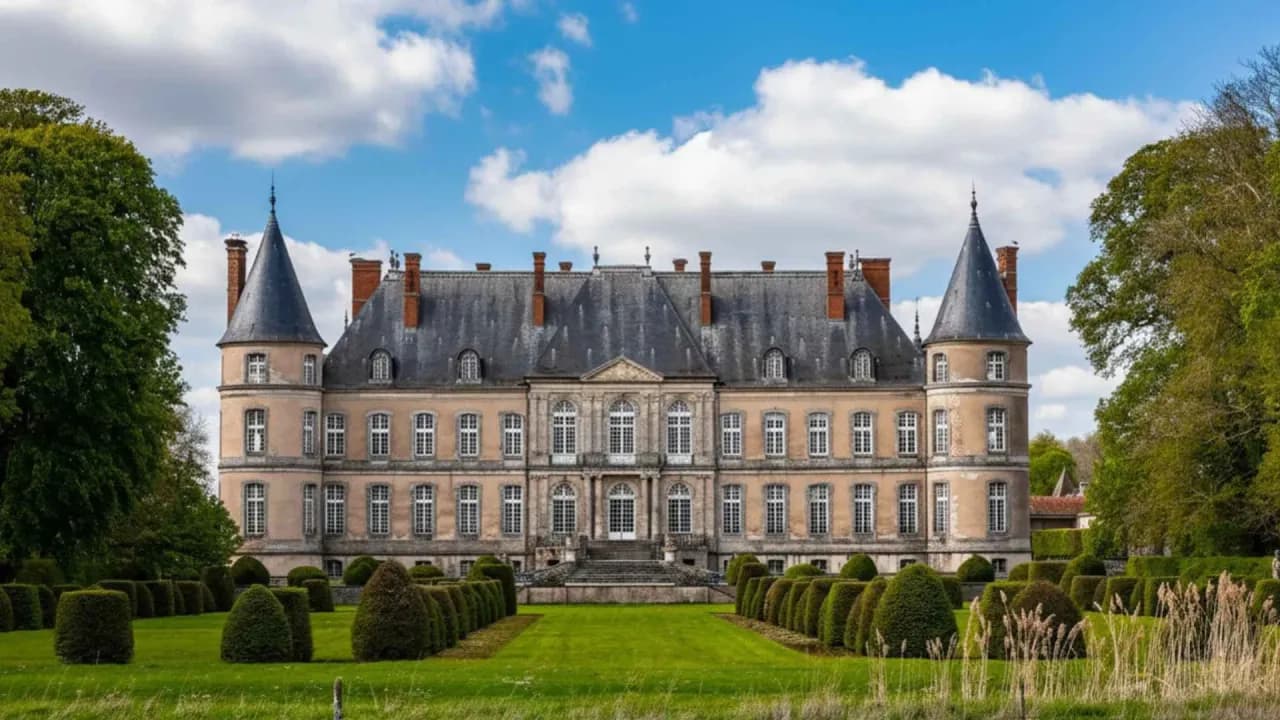
With 365 windows, 52 fireplaces, 12 towers and turrets and 4 bridges, Haroué is a calendar in stone. Built from 1720 for Marc de Beauvau-Craon to designs by Germain Boffrand, it is one of the great classical châteaux of Lorraine. Ringed by a moat, it still holds the tapestries given by Duke Leopold and Jean Lamour's iron railing. It never left the builder's descendants: Minnie de Beauvau-Craon restored it, and her children, the ninth generation, inherited it in 2023.
Haroué is a couple's château. It was built for Marc de Beauvau-Craon and his wife, Anne-Marguerite de Ligniville, and their two sedan chairs still wait in the entrance hall. Their joined coats of arms, Beauvau and Ligniville under a prince's crown, appear all over the house, down to the inlaid stone floor of the hall. From the front door, the architect laid out a sightline that runs straight through the building and ties together the village, the château and the garden.
For their wedding, Duke Leopold of Lorraine gave the Beauvau-Craons a set of twelve tapestries showing the battles of Alexander the Great against Darius, woven with the couple's arms. They hang in the arms room and along the ground-floor suite of rooms at Haroué, above Versailles-style parquet floors. Upstairs are the cartoons, the full-size designs by the painter Le Brun, from which they were woven. The arms room also holds tapestries designed by Hubert de Givenchy, a friend of the family.
Haroué's state drawing room holds a special place in the history of Lorraine, the region in northeastern France that was long an independent duchy. According to the family, the documents uniting Lorraine with France were signed in this room. It was also Anne-Marguerite de Ligniville's private room, which explains her Italian canopy bed, inscribed Ave Maria. In the summer dining room, one of the private rooms, a portrait of the couple's daughter, Anne-Marguerite de Beauvau, hangs near a painting of Marco Polo's travels.
The grand staircase at Haroué is reached through a small hidden door. It ends in a wrought-iron railing by Jean Lamour, the ironworker behind the famous gilded gates of Place Stanislas in Nancy. For the château, he wove interlaced Cs, for Craon, a motif repeated on the main entrance gate. Upstairs, a family tree traces the Beauvau line back to the old counts of Anjou. The names have faded away, but the coats of arms of the allied families remain. From the roofs, you can see the statues by Guibal, an artist from Lorraine, who carved angels and a crest with the family arms.
"Of course, the rooms open to the public are incredible, with craftsmanship and art. But up here, I think you really get a sense of how big and how beautiful the château is."
Victoria Botana de Beauvau-Craon, owner, 2024
Up in the attics, Haroué's roof frame shows the true scale of the building. The round towers, capped with round roofs, drop all the way down to the water level of the moat.
For a long time, the second floor of Haroué was left unfinished. Minnie de Beauvau-Craon completed it in 2000, with support from the SNVB bank, the region, the department and the DRAC, the regional heritage authority, and with students from the École Boulle, the Paris school of fine crafts. She designed its rooms to house furniture that belonged to King Louis XVIII: an antechamber, a drawing room and the king's billiard room. The furniture came to the family through Zoé du Cayla, a confidante of Louis XVIII, whose daughter Valentine married a Marc de Beauvau. Her portrait with her two children hangs in the billiard room.
Further on, Haroué's Hébert drawing room is gilded from floor to ceiling, and its hand-painted walls show the four seasons. One of the round towers on the same floor also has a painted ceiling.
To keep Haroué alive and share it, Minnie de Beauvau-Craon, the mother of the current owners, put on exhibition after exhibition. There was Baccarat, and in the 2000s Hubert de Givenchy, who showed wedding dresses there along with gowns by Cristóbal Balenciaga and Philippe Venet. For ten years she also staged an open-air opera. She invited artists to draw inspiration from the château. The Argentine artist Eduardo Oliveira Cezar based a work on the proportions of the grand staircase.
When the Centre Pompidou-Metz opened, she turned the cellars of Haroué into a contemporary art gallery, launched with a show by Béatrice Caracciolo and the Almine Rech gallery. The space is no longer used. Her very first project, when she inherited the château, had been the tower that holds the Pillement drawing room, restored some forty years before 2024.
Haroué is still surrounded by water. Its moat is fed by the Madon, the river that runs through the villages of the Saintois, a rural area south of Nancy. On the park side, the formal French garden was created in 1952 by Marc de Beauvau-Craon, the current owners' grandfather, with his friend the architect Emilio Terry. It features hornbeam hedges clipped into irregular cones and more statues by Guibal. The garden and its grove cover about one hectare (2.5 acres).
Minnie de Beauvau-Craon died in 2023. Her children, Victoria Botana de Beauvau-Craon and her brother Sébastian, inherited Haroué in May of that year. Sébastian's children are the tenth generation.
"My brother Sébastian and I inherited the château in May 2023 after our mother passed away, so it hasn't even been a year that we've been here without her."
Victoria Botana de Beauvau-Craon, owner, 2024
Their first restoration at Haroué is the Pillement drawing room, a Chinese-style room set inside a round tower, the same one their mother restored first. Backed by the DRAC and the region and led by a professional conservator, the project doubles as a training site for students in their final year at conservation schools. In 2024, the team is removing overpainting left by earlier restorations and securing fragile paint back onto the walls.
"Sébastian and I are the ninth generation today. So I think passing it on is really important for us, because it's something we were raised with."
Victoria Botana de Beauvau-Craon, owner, 2024
Under a 2021 agreement with the family, the Centre des monuments nationaux, the French state agency that runs national monuments, manages Haroué's public opening, weddings and exhibitions. In 2024, it is showing an exhibition by Alicia Paz from late May to November. The family keeps its private apartments, its library, where the château's archives are kept, and a chapel where it gathers to remember its dead. In 2024, the heirs' next goal is the exterior: two hectares (five acres) of roofs to restore.
For future owners
Dreaming of a château like this one?
The founder of So Châteaux has visited more than 500 châteaux in France. He takes no commission on château sales, so he can tell you what he really thinks about any property, completely independently.
See how we help buyersDid You Know?
A calendar château
The château is said to embody a symbolism of time: as many windows as days, chimneys as weeks, towers as months, and bridges as seasons.
Gallery
Frequently Asked Questions
The architect Germain Boffrand, between 1720 and 1729, for the Beauvau-Craon family.