
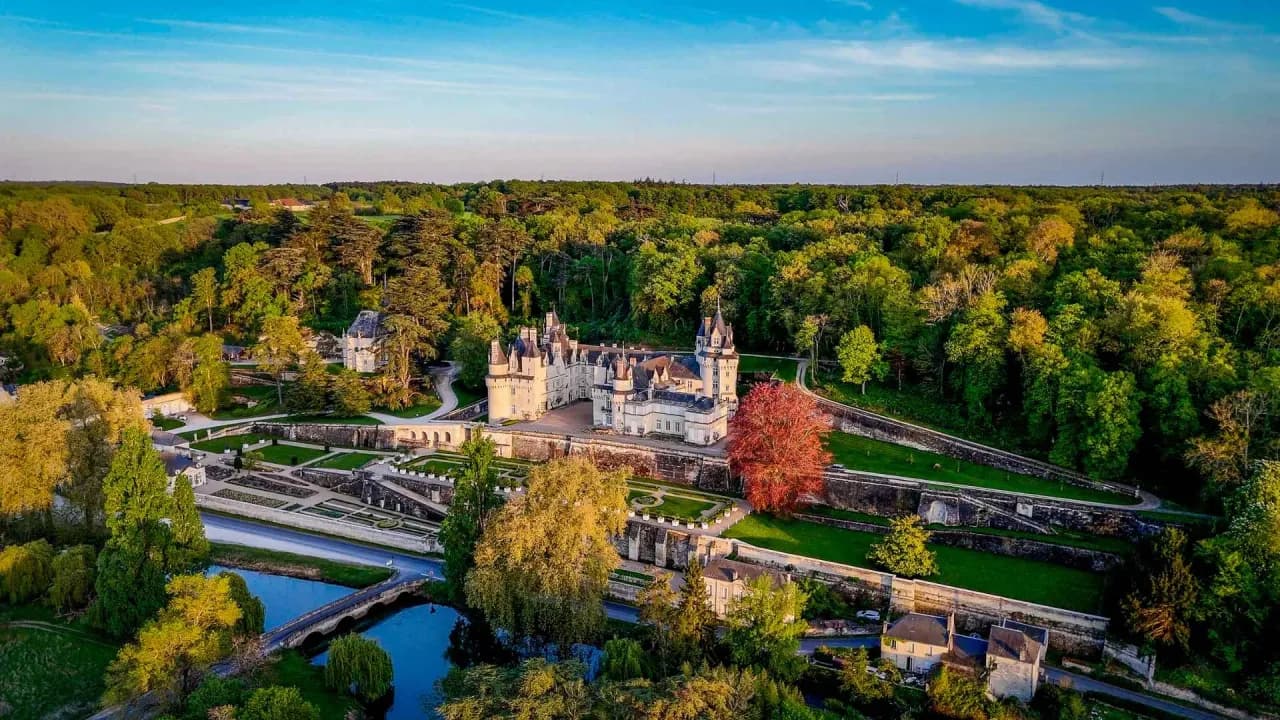
Château d'Ussé
Key facts
ProtectionClassé MH
Classé monument historique: the highest level of heritage protection in France, decided by the national government. Any work on the protected parts needs state approval and is supervised by the state heritage services.
About
Ussé is said to be the château of Sleeping Beauty, and its skyline of towers and pointed roofs is one of the most famous sights in the Loire Valley. A late medieval fortress turned country residence, it keeps a Renaissance chapel, a wing by Vauban and the furniture of the families who lived here. It is a private château, maintained and opened to the public by the Blacas family, who have owned it since the late 19th century.
Ussé stands on a site already known in Roman times as Uceum, a mile from the Loire, backed against the hillside and the forest of Chinon. In its overall form, the château as we see it dates from the end of the Hundred Years' War. Jean V de Bueil, a great soldier and an expert in military architecture, or his son Antoine gave it its defensive facade, designed for a time of peace. The east keep, the only tower whose top was never raised, is a little older than the others.
At first the fortress at Ussé closed in on a courtyard, with its castle chapel and an open gallery of pointed arches on the ground floor. At the end of the 16th century it opened up, for the sake of comfort. The Wars of Religion left their mark too. In 1568 an army camp was set up at Chinon, and the arrow slits along the wall walk were widened at the bottom to take the first muskets. People used to blame the roofers for the change. The archives gave the military explanation.
In the late 17th century, Monsieur de Valentinay wanted to make Ussé a château worthy of the marquisate he hoped to obtain. He laid out the avenue running down to the Loire. He also had Marshal Vauban, the great military engineer of Louis XIV and his son's father-in-law, build the pavilion that throws the facade off its axis. Louis XIV stopped at his house on the way back from the trial of Fouquet, his disgraced finance minister. No one knows whether the king stayed the night, or for how long. Either way, he saw a medieval stronghold, without the Vauban pavilion or the formal French terraces.
The original castle chapel at Ussé became a living space in the late 17th century, with new windows and ceilings. Louis, the son of Monsieur de Valentinay, married Vauban's second daughter, then twelve years old. The marshal stayed two weeks in this room, a very long time for him. It is still called Vauban's bedroom. In the 18th century it held a canopied Polish-style bed, and in the 20th century it became a sitting room, the heart of family life.
Redecorated a few years ago, the room brings together a suite of furniture ordered by a tax farmer, one of the financiers who collected royal taxes for profit. It was in the Valentinay family's Paris townhouse in 1757, then came to Ussé and has never left. The chairs have removable seats and armrests, so the upholstery could change with the seasons: velvet in winter, light fabric in summer. On the back, they show gilded carving, a detail reserved for the finest pieces. A rosewood slant-front desk, inlaid on all four sides so it could stand in the middle of the room, dates from 1720 to 1725, according to the family. On the walls hang four tapestries of David and Goliath, woven in northern France or the Netherlands, with borders from the late 16th century.
Next to the gilded chairs stands a plain cane chair. The old inventories mix luxury furniture and practical seating without a second thought.
"We have to stop seeing the 18th century as a museum. These are people who lived with furniture they liked, sumptuous furniture and also much more practical furniture."
Béatrix de Blacas, owner's family, 2026
The King's Bedroom at Ussé owes its decor to Henriette Madeleine de Valentinay, known as Mademoiselle d'Ussé, the daughter of Louis II de Valentinay. She never married, she was wealthy, and she lived a free and modern life for her time. When she inherited the château on the death of her half-brother Louis Sébastien, she furnished it in the Louis XVI style. The room, yellow until then, was hung with a fabric printed with small Chinese figures, still on the walls today, and given a canopied Polish-style bed. She kept the large 17th-century fireplace and an Italian mirror already documented in 1710, one of the house's masterpieces.
The chest of drawers is by Joubert, cabinetmaker to the king, and research into its history is still underway. The room takes its name from the duc de Rohan, who bought Ussé in 1778. As a duke and peer of France, he was expected to keep a bedroom ready for the king. A portrait of Madame Victoire, a daughter of Louis XV, by Élisabeth Vigée Le Brun hangs here too. It came down through the descendants of her lady-in-waiting, Madame de Chastellux, and recalls another branch of the family.
In 1807 the Duras and Kersaint families bought Ussé. Claire de Kersaint, wife of the last duc de Duras and a friend of the writer Chateaubriand, is honored here with a display case. Her novel Ourika, inspired by a story she heard in Madame de Beauvau's salon, is the first in which a Black woman speaks in the first person. The book set off a real "Ourika mania," and it has since been on the reading list of the French high school exam and of the highest national exam for literature teachers. The case holds her gloves, her belt, prayer texts and letters from Chateaubriand.
Félicie de Duras, princesse de Talmont and later comtesse Auguste de La Rochejaquelein, carried out major work at Ussé. A legitimist, loyal to the senior Bourbon line, and a friend of the duchesse de Berry, she asked her friend the sculptor Félicie de Fauveau to install the stained glass of a gallery added in the 19th century. Félicie de Fauveau also designed the decor of today's visitor entrance. The owning family descends from Clara de Duras, wife of Henri de Chastellux, duc de Rauzan. The Blacas family has owned Ussé through marriage since the late 19th century, and the comet from their coat of arms crowns the entrance. On the grand staircase, a portrait of Louis XVIII recalls the king who made the family's ancestor duc de Blacas. In the chapel, a painting by Camuccini commissioned by that first duke shows Christ blessing his four sons.
During World War II, Ussé was requisitioned to shelter the collections of the Bibliothèque nationale, France's national library, and of libraries in western France. About 1,500 crates arrived from 1940 on, some later replaced by crates from bombed coastal departments. The family found the requisition papers, with plans showing how the crates were spread through the driest rooms, and even the invoices for fire extinguishers bought for the occasion. One of them, found in the attic, is on display. The bridge at Tours made the area a bombing target, and at one point there was talk of moving the crates from the chapel into the caves behind the château. It never came to that, and the crates went back to their libraries.
The chapel at Ussé, built around 1525, is the work of the Espinay family, who followed the Bueil. Jacques d'Espinay wanted it, and his son Charles, husband of Lucrèce de Pons, built it. Back from the Italian Wars, the builders applied classical capitals, choir stalls and medallions to a Gothic vault. The doorway shows the apostles, the instruments of the Passion and skulls, a reminder of an age haunted by the plague. The great window had already lost its stained glass by 1699. The windows are being redesigned from fragments, one project after another, with the families who mattered to the château.
The choir stalls were taken down in the 17th or 18th century and put back in the 19th, and they still have their misericords, the small ledges carved under the seats. The family still uses the chapel: several generations of the owning family have been married or baptized here.
"A château isn't just us today. It's people in the past, it'll be other people in the future, and we're just one small link in the chain."
Béatrix de Blacas, owner's family, 2026
In 2026, Ussé is open to visitors and pays for its upkeep through them: the château accepts no state aid. The family, who live here, have opened new rooms to the public. The grand staircase now climbs all the way to the attic, where a room crowded with trunks has become a young woman's bedroom from the 1920s. Its wallpaper was reproduced exactly by the Offard workshop in Tours, from a fragment found on site.
"There were trunks with costumes […] old papers, old souvenirs, a fantastic jumble. I had the time of my life in that room."
Béatrix de Blacas, owner's family, 2026
The dining room at Ussé, documented as early as 1710, is open too, with its silver candy dishes bearing the arms of the first duc de Blacas. The 18th-century drawing room, furnished by Georges Jacob and home to a moon-phase clock made in Tours in 1779, stays private. Dogs are welcome on a leash, children have a game of their own, and the wall walk hosts the Sleeping Beauty trail.
For future owners
Dreaming of a château like this one?
The founder of So Châteaux has visited more than 500 châteaux in France. He takes no commission on château sales, so he can tell you what he really thinks about any property, completely independently.
See how we help buyersGallery
About
Ussé is said to be the château of Sleeping Beauty, and its skyline of towers and pointed roofs is one of the most famous sights in the Loire Valley. A late medieval fortress turned country residence, it keeps a Renaissance chapel, a wing by Vauban and the furniture of the families who lived here. It is a private château, maintained and opened to the public by the Blacas family, who have owned it since the late 19th century.
Ussé stands on a site already known in Roman times as Uceum, a mile from the Loire, backed against the hillside and the forest of Chinon. In its overall form, the château as we see it dates from the end of the Hundred Years' War. Jean V de Bueil, a great soldier and an expert in military architecture, or his son Antoine gave it its defensive facade, designed for a time of peace. The east keep, the only tower whose top was never raised, is a little older than the others.
At first the fortress at Ussé closed in on a courtyard, with its castle chapel and an open gallery of pointed arches on the ground floor. At the end of the 16th century it opened up, for the sake of comfort. The Wars of Religion left their mark too. In 1568 an army camp was set up at Chinon, and the arrow slits along the wall walk were widened at the bottom to take the first muskets. People used to blame the roofers for the change. The archives gave the military explanation.
In the late 17th century, Monsieur de Valentinay wanted to make Ussé a château worthy of the marquisate he hoped to obtain. He laid out the avenue running down to the Loire. He also had Marshal Vauban, the great military engineer of Louis XIV and his son's father-in-law, build the pavilion that throws the facade off its axis. Louis XIV stopped at his house on the way back from the trial of Fouquet, his disgraced finance minister. No one knows whether the king stayed the night, or for how long. Either way, he saw a medieval stronghold, without the Vauban pavilion or the formal French terraces.
The original castle chapel at Ussé became a living space in the late 17th century, with new windows and ceilings. Louis, the son of Monsieur de Valentinay, married Vauban's second daughter, then twelve years old. The marshal stayed two weeks in this room, a very long time for him. It is still called Vauban's bedroom. In the 18th century it held a canopied Polish-style bed, and in the 20th century it became a sitting room, the heart of family life.
Redecorated a few years ago, the room brings together a suite of furniture ordered by a tax farmer, one of the financiers who collected royal taxes for profit. It was in the Valentinay family's Paris townhouse in 1757, then came to Ussé and has never left. The chairs have removable seats and armrests, so the upholstery could change with the seasons: velvet in winter, light fabric in summer. On the back, they show gilded carving, a detail reserved for the finest pieces. A rosewood slant-front desk, inlaid on all four sides so it could stand in the middle of the room, dates from 1720 to 1725, according to the family. On the walls hang four tapestries of David and Goliath, woven in northern France or the Netherlands, with borders from the late 16th century.
Next to the gilded chairs stands a plain cane chair. The old inventories mix luxury furniture and practical seating without a second thought.
"We have to stop seeing the 18th century as a museum. These are people who lived with furniture they liked, sumptuous furniture and also much more practical furniture."
Béatrix de Blacas, owner's family, 2026
The King's Bedroom at Ussé owes its decor to Henriette Madeleine de Valentinay, known as Mademoiselle d'Ussé, the daughter of Louis II de Valentinay. She never married, she was wealthy, and she lived a free and modern life for her time. When she inherited the château on the death of her half-brother Louis Sébastien, she furnished it in the Louis XVI style. The room, yellow until then, was hung with a fabric printed with small Chinese figures, still on the walls today, and given a canopied Polish-style bed. She kept the large 17th-century fireplace and an Italian mirror already documented in 1710, one of the house's masterpieces.
The chest of drawers is by Joubert, cabinetmaker to the king, and research into its history is still underway. The room takes its name from the duc de Rohan, who bought Ussé in 1778. As a duke and peer of France, he was expected to keep a bedroom ready for the king. A portrait of Madame Victoire, a daughter of Louis XV, by Élisabeth Vigée Le Brun hangs here too. It came down through the descendants of her lady-in-waiting, Madame de Chastellux, and recalls another branch of the family.
In 1807 the Duras and Kersaint families bought Ussé. Claire de Kersaint, wife of the last duc de Duras and a friend of the writer Chateaubriand, is honored here with a display case. Her novel Ourika, inspired by a story she heard in Madame de Beauvau's salon, is the first in which a Black woman speaks in the first person. The book set off a real "Ourika mania," and it has since been on the reading list of the French high school exam and of the highest national exam for literature teachers. The case holds her gloves, her belt, prayer texts and letters from Chateaubriand.
Félicie de Duras, princesse de Talmont and later comtesse Auguste de La Rochejaquelein, carried out major work at Ussé. A legitimist, loyal to the senior Bourbon line, and a friend of the duchesse de Berry, she asked her friend the sculptor Félicie de Fauveau to install the stained glass of a gallery added in the 19th century. Félicie de Fauveau also designed the decor of today's visitor entrance. The owning family descends from Clara de Duras, wife of Henri de Chastellux, duc de Rauzan. The Blacas family has owned Ussé through marriage since the late 19th century, and the comet from their coat of arms crowns the entrance. On the grand staircase, a portrait of Louis XVIII recalls the king who made the family's ancestor duc de Blacas. In the chapel, a painting by Camuccini commissioned by that first duke shows Christ blessing his four sons.
During World War II, Ussé was requisitioned to shelter the collections of the Bibliothèque nationale, France's national library, and of libraries in western France. About 1,500 crates arrived from 1940 on, some later replaced by crates from bombed coastal departments. The family found the requisition papers, with plans showing how the crates were spread through the driest rooms, and even the invoices for fire extinguishers bought for the occasion. One of them, found in the attic, is on display. The bridge at Tours made the area a bombing target, and at one point there was talk of moving the crates from the chapel into the caves behind the château. It never came to that, and the crates went back to their libraries.
The chapel at Ussé, built around 1525, is the work of the Espinay family, who followed the Bueil. Jacques d'Espinay wanted it, and his son Charles, husband of Lucrèce de Pons, built it. Back from the Italian Wars, the builders applied classical capitals, choir stalls and medallions to a Gothic vault. The doorway shows the apostles, the instruments of the Passion and skulls, a reminder of an age haunted by the plague. The great window had already lost its stained glass by 1699. The windows are being redesigned from fragments, one project after another, with the families who mattered to the château.
The choir stalls were taken down in the 17th or 18th century and put back in the 19th, and they still have their misericords, the small ledges carved under the seats. The family still uses the chapel: several generations of the owning family have been married or baptized here.
"A château isn't just us today. It's people in the past, it'll be other people in the future, and we're just one small link in the chain."
Béatrix de Blacas, owner's family, 2026
In 2026, Ussé is open to visitors and pays for its upkeep through them: the château accepts no state aid. The family, who live here, have opened new rooms to the public. The grand staircase now climbs all the way to the attic, where a room crowded with trunks has become a young woman's bedroom from the 1920s. Its wallpaper was reproduced exactly by the Offard workshop in Tours, from a fragment found on site.
"There were trunks with costumes […] old papers, old souvenirs, a fantastic jumble. I had the time of my life in that room."
Béatrix de Blacas, owner's family, 2026
The dining room at Ussé, documented as early as 1710, is open too, with its silver candy dishes bearing the arms of the first duc de Blacas. The 18th-century drawing room, furnished by Georges Jacob and home to a moon-phase clock made in Tours in 1779, stays private. Dogs are welcome on a leash, children have a game of their own, and the wall walk hosts the Sleeping Beauty trail.
For future owners
Dreaming of a château like this one?
The founder of So Châteaux has visited more than 500 châteaux in France. He takes no commission on château sales, so he can tell you what he really thinks about any property, completely independently.
See how we help buyers