
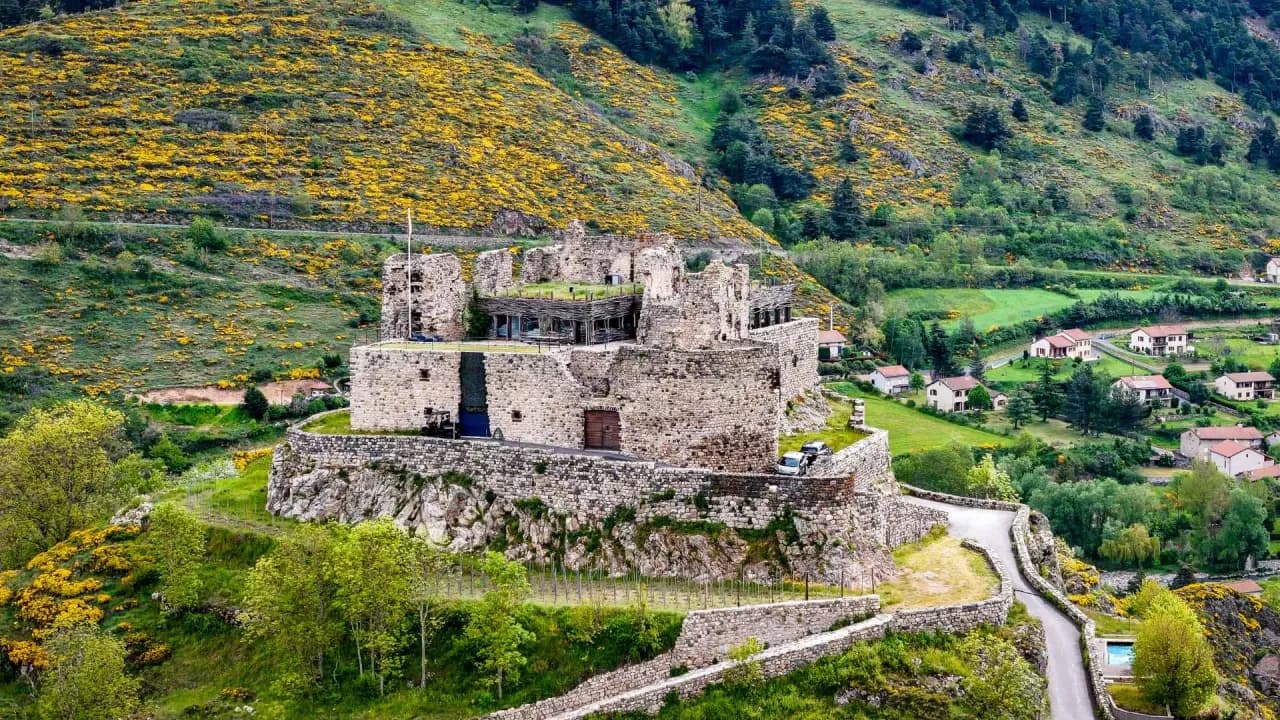
Château de Beaufort
Key facts
ProtectionClassé MH
Classé monument historique: the highest level of heritage protection in France, decided by the national government. Any work on the protected parts needs state approval and is supervised by the state heritage services.
About
A modern house set down inside a ruined fortress, without touching an old wall: that was the gamble of architect Jean-Jacques Julien, who bought Beaufort when its ruins were given fifteen years to live. The stronghold, built between the 13th and 16th centuries, stands on a rocky peak in the Haute-Loire, wrapped by a bend of the Loire River. It has been shored up every year since. Lived in once more, the château is also bringing back the vineyards that once surrounded it.
Beaufort stands on a rocky peak inside a bend of the Loire, in the village of Goudet, not far from the river's source at Mont Gerbier-de-Jonc. Most castles in the area were built on a spur, with the hillside at their back. Beaufort is open on all sides, a full 360 degrees. Traveling down the Loire, it is the second castle you come to. From its rock, it overlooks the valleys that lead into Goudet, and that view was its military strength.
The Château de Beaufort is thought to have been built around 1200, and most of its walls date from the 13th to the 16th century. It belonged to the lords of Beaufort. For three or four centuries, the oaths of loyalty they swore to the bishops of Le Puy listed what they held: the castle, farmland, a mill and vineyards. The viscounty of Beaufort covered hundreds of hectares.
Beaufort was besieged several times, notably by the English during the Hundred Years' War, and it kept its military importance until the Wars of Religion. In the 16th century, Antoine de La Tour added a large horseshoe-shaped tower to the southwest, a tower to the northwest, and a low outer rampart, called a fausse-braie, with a corner tower. A lady of Beaufort still lived there in the 18th century. By the early 19th century, the castle was nothing but a ruin, also known as the Château de Goudet.
Before it changed hands, Beaufort belonged to Michel Guyot, owner of Saint-Fargeau and the man behind Guédelon, the medieval castle being built from scratch in Burgundy. A survey by the DRAC, the regional heritage authority, gave the ruins fifteen years before they disappeared. Every year, sections of wall came down, and the site, open to anyone, was littered with beer cans and the remains of campfires.
Jean-Jacques Julien, an architect with roots in the Haute-Loire, was looking for a fortified house in the area for his family. His father spent his vacations in Goudet, and a cousin lives in the village. Michel Guyot warned him that he would never be allowed to do anything with a protected monument. After a two-hour tour of Saint-Fargeau, Jean-Jacques Julien wrote him a check for the deposit anyway.
"You know, Dad, I just bought the Château de Beaufort. He goes, in Goudet? I say yes. He goes, but it's a pile of rocks. I tell him, well sure, yeah, it's a pile of rocks, but I don't know, it makes sense."
Jean-Jacques Julien, owner, 2024
His father, chief architect of the City of Paris, was a deeply cultured man but a true son of the Haute-Loire. He could not see the point of buying something that served no purpose.
At Beaufort, the project began with a sketch. Jean-Jacques Julien's first drawings produced a storybook castle. Then he came back to a simpler idea: live on the site to bring it back to life, and give it not a restoration but a form of sanctuary, enough to stop the ruins from crumbling further.
"An architect running free is a public menace. I'd drawn Ludwig II of Bavaria's castle, of course."
Jean-Jacques Julien, owner, 2024
Martin de Framond, director of the departmental archives, and then Didier Repellin, an architect from Lyon who long served as heritage architect for the Haute-Loire, both told him he would be turned down. It took two years to get the permits. The DRAC in Clermont approved a reversible project: the house sits inside the castle walls, can be taken apart, does not touch the old masonry and leaves the landscape unchanged.
Since the purchase, Beaufort has had a new campaign of work every year. By 2024, that made about fifteen years. The goal is to consolidate the masonry rather than rebuild it, and to make the castle readable again: a clear silhouette, a structure, distinct levels. Now that people live there, the château has regained what its owner calls a social legitimacy.
"We try to straighten up everything that can be straightened and shore up everything that can be shored up."
Jean-Jacques Julien, owner, 2024
The archives gave Beaufort a new project. On Martin de Framond's advice, Jean-Jacques Julien read through the oaths sworn to the bishops of Le Puy and found that the lordship had owned vineyards. A local historian from the village placed them all around the castle. The open ground to the south, which he had assumed was meant for a kitchen garden, had in fact been planted with vines.
Three years before 2024, he set out to create a wine estate around Beaufort, at about 800 meters (2,600 feet) above sea level, choosing hybrid grape varieties. The choice raised a few smiles at first. A winemaker from Touraine, in the Loire Valley, advised him to stick with traditional varieties, before planting hybrids himself.
In 2024, Beaufort is a private property where its owner lives, and its vineyard is in its third year. Living there gave the château a social legitimacy. The vines are meant to give it an economic one. The fortress that everyone thought was doomed is now recognized as part of the heritage of the Haute-Loire.
For future owners
Dreaming of a château like this one?
The founder of So Châteaux has visited more than 500 châteaux in France. He takes no commission on château sales, so he can tell you what he really thinks about any property, completely independently.
See how we help buyersGallery
Frequently Asked Questions
It was built around 1200 and fell into ruin in the early 19th century.