
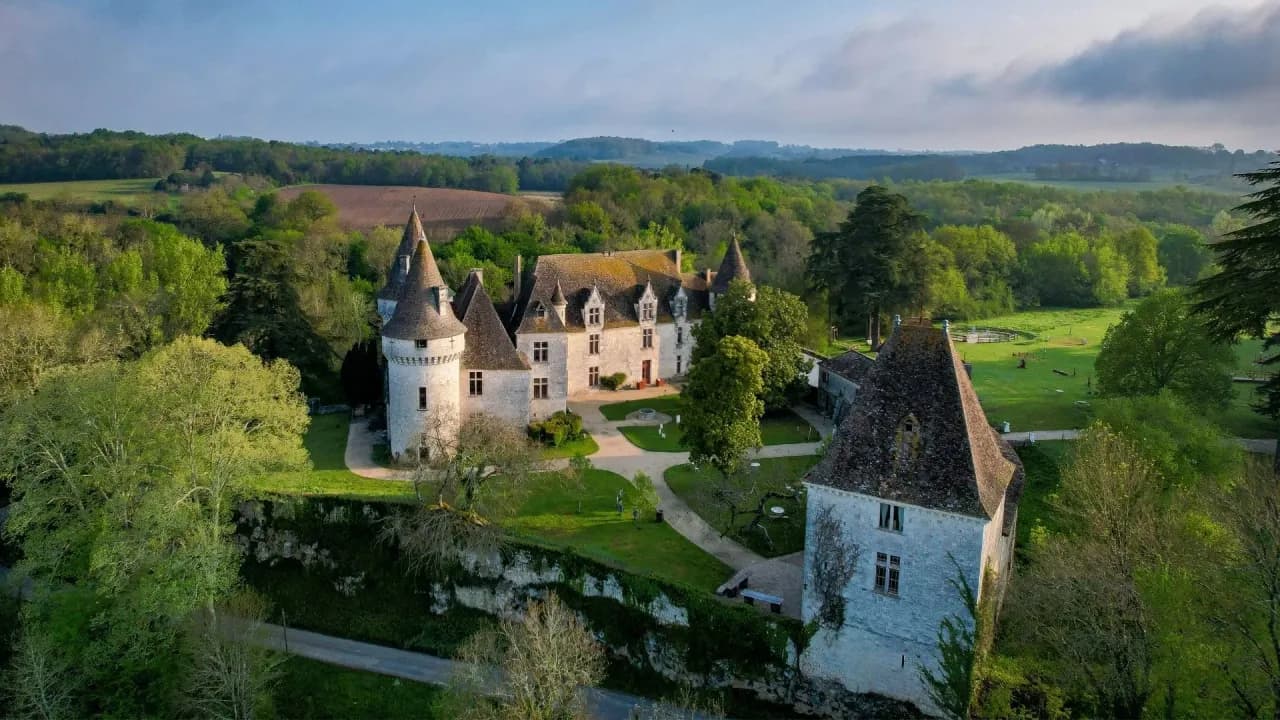
Château de Bridoire
Key facts
ProtectionClassé MH
Classé monument historique: the highest level of heritage protection in France, decided by the national government. Any work on the protected parts needs state approval and is supervised by the state heritage services.
About
Bridoire has two stories: a 12th-century fortress that became a Protestant stronghold and then the home of the Foucauld family, and a château looted for thirty years after a company tied to Emperor Bokassa bought it in 1978. Seized by the French state, the château stands on a spur among the Monbazillac vineyards of the Dordogne. The Guyot family bought it in 2011, opened it to the public for the first time in 2012 and turned it into the château of games.
Bridoire began in the 12th century as a small keep, built on a rocky spur to watch over a crossing on the Gardonette, a stream where the lords of Bergerac collected a toll. Little remains of that first fortress except one remarkably thick wall upstairs, where the old keep once stood. The cellars, cut into the rock, expose the foundations. Arrow slits pierce their walls, a sign that the courtyard, filled in later, was once much lower.
Bridoire's present outline dates mostly from the 16th century: big pepper-pot towers roofed in tile, in the Périgord manner, and the white limestone of the Bergerac area, paler than the ocher stone of Sarlat. Visitors enter the walled courtyard through a 15th-century gatehouse. Records are scarce, and the historians who have studied the château have often had to work by deduction.
Not until the 19th century did a family really live at Bridoire. Early in the century, a daughter of the marquis de Souillac married a Foucauld, and through that marriage the château passed to the Foucaulds, a leading family of the Périgord. Their coat of arms, a rearing lion, and that of the Souillacs, three swords, decorate the two large dormers added to the main wing to let in light. A tower was partly rebuilt, a corner turret was fitted with a staircase, the marquis de Foucauld equipped the stables with every comfort, and the interiors were brought up to date.
The dining room is the showpiece of Bridoire: walnut paneling, a fireplace carved with the Foucauld arms and vine leaves, and a ceiling scattered with fleurs-de-lis, a sign of royalist loyalty. The hall holds an Italian-style staircase, turning at right angles, built in the 17th century. At the very end of the 19th century, a chapel was set into a 15th-century level of the Chapel Tower, with the Foucauld lion on its keystone. Higher up, the spiral staircase opens onto carved corbels and a 15th-century keystone, still intact.
Bridoire also welcomed a cousin of the family, Father Charles de Foucauld, in 1911 and 1913. He stayed in a bedroom with a raised platform that looked straight into the chapel.
The Foucaulds could not hold on to Bridoire. In 1938 a Swiss family bought it, kept it up and lived there. In 1978 the château and its land were acquired by Bokassa, the Central African emperor, through a near-phantom company. With no caretaker and no one living there, Bridoire was left to looters and squatters for thirty years. Parquet floors and paneling were ripped out, fireplaces stolen, furniture carried off, and graffiti covered the house from cellar to attic, some of it carved with knives or nails into the plaster of the stairwell.
"It had a certain charm, for urbex and for those kind of grungy photos. But it's true that Bridoire was in really bad shape."
Alice Guyot, of the owning family, 2022
Since the owner never filed a complaint, no one could step in. A local association campaigned for the château's protection. The French state listed it as a historic monument on its own authority, interiors included, ordered the owner to carry out repairs and, with no response, began a long expropriation process. It is described as the only case in France of the state taking a private property this way.
Now the owner of an empty shell overrun with brambles, the state called for bids to find buyers who could restore Bridoire and bring it back to life. In 2011 the Guyot family won and paid €700,000 for a château stripped bare, with no land at all.
"My parents, who have this reputation for being château crazy, threw themselves into this adventure. They put forward a project, they bought the château back from the state. It was no gift."
Alice Guyot, of the owning family, 2022
In July 2012, Bridoire opened to the public for the first time in its history. For a little over six months, craftsmen and an army of volunteers took turns. The volunteers cleared rubble, scrubbed off graffiti, replaced windowpanes and repainted, clearing the way for the craftsmen. Half of the dining room parquet was remade exactly as it had been, along with the carved panels of the paneling. The stolen fireplaces in the billiard room and the drawing room were replaced with antique fireplaces of the right size. The ground floor came first, then the upper floors.
Upstairs at Bridoire, the armory had been split into three rooms by a corridor and two partitions. Tearing them down uncovered a large fireplace half buried in plaster, and opening the ceiling revealed massive beams. The joists were rebuilt at their original height. In the Italian-style stairwell, the graffiti-covered plaster was stripped to bare the stone. The kitchen, at courtyard level near the well and the cellar entrance, had lost part of its floor. Only the heavy stone sink was left. It now has a working 18th-century counterweight spit and a set of copper pans, and it is still used for events.
The tile roofs were in fairly sound condition in 2011, so the first years could go to the interiors. Three years later, one whole side was redone, its old tiles sorted and laid again. In 2022, Father Charles de Foucauld's bedroom, one of the last rooms left to restore, was getting a fireplace and new paneling, and a cabinet of curiosities had just been completed. The next big project is the chapel, whose stained-glass windows were all smashed: paneling and plaster first, then the windows, when the budget allows.
Since it opened in 2012, Bridoire has welcomed visitors as the château of games. The theme, chosen to draw a broad audience, brought in more than 30,000 visitors the first year and 60,000 in 2022. The wooden games, made for all ages to play together, are designed by the family. Immersive events, such as the Easter program built around Alice in Wonderland, refresh the visit at certain times of year.
"That's what really saved Bridoire. Because Bridoire is still a small site, and it manages to hold its own thanks to this very strong theme, the games."
Alice Guyot, of the owning family, 2022
The stables of the marquis de Foucauld, in the curved outbuildings that extend from the gatehouse, are still in use. Horses and ponies, all trained, take part in the activities. Bridoire is a private château, open to visitors and available for events.
For future owners
Dreaming of a château like this one?
The founder of So Châteaux has visited more than 500 châteaux in France. He takes no commission on château sales, so he can tell you what he really thinks about any property, completely independently.
See how we help buyersDid You Know?
Saved from ruin
Looted and threatened with collapse, the château was expropriated by the French state in 2003, before being bought and restored starting in 2011 by the Guyot family.
Gallery
Frequently Asked Questions
Yes, reopened in 2012, it offers tours, old-fashioned games, and themed evenings.