
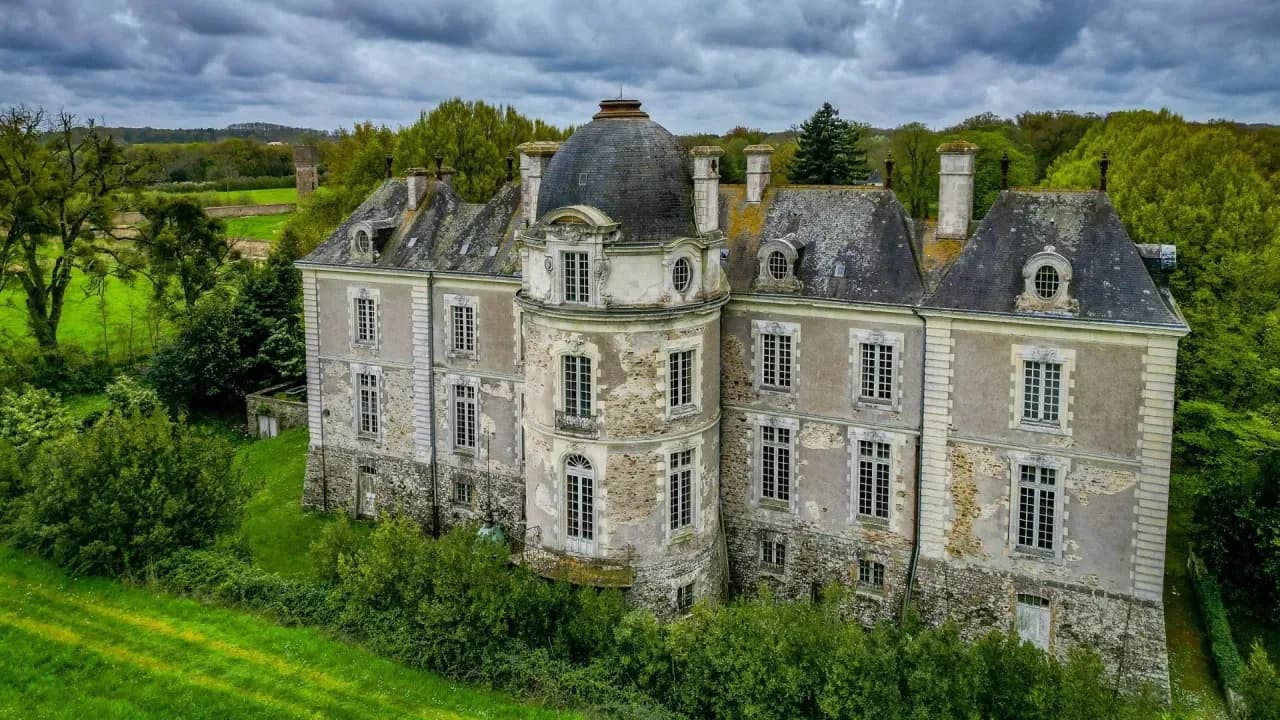
Château de Briord
Key facts
ProtectionInscrit MH
Inscrit monument historique: the second level of heritage protection in France, decided by the regional prefect. Owners must notify the state before any work on the protected parts, and the regional heritage authority (the DRAC) reviews it.
About
Left for nearly a century without modernization, Briord has kept the 1770 paneling described in its Revolutionary inventory, the tower of the comte Pelet de Lautrec and the Belle Époque fancies of shipowner Jean-Baptiste Étienne, from a Chinese bedroom to a painted hunting room. The château stands in the Pays de Retz, between Nantes and Pornic. Éric Peters bought it in the early 2020s and is restoring it with about a hundred volunteers, opening it to the public for free.
Briord was built in 1770 by a knight and local lord, Joseph Charette de Briord, born on this land in the commune of Port-Saint-Père. It lies in the heart of the Pays de Retz, which would become a stronghold of the Vendée Wars, the royalist uprisings against the Revolution in western France. The château follows a strictly rectangular plan. When it was seized during the Revolution, officials drew up a precise inventory of its furniture, paneling and decoration. That document now shows exactly what has not moved since.
Briord's first salon, to the left of the entrance hall, still looks as it did in the 18th century, with its paneling, carvings, stucco and full-height interior shutters. The inventory describes a small alcove here with a copper fountain used to refresh the lord. Only the white marble fireplace is 19th-century, with a cast-iron fireback made by Voruz at the very end of that century. The paneling is carved with scallop shells, a motif repeated upstairs. Next door, the darker "billiard" room was the men's salon, where they smoked, played billiards and held political meetings. It too has stayed as it was in the 18th century.
In the mid-19th century, the comte Pelet de Lautrec broke Briord's rectangular plan by adding an imposing tower to the north facade, with a salon or bedroom on each of its four levels. The lowest level, fitted out as an office, was later used by each owner in turn. It now holds two carved stones bearing the arms of the Pelet de Lautrec and Pantin de La Guère families. They once stood on either side of the courtyard entrance to show who owned the estate. Next to them hangs a plan of the kitchen garden dated 1907, drawn from older documents.
The last great builder at Briord was Jean-Baptiste Étienne, born in 1870 and died in 1949. He ran a large shipping fleet, part of which was sunk during World War I, and loved sailing and the exotic. In 1898 he launched a modernization campaign that lasted six or seven years. He had a huge low-pressure steam boiler installed in the basement, with sixteen cast-iron radiators 4 meters (13 feet) long. It was a revolution for the time, even if it only raised the temperature of the central rooms by two or three degrees. In 1898 the kitchens got cast-iron ranges, whose invoices have been found, and a dumbwaiter. Belle Époque cement tiles and early electricity, with its twisted wires still visible, reached the upper floors.
A master of the hunt, Jean-Baptiste Étienne led a hunting pack known far beyond the region, with 70 Vendée hounds, and rode to hounds in the nearby forests. His portrait on horseback with his pack, painted on wood in 1930, was found in pieces in the estate bakery and then pieced back together by a volunteer. It is the only color image of him that survives.
Upstairs at Briord, Jean-Baptiste Étienne created a Chinese bedroom, in the exotic taste of his day. The painted decoration on the ceiling and walls is the work of a decorator from Nantes, whose invoices have been found. The big marriage bed, the wardrobe and the table are fine 19th-century Chinese work. Three large hand-embroidered silk panels decorated the room, each thread about as thick as a hair. Those burned by the sun will be stabilized to stop the damage, though not necessarily restored.
Above it, under the tower's dome, he had fitted out an Ottoman room, with fabric-lined walls, poufs, cushions and opium pipes, described in a magazine report from 1911. Water leaks ruined this pleasure den. All that remains are Moorish-style decorations around the round windows and painted shutters. Jean-Baptiste Étienne died a bachelor.
Briord's grand stone staircase, as old as the château, has been listed as a historic monument by the French state for about forty years, for its wrought-iron railing. Above it, a trompe-l'oeil ceiling paints a balcony, with only a few hairline cracks. On either side, on the north and south facades, two small so-called secret rooms have a window that is invisible from outside, blended into the design of the facade.
The bedroom floor has changed little. There are 35 fireplaces on the estate, including large 18th-century marble ones. One bedroom keeps its alcove with two small side closets, the only one left as it was in the 18th century, when so many other châteaux tore theirs out to gain space. The service stairs lead to the top floor, where some twenty servants lived. Round windows, reached by a few steps, let them see outside.
"This spot, which is really a nothing room, I think it sums up the suspended-in-time side of Briord. You'd think the last bottles were taken out a few days ago and the labels are still here."
Éric Peters, owner, 2023
In Briord's basement, the great kitchen of Charette's time, in 1770, became a hunting room around 1900, decorated by Jean-Baptiste Étienne. Tiles replaced the terracotta floor, and he added stained glass and a painted ceiling that survives intact. Under the arches runs an animal frieze where a greyhound chases a hare and a fox stalks storks. A volunteer spent a winter toning down the gaps without retouching the original pigments. A 1911 magazine report describes the room with its big oak table and its Cordoba leather chairs bearing the monogram of Gustave Étienne, chairs that have been found in the château. In the cellar next door, emptied of its bottles, the wooden tags on the racks still show vintages from 1887 to 1929.
Éric Peters bought Briord in the early 2020s and turned it into a community project, the Terre de Briord. About a hundred volunteers, the "volontaires de Charette," come every week to work in the garden, on the timber frame of a sheepfold or on the château's monthly cleaning. The protected parts are handled by certified firms, under the supervision of a heritage architect. In 2023, a team of six or seven volunteers was digitizing more than 14,000 documents found at the château: letters, invoices, even a register of German prisoners of war put to work on the estate during World War I. This archive on the life of a 19th-century estate is meant to be shared with everyone.
"This is a project that's, that's going to last a very, very long time, well beyond how long I'll last myself. But, well, we'll have started a movement and, I hope, managed to make this place visible enough and protected enough that it survives for dozens of generations to come."
Éric Peters, owner, 2023
Outside, the 1907 plan guides the restoration of the kitchen garden and of a large heritage orchard of more than 400 fruit trees, 180 of them planted in 2023, along with an arboretum. Hunting has stopped, and the estate has become a refuge for deer, wild boar and foxes.
In 2023, Briord opened once a month for a large free tour, with advance registration. Beyond the château, the tour takes in the estate village, its joinery workshop and bakery, the water tower built in 1907, the gamekeeper's house, the chapel and the almonry across from it.
"All of this is completely free. Like I said, that's the essence of the project. It's about sharing with as many people as possible, with no financial strings."
Éric Peters, owner, 2023
The first major restoration, announced for fall 2023, concerns Briord's tower: more than a year under scaffolding to rebuild the timber frame and roof of its dome exactly as they were. In the attics, more than a quarter still remained to be explored.
For future owners
Dreaming of a château like this one?
The founder of So Châteaux has visited more than 500 châteaux in France. He takes no commission on château sales, so he can tell you what he really thinks about any property, completely independently.
See how we help buyersGallery
Frequently Asked Questions
The current château was built in 1770 on medieval foundations.