
Château de Brissac
Key facts
ProtectionClassé MH
Classé monument historique: the highest level of heritage protection in France, decided by the national government. Any work on the protected parts needs state approval and is supervised by the state heritage services.
About
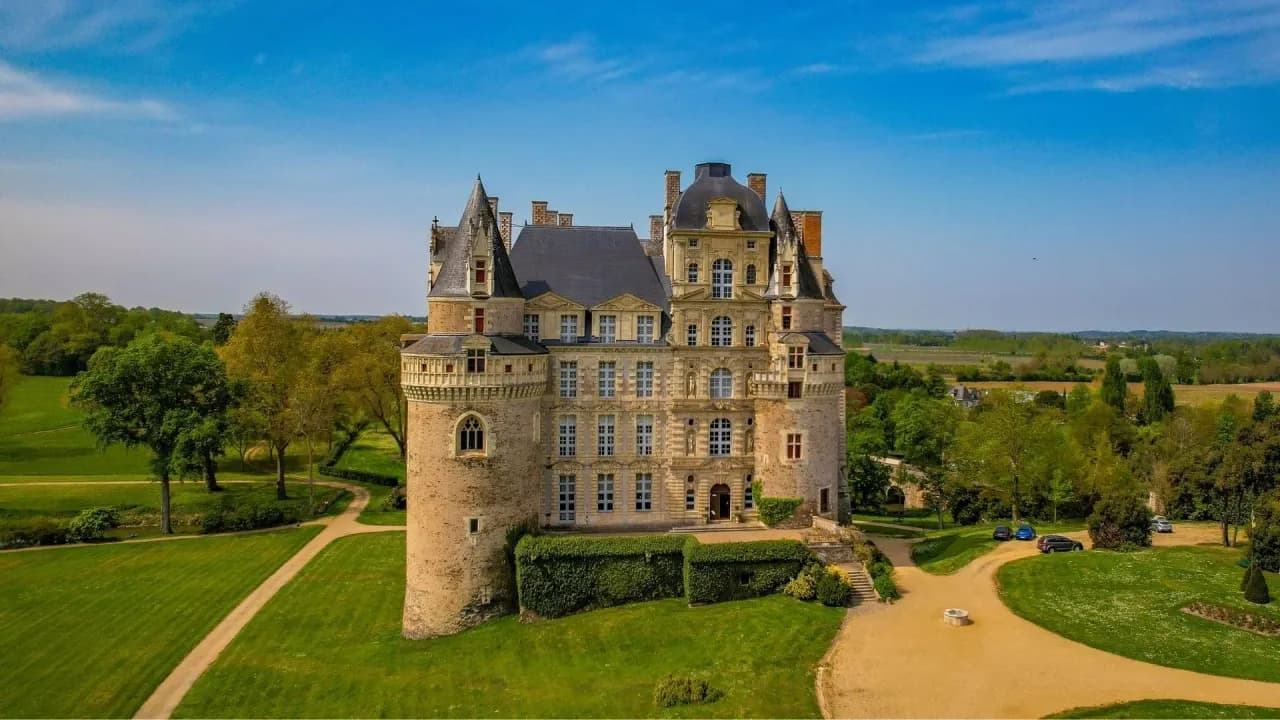
Left unfinished since the second duke abruptly stopped his father's building work in the early 17th century, Brissac pairs two medieval towers with a seven-story palace said to be the tallest château in France. This giant of Anjou, in the Loire Valley, keeps its painted and gilded ceilings, the room where Louis XIII and Marie de Médicis made peace in 1620, and Jeanne Say's theater. The Cossé-Brissac family, lords here since 1502, live there and open it to the public.
The Brissac family knows the exact date it arrived: the lordship was bought on May 26, 1502, more than half a millennium ago. Of the original castle, the two massive towers framing the facade remain. At the very start of the 17th century, Charles de Cossé, first Duke of Brissac, set out to rebuild everything. His monogram, a double C, became the château's signature motif, carved in stone and wrought in iron.
The Brissac project stopped halfway. When the first duke died, his son, the second duke, abruptly halted the work. The medieval towers that were supposed to come down are still standing, and the entire right wing is missing. The central pavilion is badly named, since it is not in the center, and behind the towers, windows still wait for a demolition that never happened. That interruption gave Brissac its character: half medieval fortress, half grand palace.
"We've been attached to this place for more than half a millennium, we're here to serve this place. And it's a pleasure for us to open it to the public, to everyone."
Charles-André de Brissac, owner, 2022
The grand salon at Brissac is called the gilded salon because of its ceiling, whose beams and joists are carved and painted with gold leaf. The first duke appears over the fireplace. The collection of family portraits, listed as a historic monument by the French state, traces the family's history back to the 15th century. The large full-length portrait of the eighth Duke of Brissac recalls a leading figure of his time. He was governor of Paris and lived at the court of Versailles, but stayed deeply attached to his estate in Anjou, where he set up charities for abandoned children and orphans. The lover of Madame du Barry for fifteen years, he died a victim of the Revolution, as she did a few months apart.
Until the Revolution, the Brissac keep was topped by a bell tower crowned with a winged bronze Mercury. The family recently bought at auction a reproduction of Giambologna's Mercury, whose original is in Florence. Two portraits painted after World War II by Bernard Boutet de Monvel show the twelfth duke, Pierre, and his wife, the daughter of Eugène Schneider, the steel magnate of Le Creusot. The painter died shortly afterward in a plane crash in the Azores, along with the boxer Marcel Cerdan and the violinist Ginette Neveu.
On the second floor, the great gallery, the ballroom of Brissac, has kept the ceiling painted when the château was built in the early 17th century. The work of Italian painters, in the spirit of the School of Fontainebleau, it holds about a hundred small paintings on its beams and joists: figures from mythology, Bible scenes, Italian landscapes. The gallery faces due south over the park, and the château is mirrored in the pond below.
Brissac also keeps a sedan chair that was hardly ever used. An uncle gave it as a wedding present to Mathilde de Crussol d'Uzès, daughter of the famous Duchess of Uzès, when she married the eleventh Duke of Brissac. As duchess, she loved costumes and parties at the château, and the chair was meant for triumphant entrances. Its carved decoration is all about love: Cupid, the words "happiness, love, joy," eggs about to hatch, and the arms of Brissac and Uzès.
The room known as Louis XIII's bedroom at Brissac recalls the most famous event in the château's history. In August 1620, the young king, then 19, was reconciled here with his mother, Marie de Médicis, widow of Henry IV. Louis XIII had never forgiven her for keeping him from power during his childhood and for surrounding herself with the Concinis. He had the minister assassinated and his wife, Leonora Galigaï, burned for witchcraft. After a battle fought near Angers, on the banks of the Loire, and quickly won by the king's troops, the reunion was celebrated at Brissac. Among those present was the Bishop of Luçon, the future Cardinal Richelieu. The peace ended a climate of civil war.
The walls of the room are hung with a set of tapestries of the battles of Alexander the Great, after the series by Charles Le Brun: the Battle of the Granicus, the entry into Babylon, and Alexander's mercy toward the family of the Persian king Darius. A portrait of Anne of Austria hangs above the door.
In the 19th century, Brissac belonged to a great music lover, Jeanne Say. Born in 1848, the daughter of Constant Say, an industrialist whose name is tied to the history of sugar in France, she married the marquis Roland de Brissac at 18. He died in 1871 as a volunteer in General Bourbaki's army. She then married the Count of Trédern, divorced him, and was free to use a large fortune as she wished. Her rank barred her from a career at the opera, so she built one at home. On the third floor, she removed one level of a gallery to create a hall of about a hundred seats and a stage, opened in 1880.
Until her death in 1916, Jeanne Say made Brissac a center of music, singing herself for her friends and the greatest names of her day. She divided her life between the château and her town house at 14 Place Vendôme in Paris. Her stage sets, including a view of Rome for Italian operas, survive. Restored by volunteers, the theater was inaugurated a second time in 1983. In the dining room, Jeanne Say also had an orchestra gallery built in wood painted to look like marble, so that meals could be served with music.
"Thank you to the volunteers who restored it. And thank you to her for creating it. Because Brissac without its theater wouldn't be Brissac."
Charles-André de Brissac, owner, 2022
The dining room at Brissac holds a monumental canvas by Pierre-Denis Martin: a bird's-eye view of the Château de Bercy, with the Seine at its feet and, in the distance, the fortifications of Paris. The estate then covered the Paris neighborhood where the Ministry of Finance and the big sports arena stand today. Its last owners were the Nicolaï family, the family of one of the current owner's ancestors. When the Château de Bercy was demolished under Napoleon III's Second Empire, the painting went to another family property in the Cher before arriving at Brissac.
"It's not without emotion, when I'm on the Périphérique, that I tell myself, there you go, I'm driving through the Bercy dining room."
Charles-André de Brissac, owner, 2022
The basements of Brissac are part of the tour. In the cellars, the estate's wines are presented and tasted, including the three rosés typical of Anjou: Rosé de Loire, Rosé d'Anjou and Cabernet d'Anjou. A vineyard has always belonged to the château. The old kitchens, with their powerful vaults and very tall fireplace, serve as a restaurant for groups. This is where the brotherhood of the rillauds d'Anjou meets. Rillauds, chunks of slow-cooked pork belly, are the village specialty, and the brotherhood's oath is engraved on a plaque of enameled lava stone.
In 2022, Brissac is still the home of the Cossé-Brissac family, who open it to the public. The château stands in a 70-hectare (173-acre) landscaped park, kept up with plantings, vistas and ponds, and with paths laid out to take in the building from a distance. Visitors walk through the grand salon, the great gallery, Louis XIII's bedroom and Jeanne Say's theater, then go down to the cellars, where the tour ends with a tasting of the estate's wines.
For future owners
Dreaming of a château like this one?
The founder of So Châteaux has visited more than 500 châteaux in France. He takes no commission on château sales, so he can tell you what he really thinks about any property, completely independently.
See how we help buyersDid You Know?
The Green Lady
A persistent legend has the silhouette of a green lady wandering the walls, said to appear on stormy nights.
A royal reconciliation
In 1620, the château was the site of the reconciliation between the young Louis XIII and his mother Marie de Médicis, following their armed conflict.
Gallery
Frequently Asked Questions
Because with its seven stories, it is the tallest château in France.