
Château de Chastellux
Key facts
ProtectionPartiellement classé MH
Only some parts of the château (for example a facade, a roof, a room or the gardens) are classé monument historique, the highest level of heritage protection in France. The other parts have a lower protection or none.
About
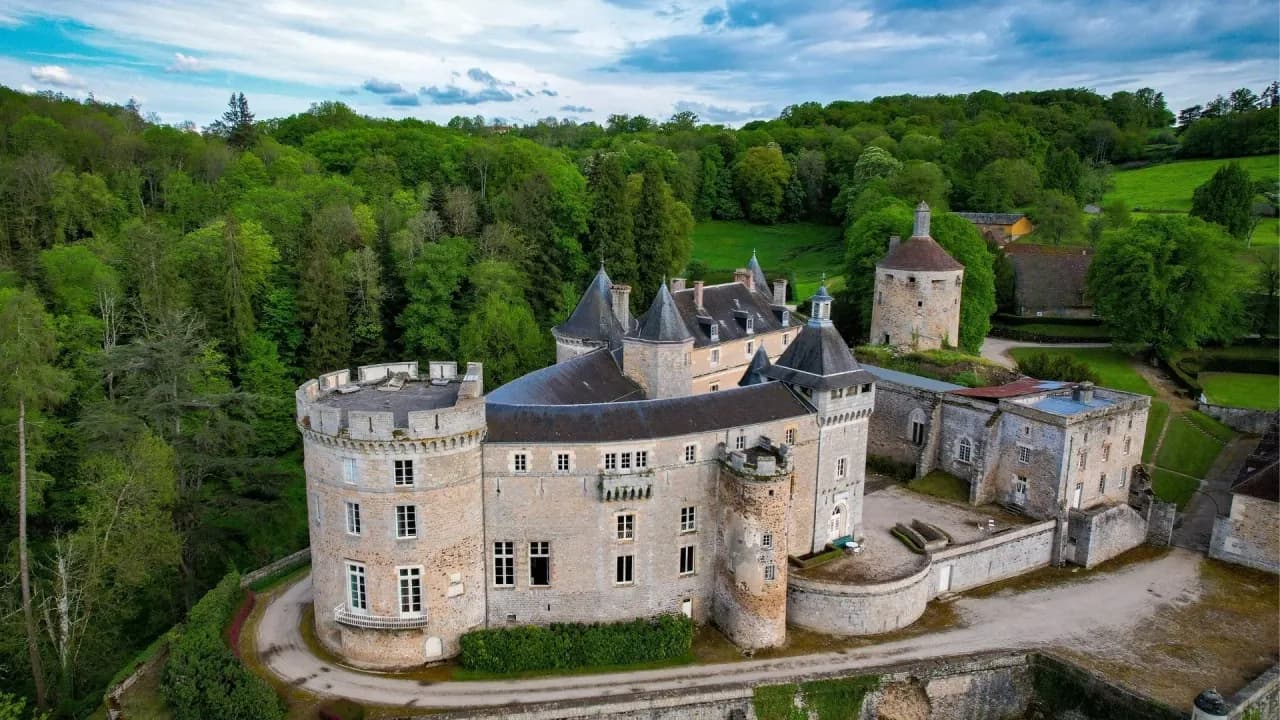
Twenty-eight generations of one family have lived at Chastellux, a fortress on a granite peak above the Cure River, long said to be impregnable. Enlarged under Saint Louis and again in 1414, reworked in every century since, it gave France François-Jean de Chastellux, a member of the Académie française who served with Rochambeau in America. Two-thirds of it burned in 1975. The Chastellux family is rebuilding it room by room, lives there, and opens it to visitors in summer.
The oldest part of Chastellux is the Saint-Jean tower, the justice tower, with its dungeons, its oubliettes and its cells. In the Middle Ages, it stood next to a rectangular keep, of which two buttresses survive, and a huge tower called the Boulevard, the castle's first ring of defense. A second wall ran about 500 meters (1,640 feet) out. All that is left of it are three small towers, two of them in the park.
In 1240, under Saint Louis, Chastellux was enlarged to house more soldiers, with a great guardroom. In 1414, in the middle of the Hundred Years' War, the marshal de Chastellux raised two towers and began two wings laid out in a triangle, because the granite dictated the plan. They meet at a small tower that kept watch over the Cure valley. The castle overlooks two ravines 47 meters (154 feet) deep and a rock 40 meters (131 feet) high, and its walls are up to 2.70 meters (nearly 9 feet) thick. It was taken only once, for half a day, and won back at once. In 1612 a covered gallery was added. Its wall paintings, never retouched, show a very early view of the castle.
The Chastellux family was originally called Montréal, after the castle it held. Saint Louis took that castle away and gave it to the Duke of Burgundy, and since 1255 the family motto has laid claim to Montréal. The coat of arms, a gold diagonal band on blue with seven small gold blocks, four above and three below, is said to stand for the four Burgundian lordships and the three in the Nivernais that the family held in the 15th century. All 294 members of the line are known thanks to an ancestor trained as an archivist and paleographer. After the Paris archives burned during the Commune in 1871, he retired to Chastellux to decipher the records of the château and the surrounding area.
Young Vauban, later Louis XIV's great military engineer, spent time at Chastellux. He was born in Saint-Léger-de-Foucheret, now Saint-Léger-Vauban, at the home of a great-grandmother from the family, and later settled at Bazoches, an estate that belonged to the Chastellux for more than two centuries and has since passed to his descendants. Family tradition holds that the lord of Chastellux introduced him to the Prince de Condé at the nearby Château de Vésigneux, the starting point of his career. A portrait long framed in gold under Vauban's name is now disputed. Its frame is black today, in memory of Louis XVI.
The 17th century left Chastellux two decorated rooms. In 1620, Hercule de Chastellux and his wife Charlotte had a room painted with their initials and with palm leaves, copying the decor of the Dauphine's bedroom at the Tuileries, which was lost when the palace burned. In 1663, Judith Barillon, wife of a Chastellux, who lived at Versailles in the circle of Louis XIV, wanted a room fit for the court. The result is the portrait salon. Every sitter except her was born a Chastellux, and the owners of the château since the 13th century hang in order, each father to the left of his son. The paintings, attributed to the workshop of Le Brun, were taken down during the 1975 fire. One could not be saved, and the others are being restored.
Upstairs, a hallway displays panels of sibyls, once part of the ground-floor decor and moved there in the 19th century. It leads to the private chapel of Chastellux, dedicated to Saint Anthony and dating from the early 15th century. Its panels of the apostles date from 1620, its blue ceiling with gold stars from the 19th century, and its 1414 stained glass was restored under the supervision of Françoise Gatouillat, a specialist in historic stained glass. The family often prays there, and the chapel is not open to the public.
The most endearing Chastellux of the line is François-Jean, born on the Place Vendôme in Paris, at the home of his grandfather, Chancellor d'Aguesseau. As a younger son, he chose the army, fought in the Seven Years' War in Germany, and was elected to the Académie française, where Voltaire held him in high regard. He is said to have been the first Frenchman to be inoculated against smallpox. A friend of Benjamin Franklin, won over to the American cause by Lafayette, he sailed with Rochambeau's expeditionary force as one of his four seconds in command.
Family tradition gives him a decisive role. Rather than attack New York at the cost of a bloodbath, he is said to have advised Washington to march on Yorktown, in Virginia, where the French fleet could block British reinforcements. Lord Cornwallis surrendered in October 1781. The 1620 room holds a portrait of Madame Victoire by Adélaïde Labille-Guiard, a reminder of the family's ties to the daughters of Louis XV, whom it accompanied to Italy.
The Chastellux left during the French Revolution and came back to find the château stripped bare. They refurnished it with family pieces from other houses and with armor brought back from Italy. The 1240 guardroom, split in two in 1760 to create a dining room, can now show only half of the Louis XIII riding lesson tapestries. The set has ten pieces woven in Flanders, two of them subcontracted to the Gobelins workshops, which you can tell apart by their sky. The dining room, decorated in the 19th century, is still where the family eats.
Close to Louis XVIII, the Chastellux sat as peers of France from 1815 to 1830, during the Bourbon Restoration. One of them, sent to fight in northern Spain, traveled on as far as the Alhambra and brought back the drawing of a fountain basin. It was carved from a single block of local stone and set at Chastellux where the original well had been. In 1830, after the fall of Charles X, the Duchess of Berry came to take refuge with this staunchly royalist family, and a painting in the dining room records her visit. The great Louis XV stables, with stalls for sixteen horses, house carriages and a sedan chair. The plan to rebuild the château that was meant to go with them was never carried out.
In 1975, a bird's nest blocked one of Chastellux's chimneys, even though it had been swept. The fire started at 9 a.m. and was not discovered until noon. It gutted nearly two-thirds of the château across two floors, and the firefighters' water damaged the ground floor. A 40-ton concrete slab made one tower weathertight again, and Americans from San Francisco, devoted to the memory of Rochambeau's companion, helped redo a roof.
In 2023, after twenty-five years of work on the roofs, the walls, the terraces and the ponds in the park, the restoration of Chastellux had reached the interiors. The château has 64 rooms, and about two a year are restored. One fire-damaged room was due to be finished in spring 2024. For the past ten years, all the family furniture has been restored first, ahead of the paintings.
"The hardest part is behind us now. We've restored quite a few roofs, quite a few walls, and now it's the interiors."
Philippe de Chastellux, owner, 2023
"Once you've made it watertight, well, you can't see a thing, and people think you haven't done anything at all."
Philippe de Chastellux, owner, 2023
In 2023, the Chastellux family lives at the château almost all year, and the thirtieth generation has already been born. The estate's forests, replanned by the owner's grandfather, the Duc de Duras, who had saved the furniture from an ancestor ready to sell everything, keep the château going through timber sales. Water for the château and the nearby houses comes from its own springs. Chastellux is open to visitors in summer.
"You can tell this is a château that haunts me, that follows me around all day, and that I'll be very happy to show you this summer."
Philippe de Chastellux, owner, 2023
For future owners
Dreaming of a château like this one?
The founder of So Châteaux has visited more than 500 châteaux in France. He takes no commission on château sales, so he can tell you what he really thinks about any property, completely independently.
See how we help buyersGallery
Frequently Asked Questions
The Chastellux family, who have lived there since its founding, a rare feat in France.