
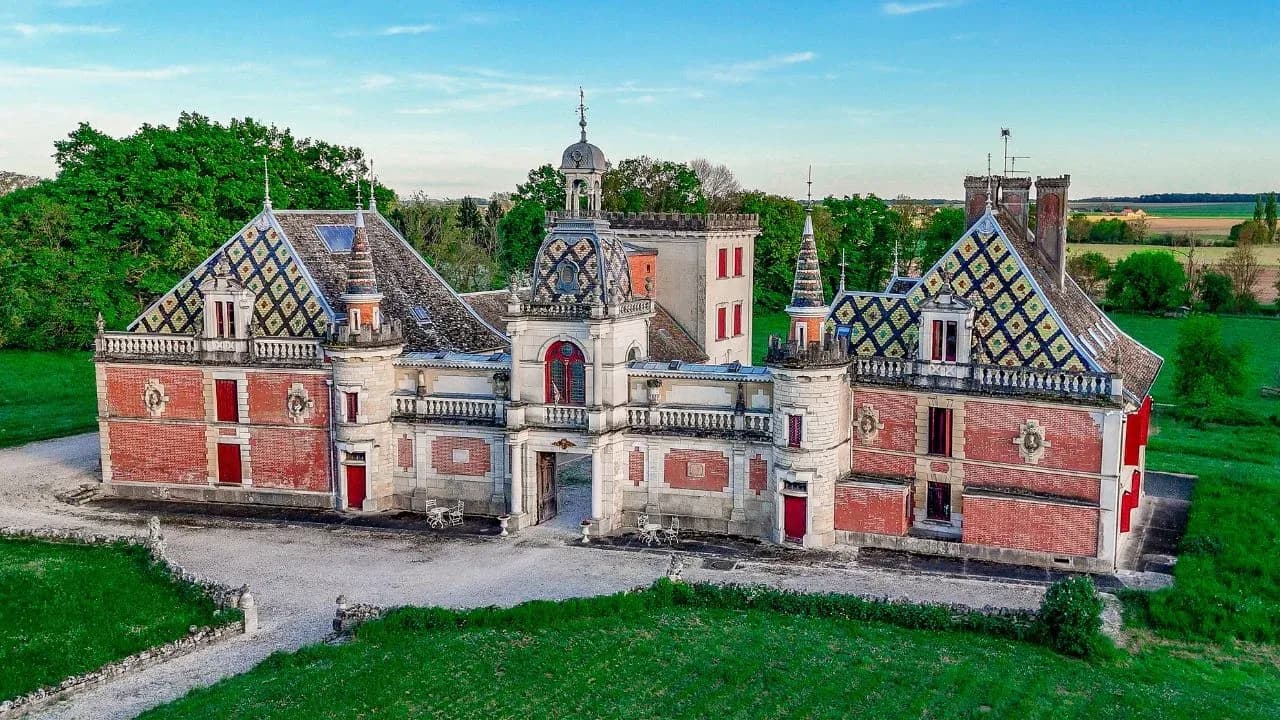
Château de Chevigny-en-Valière
Key facts
About
Doors from the old Russian embassy, a foyer from the Place des Victoires, marble troughs saved from a Paris store: Louis Brossard filled his château in Burgundy with the lost interiors of Haussmann's Paris. Over 35 years, this man of leisure from Beaune turned a winegrower's farm into a folly, right down to its own Italian-style theater. Bought in 2020 by Stéphane Sésé, Chevigny-en-Valière is emerging from the forest that had swallowed it and slowly regaining its luster.
Chevigny-en-Valière owes almost everything to one man. Between 1870 and 1905, Louis Brossard, a man of independent means from Beaune, the wine town of Burgundy, turned an old winegrower's farm into a country house. He never stopped enlarging it. For 35 years he had things built, torn out and built again. The result is a folly in the old sense of the word: a patchwork of interiors gathered from everywhere.
Brossard was a friend of Baron Haussmann, the prefect Napoleon III put in charge of turning Paris into a modern city. Cutting the great boulevards meant tearing down dozens of private mansions, the hôtels particuliers, and their paneling, doors and fireplaces went up for sale. Brossard bought a great many of them and had them reassembled in Burgundy. He could afford it: he came from a wealthy family, and his first wife, eighteen years his junior, was a rich heiress. His memoirs describe every project he undertook, so the origin of nearly everything in the château can be traced.
A neighboring château owner refused to sell him his family's wrought-iron gate, however much Brossard offered, and the two men fell out. When the neighbor went broke and had to sell, Brossard had a friend buy the château as a front. He took the gate down, installed it at home, and sold the château again a few months later. The gate still opens onto the main drive.
"He was a passionate man who went all the way. […] All his life, he was driven by a passion for beauty."
Stéphane Sésé, owner, 2026
Chevigny-en-Valière had already been remodeled before Brossard. In 1767, the Marquis François Melchior de Vogüé, husband of a Bouyer de Versailleux from a Dijon family, added a story to the house and turned it into a country residence. The date is carved on the facade, and a letter B flanked by two fleurs-de-lis recalls the Bouyer family. The main wing rises four stories, with a gallery that has an almost Oriental feel.
The courtyard is entered through a solid oak door Brossard bought in Paris. It came from the mansion where Louis XIV had his acknowledged illegitimate children raised. He later topped it with a carved mask of the young king, which the current owners have had covered in gold leaf. On the ground floor, under low ceilings, the old winegrowers' bedroom and the kitchen still have their large period fireplaces.
In the main wing of Chevigny-en-Valière, Brossard livened up the staircase with wood carvings. The quatrefoil, a four-leaf clover shape that became the emblem of the château, appears everywhere, down to the stained glass in the hallway. His own bedroom is the high point: stained glass, a celadon green painted ceiling picked out with gilded relief, and a tilted mirror set up to bring in more light.
The room next door is named for its doors. They came from 33 Rue du Faubourg-Saint-Honoré in Paris, now home to the Cercle de l'Union Interalliée, a private club, and in Brossard's day the Russian Embassy. When the embassy moved out, the Rothschilds, who owned the building, redecorated and sold the doors. In one of the paintings, Brossard had himself portrayed as Czar Nicholas II. Unhappy with the frescoes two painter friends produced during a week of hunting at the château, he had them painted over by another artist. One of her scenes shows the park and its two ponds, which are still there.
The room keeps a secret, revealed by Brossard's memoirs. The bedroom door was hung backward on purpose, and paintings are hidden behind every one of the doors. Only one still opens. It hides a portrait of his mother, his sister and his niece, and he did not want to shut them away forever.
Chevigny-en-Valière has two stables, one for draft and work horses, the other for the master's horses. The second is lined with gray Flanders marble, because Brossard wanted his horses treated like princes. Its marble troughs came from a Paris department store gutted by fire. The cement-tile floor still shows where the stalls stood, and the stalls themselves, found in the estate farm, are meant to go back in. Cool in summer, the stable now hosts lunches and dinners, with Burgundy and Champagne chilling in the troughs.
The keep of Chevigny-en-Valière was once crowned by a tower 7 meters (23 feet) high. Brossard built it so his guests could enjoy the view over the Côte d'Or, Burgundy's famous wine slope, sheltered from the weather. Charles Garnier, the architect of the Paris Opera, had it pulled down when he came to the château: its weight threatened to bring the whole building down with it.
All that remains of the tower is the staircase that led up to it, the centerpiece of the top floor. It is a double-spiral staircase, two intertwined flights on the principle attributed to Leonardo da Vinci. Built by master craftsmen from the Tours region, it hangs free, with no column to support it, which is why the tower's weight was such a danger. Its frame, still visible, came from the Eiffel workshops, a reminder that Gustave Eiffel was born in Dijon.
The room keeps the memory of Sadi Carnot, related to Brossard through Brossard's wife. A member of parliament for the Côte-d'Or before he was elected president of France, Carnot had his own apartment here when he visited his cousin. Its two fireplaces, one pink and one white, have a simple explanation: the space used to be two separate rooms.
Parties were frequent at Chevigny-en-Valière, and one room was set aside for them. In the banquet hall, every column is topped with a hand-painted panel of flowers, and of the eighty bouquets, no two are alike. Brossard's memoirs even preserved the menu of the last banquet, which featured a great Burgundy wine that was already famous.
The château has twelve fireplaces, all in working order. A painted medallion in the hall shows the house and its park as they once were: the tower that crowned the keep, a bridge in the style of the Buttes-Chaumont park in Paris, and a pedestal topped by a phoenix, the bird that rises from its ashes. Louis Brossard's grave lies directly across from that phoenix.
In the other wing of Chevigny-en-Valière, a Carrara marble staircase leads to the theater. Its steps were cut in Nice by a craftsman who never came to install them, yet they fit together perfectly. The foyer in front of the auditorium came from a mansion on the Place des Victoires in Paris, whose owner, a marquis, wanted to redecorate. Its glass front was bought at the Paris World's Fair, where it had been part of the South American pavilion.
The Italian-style theater, completed between 1885 and 1893, was a commission from Brossard to Charles Garnier. Brossard wanted the Parisian performers who came to rest at his house to be able to dance and make music there. Garnier found the theater and came to install it with his crews. A dome, invisible from outside, crowns the room, and its carefully designed acoustics are judged perfect by the musicians who play there, such as clarinetist Kevin Spagnolo and Dutch violinist Edmond Fokker.
The chandelier has a story of its own. On the day the preliminary sale agreement was signed, the former owner revealed where her father used to hide it whenever the family went back to Sweden. Taken apart and packed in shoeboxes, it turned out to be a mouth-blown Murano chandelier from a palace on the island. Régis Mathieu, the French specialist in antique lighting, restored it, wired it and hung it himself. He hung it low, the way it was done at the time, to show off the owner's wealth.
For Louis Brossard, a château without a chapel was not a real château. The chapel at Chevigny-en-Valière lost its original stained glass to thieves before the current owners arrived. Its small bell tower was their first restoration project, carried out by about ten local craftsmen from the original plans. The bell rings regularly again.
"It was time for this château to find an owner, because I think it was about to fall to pieces."
Stéphane Sésé, owner, 2026
Entrepreneur Stéphane Sésé bought the château in October 2020 from its Swedish owner. The forest had covered it so completely that some villagers had forgotten it existed. Clearing the park was the first priority, and the house can be seen from the village again. A single key now opens all 150 of its doors.
"I even have people from the village who had forgotten there was a château."
Stéphane Sésé, owner, 2026
In 2026, Chevigny-en-Valière is a private home and is not open to the public. The owners host a few private tours, private concerts in the theater, and lunches and dinners, while the restoration goes on.
For future owners
Dreaming of a château like this one?
The founder of So Châteaux has visited more than 500 châteaux in France. He takes no commission on château sales, so he can tell you what he really thinks about any property, completely independently.
See how we help buyersGallery
About
Doors from the old Russian embassy, a foyer from the Place des Victoires, marble troughs saved from a Paris store: Louis Brossard filled his château in Burgundy with the lost interiors of Haussmann's Paris. Over 35 years, this man of leisure from Beaune turned a winegrower's farm into a folly, right down to its own Italian-style theater. Bought in 2020 by Stéphane Sésé, Chevigny-en-Valière is emerging from the forest that had swallowed it and slowly regaining its luster.
Chevigny-en-Valière owes almost everything to one man. Between 1870 and 1905, Louis Brossard, a man of independent means from Beaune, the wine town of Burgundy, turned an old winegrower's farm into a country house. He never stopped enlarging it. For 35 years he had things built, torn out and built again. The result is a folly in the old sense of the word: a patchwork of interiors gathered from everywhere.
Brossard was a friend of Baron Haussmann, the prefect Napoleon III put in charge of turning Paris into a modern city. Cutting the great boulevards meant tearing down dozens of private mansions, the hôtels particuliers, and their paneling, doors and fireplaces went up for sale. Brossard bought a great many of them and had them reassembled in Burgundy. He could afford it: he came from a wealthy family, and his first wife, eighteen years his junior, was a rich heiress. His memoirs describe every project he undertook, so the origin of nearly everything in the château can be traced.
A neighboring château owner refused to sell him his family's wrought-iron gate, however much Brossard offered, and the two men fell out. When the neighbor went broke and had to sell, Brossard had a friend buy the château as a front. He took the gate down, installed it at home, and sold the château again a few months later. The gate still opens onto the main drive.
"He was a passionate man who went all the way. […] All his life, he was driven by a passion for beauty."
Stéphane Sésé, owner, 2026
Chevigny-en-Valière had already been remodeled before Brossard. In 1767, the Marquis François Melchior de Vogüé, husband of a Bouyer de Versailleux from a Dijon family, added a story to the house and turned it into a country residence. The date is carved on the facade, and a letter B flanked by two fleurs-de-lis recalls the Bouyer family. The main wing rises four stories, with a gallery that has an almost Oriental feel.
The courtyard is entered through a solid oak door Brossard bought in Paris. It came from the mansion where Louis XIV had his acknowledged illegitimate children raised. He later topped it with a carved mask of the young king, which the current owners have had covered in gold leaf. On the ground floor, under low ceilings, the old winegrowers' bedroom and the kitchen still have their large period fireplaces.
In the main wing of Chevigny-en-Valière, Brossard livened up the staircase with wood carvings. The quatrefoil, a four-leaf clover shape that became the emblem of the château, appears everywhere, down to the stained glass in the hallway. His own bedroom is the high point: stained glass, a celadon green painted ceiling picked out with gilded relief, and a tilted mirror set up to bring in more light.
The room next door is named for its doors. They came from 33 Rue du Faubourg-Saint-Honoré in Paris, now home to the Cercle de l'Union Interalliée, a private club, and in Brossard's day the Russian Embassy. When the embassy moved out, the Rothschilds, who owned the building, redecorated and sold the doors. In one of the paintings, Brossard had himself portrayed as Czar Nicholas II. Unhappy with the frescoes two painter friends produced during a week of hunting at the château, he had them painted over by another artist. One of her scenes shows the park and its two ponds, which are still there.
The room keeps a secret, revealed by Brossard's memoirs. The bedroom door was hung backward on purpose, and paintings are hidden behind every one of the doors. Only one still opens. It hides a portrait of his mother, his sister and his niece, and he did not want to shut them away forever.
Chevigny-en-Valière has two stables, one for draft and work horses, the other for the master's horses. The second is lined with gray Flanders marble, because Brossard wanted his horses treated like princes. Its marble troughs came from a Paris department store gutted by fire. The cement-tile floor still shows where the stalls stood, and the stalls themselves, found in the estate farm, are meant to go back in. Cool in summer, the stable now hosts lunches and dinners, with Burgundy and Champagne chilling in the troughs.
The keep of Chevigny-en-Valière was once crowned by a tower 7 meters (23 feet) high. Brossard built it so his guests could enjoy the view over the Côte d'Or, Burgundy's famous wine slope, sheltered from the weather. Charles Garnier, the architect of the Paris Opera, had it pulled down when he came to the château: its weight threatened to bring the whole building down with it.
All that remains of the tower is the staircase that led up to it, the centerpiece of the top floor. It is a double-spiral staircase, two intertwined flights on the principle attributed to Leonardo da Vinci. Built by master craftsmen from the Tours region, it hangs free, with no column to support it, which is why the tower's weight was such a danger. Its frame, still visible, came from the Eiffel workshops, a reminder that Gustave Eiffel was born in Dijon.
The room keeps the memory of Sadi Carnot, related to Brossard through Brossard's wife. A member of parliament for the Côte-d'Or before he was elected president of France, Carnot had his own apartment here when he visited his cousin. Its two fireplaces, one pink and one white, have a simple explanation: the space used to be two separate rooms.
Parties were frequent at Chevigny-en-Valière, and one room was set aside for them. In the banquet hall, every column is topped with a hand-painted panel of flowers, and of the eighty bouquets, no two are alike. Brossard's memoirs even preserved the menu of the last banquet, which featured a great Burgundy wine that was already famous.
The château has twelve fireplaces, all in working order. A painted medallion in the hall shows the house and its park as they once were: the tower that crowned the keep, a bridge in the style of the Buttes-Chaumont park in Paris, and a pedestal topped by a phoenix, the bird that rises from its ashes. Louis Brossard's grave lies directly across from that phoenix.
In the other wing of Chevigny-en-Valière, a Carrara marble staircase leads to the theater. Its steps were cut in Nice by a craftsman who never came to install them, yet they fit together perfectly. The foyer in front of the auditorium came from a mansion on the Place des Victoires in Paris, whose owner, a marquis, wanted to redecorate. Its glass front was bought at the Paris World's Fair, where it had been part of the South American pavilion.
The Italian-style theater, completed between 1885 and 1893, was a commission from Brossard to Charles Garnier. Brossard wanted the Parisian performers who came to rest at his house to be able to dance and make music there. Garnier found the theater and came to install it with his crews. A dome, invisible from outside, crowns the room, and its carefully designed acoustics are judged perfect by the musicians who play there, such as clarinetist Kevin Spagnolo and Dutch violinist Edmond Fokker.
The chandelier has a story of its own. On the day the preliminary sale agreement was signed, the former owner revealed where her father used to hide it whenever the family went back to Sweden. Taken apart and packed in shoeboxes, it turned out to be a mouth-blown Murano chandelier from a palace on the island. Régis Mathieu, the French specialist in antique lighting, restored it, wired it and hung it himself. He hung it low, the way it was done at the time, to show off the owner's wealth.
For Louis Brossard, a château without a chapel was not a real château. The chapel at Chevigny-en-Valière lost its original stained glass to thieves before the current owners arrived. Its small bell tower was their first restoration project, carried out by about ten local craftsmen from the original plans. The bell rings regularly again.
"It was time for this château to find an owner, because I think it was about to fall to pieces."
Stéphane Sésé, owner, 2026
Entrepreneur Stéphane Sésé bought the château in October 2020 from its Swedish owner. The forest had covered it so completely that some villagers had forgotten it existed. Clearing the park was the first priority, and the house can be seen from the village again. A single key now opens all 150 of its doors.
"I even have people from the village who had forgotten there was a château."
Stéphane Sésé, owner, 2026
In 2026, Chevigny-en-Valière is a private home and is not open to the public. The owners host a few private tours, private concerts in the theater, and lunches and dinners, while the restoration goes on.
For future owners
Dreaming of a château like this one?
The founder of So Châteaux has visited more than 500 châteaux in France. He takes no commission on château sales, so he can tell you what he really thinks about any property, completely independently.
See how we help buyers