
Château de Bonneval
Key facts
About
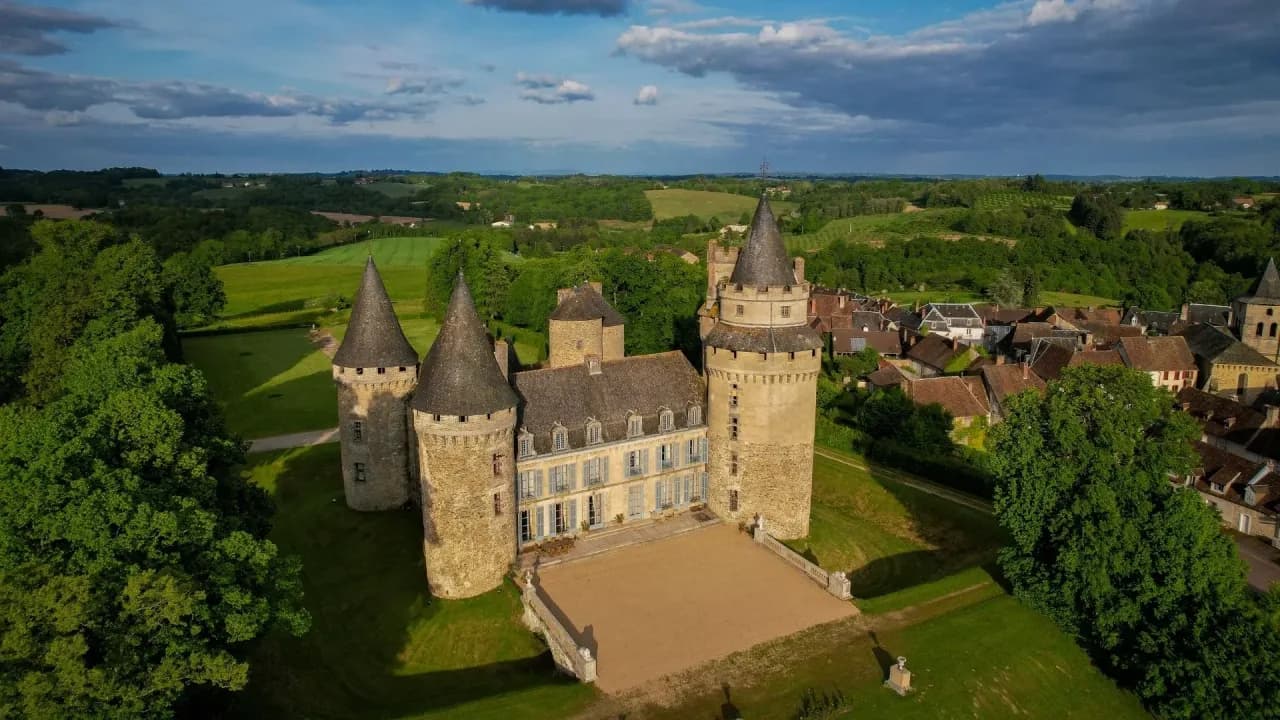
For nearly a thousand years, Bonneval has never left the family that bears its name, and each generation has left its mark. A Limousin fortress with two drawbridges, it was given windows and made livable around 1800 by Hippolyte de Bonneval. It was also the birthplace of Claude-Alexandre, the famous Pasha of Bonneval. The family still lives in this château in the Haute-Vienne, opens it to visitors in summer and hosts weddings and seminars.
The earliest known signature of a Bonneval dates from 1050, when a Géraud de Bonneval gave land to the monks of Solignac. The family tree starts with that deed and runs without a break down to Bernard and Marie-Antoinette de Bonneval, the current owner's parents. A new chart had to be started for the generations that followed. Bonneval is one of the very few châteaux in France that have never left their family. When the senior line ended with César Phœbus François, it passed to the junior line, with André de Bonneval.
Bonneval's archive room holds nearly 30,000 documents: parchments in Old French and Latin, inventories, family deeds, the oldest from the 13th century. The family still adds its births, baptisms and marriages to them. On the drawbridge, the Bonneval emblem, a lion, carries the motto "Victorious at every hazard."
"When you start opening one of those boxes, well, you lose all track of time. Because you start diving into it and you want to know everything."
Géraud de Bonneval, owner, 2023
Walking around Bonneval is a way of reading its history. The entrance front, medieval, keeps its two drawbridges, and the northwest side still has no openings at all. To the north, a 17th-century facade lines up mullioned windows, restored by the owner's parents from a description found in the archives. Further on, the 18th-century facade owes its seventeen windows to Hippolyte de Bonneval.
Germain de Bonneval gave the fortress a Renaissance inner courtyard, a rare thing in a medieval castle, carried on columns that are all different. The oldest are sandstone, while three others, remade later by Hippolyte, are granite. Germain also built the chapel tower. Set right above the drawbridge, rib-vaulted and stamped with the Bonneval coat of arms, the chapel is decorated with angels attributed to the sculptor Bouchardon. Consecrated in 1825, it still hosts baptisms, weddings and wakes.
The most famous Bonneval is Claude-Alexandre, born at the château in the bed of his mother, Claude de Monceaux. A naval ensign at thirteen, a brilliant soldier with a difficult temper, he fell out with Chamillart, Louis XIV's minister of war, and went over to Austria under Prince Eugene of Savoy. He won many battles with him before quarreling with him too. He then went to Constantinople, reorganized the Ottoman army, founded a military school and received from the sultan the title of three-tailed pasha.
He wanted his bones to rest with his ancestors at Bonneval. The owner's grandparents and then his parents tried to bring his body home, in vain: Turkey treats his tomb as a national monument. The room where he was born keeps the paneling his mother commissioned, carved with a scene of the Passion, enigmatic figures and a landscape of coconut palms with a small boat, under the motto "Love joins them." A closet with double doors hides the château's only secret passage, which leads to the King's Room.
The man who transformed Bonneval most was Hippolyte de Bonneval, a general under Napoleon, who lived there for fifty-six years between the late 18th and the 19th century. He enclosed the courtyard's wall walks to make glazed galleries and cut windows into the facades. With the help of scouts who watched auction sales and dismantled châteaux, he filled the house with the finest things he could find. In the Pages' Gallery: a German Renaissance door carved with the martyrdom of Saints Peter and Paul, a 14th-century chest showing Christ and his apostles, and five tapestries with the arms of the Bonneval and Beynac families. In the grand salon: paneling signed by Pluvinet from a dismantled Paris town house, a ceiling attributed to Boucher, and a Fontainebleau tapestry of Mercury. In the Diana Salon, he built a fireplace around the headboard beam of Diane de Poitiers's bed, bought at the sale of her château of Anet, even if it meant cutting through the ceiling.
Using kaolin, the clay of fine porcelain, dug a few kilometers away, Hippolyte de Bonneval also founded a porcelain factory that ran from 1820 to 1855. The white pieces were sent to Paris to be decorated. When the king considered making him a duke in the Limousin, he was criticized for this trade. He replied that he would rather make dishes and plates in the Limousin than grovel at court, a pun on "faire des plats," which in French means both making dishes and fawning.
Bonneval's dining room is hung with paintings of birds from the late 17th or early 18th century, by a Dutch painter mentioned in the archives. The owner's parents searched for them in vain, then found them rolled up in an old trunk in the attic and had them restored in Paris. An 18th-century Flemish tapestry shows King Shapur, the Persian ruler who defeated the Roman emperor Valerian, and a wood stove both heated the room and kept the dishes warm.
The owner's mother and wife are Brazilian, and the château shows it: 18th-century statuettes of saints from Minas Gerais, Our Lady of Aparecida in the chapel, a Brazilian enamel of Bahia dancers among the Limoges enamels, and a 17th-century Portuguese Christ, seated, his hands bound.
In 2023, Bonneval is home to the family, who live in every room. They entertain in the salon, dine in the dining room, and friends sleep in the Pasha's Room or the King's Room. The château is open daily except Mondays from July through European Heritage Days in September, and it also hosts weddings and corporate seminars. A two-bedroom guesthouse for four opened in the park that year.
"People might think, OK, the château, you've got your own corner, and the rest of it, you never go there. Well, no, we live everywhere in the château."
Géraud de Bonneval, owner, 2023
"Maybe we hope it'll go on for another 1,000 years, we'll see!"
Géraud de Bonneval, owner, 2023
For future owners
Dreaming of a château like this one?
The founder of So Châteaux has visited more than 500 châteaux in France. He takes no commission on château sales, so he can tell you what he really thinks about any property, completely independently.
See how we help buyersDid You Know?
The pasha of Bonneval
Claude-Alexandre de Bonneval, born at the château in 1675, ended his career as a three-tailed pasha in the service of the Ottoman Empire.
Gallery
Frequently Asked Questions
The Bonneval family, who have owned it for nearly a thousand years.