
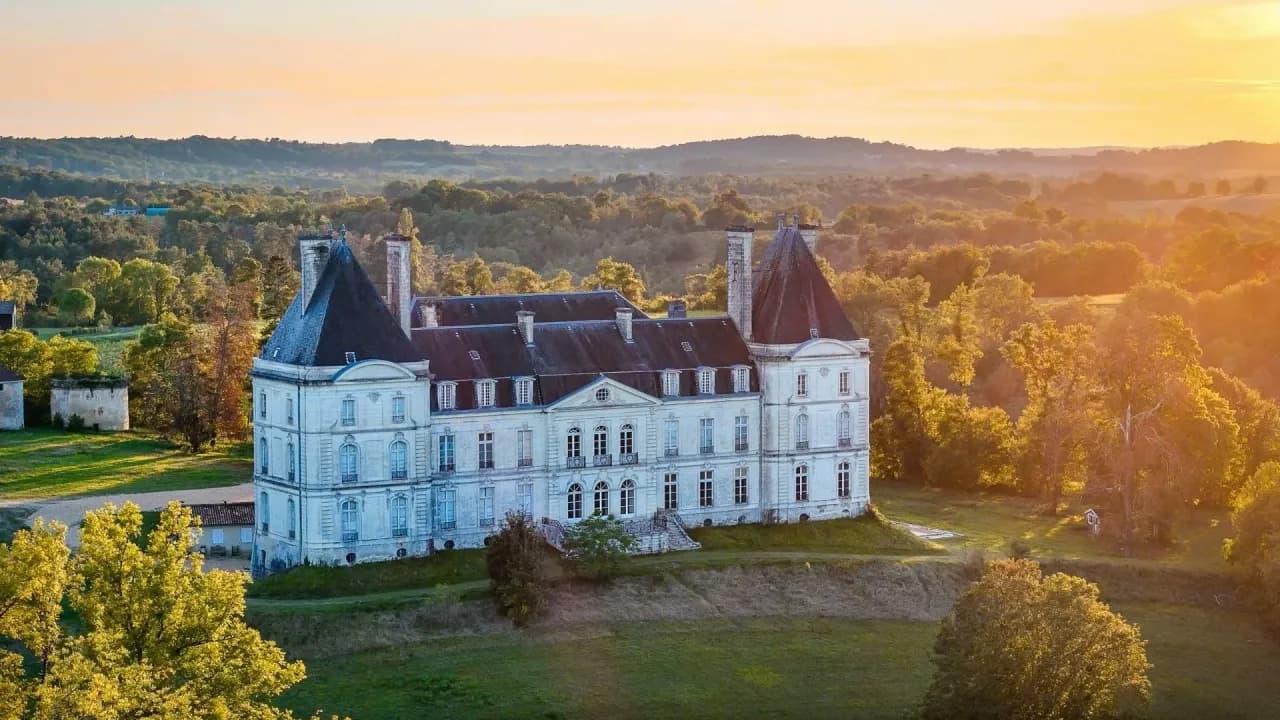
Château de Fayolle
Key facts
ProtectionInscrit MH
Inscrit monument historique: the second level of heritage protection in France, decided by the regional prefect. Owners must notify the state before any work on the protected parts, and the regional heritage authority (the DRAC) reviews it.
About
Nothing has moved at Fayolle since the last marquis left: ashes in the fireplaces, linens tied and labeled, spare rolls of wallpaper, a private theater from Napoleon's Consulate. Built in 1766 on medieval foundations by Nicolas II de Fayolle, this Dordogne château stayed for more than two centuries in the family that bore its name. Long a haunt of urban explorers, it was bought in 2023 by Grégory Mangeret and his wife, Florence, who mean to restore it without losing its soul.
The Fayolle family owned its land in the Périgord, the historic name of the Dordogne, for some nine hundred years. Two earlier châteaux stood here before the present one. The medieval castle, surrounded by dry moats, sat on the edge of English-held territory and was regularly attacked from there. Its foundations still carry today's building. In 1724, Louis XV raised the estate to a marquisate for Nicolas I de Fayolle.
The Château de Fayolle was built in 1766 by the third marquis, Nicolas II de Fayolle, to plans by the architect Chauvin. In its heyday, from the late 18th century to the Bourbon Restoration, some thirty servants waited on the marquis and marquise, and all of the Périgord flocked to the parties at the château, a place of conversation, culture and art.
Fayolle was also a wine estate, until phylloxera, the insect that ravaged French vineyards about a hundred and fifty years ago. The cellars, with their high vaults, good ventilation and no damp, still hold the barrels and many bottles, a lot of them champagne.
Beneath the kitchen, remodeled in the 19th century, Fayolle has a cluzeau, a gallery dug into the limestone, of a kind found all over the Périgord. This one was defensive: in case of attack, the family took shelter inside. It has a chamber where bits of old candles remain, arrow slits, what is left of an iron door and, where the passage opens out, a pit eleven and a half feet deep (3.5 meters) for attackers to fall into.
The entrance to a tunnel also opens off Fayolle's cluzeau. It was walled up, then reopened, probably by explorers, and it has no known exit. Legend says it runs all the way to the village church. More likely, the tunnel led to the dry moats of the medieval castle.
Fayolle has a theater built inside the château itself, not in an outbuilding, which is rare. It dates from the Consulate, Napoleon's regime between 1799 and 1804. The gilding is in good shape, the ceiling is painted in shades that fade like a sky, and only the curtain is missing, though its pulley system survives. Before leaving, the Fayolle family took down the tapestry showing the chevalier de Fayolle returning from the Crusades, to protect it from damage and theft.
Fayolle's theater opens onto the library, which has kept its smell and part of its books. There, someone found the notebook of Alain de Fayolle, a marquis's brother and a Saint-Cyr graduate, from France's top military academy, killed at the front at the start of World War I. It stops the day before his death. A box found later on a shelf bears the words "Objects found in the trunk of my son Alain, killed in action on August 22, 1914." Inside are his white gloves, the ones he wore as he led his men into the attack.
On the family floor, Fayolle's Empire bedroom is hung with a late 18th-century wallpaper of which only five copies are said to exist in the world: two in the United States, one in Germany and one in France. Its nine panels, printed in five sets, were hand-painted on site. In the early 20th century the paper was taken down and shipped to New York for an exhibition, then put back on the château's walls. The room, with trompe-l'oeil doors in all four corners, has its own vestibule and washroom.
Next door, Fayolle's blue bedroom, richly decorated, on an 18th-century Périgord parquet floor, has two beds mounted on rails, which could be pushed together so a couple could sleep side by side. A little farther on, the family museum gathered portraits, porcelain and earthenware. Here you meet the first marquis, Nicolas; Nicolas II, the builder; Gérard de Fayolle, a founder and president of the Société historique et archéologique du Périgord, the regional history society; and the last marquis, Alain de Fayolle, who died in 2012. He had no son, only a daughter, Dominique, who sold the château.
Fayolle's second floor, the servants' quarters, long served as an attic, and time stopped there. One bedroom, probably a governess's, still has its canopy bed, its fireplace, a painting, its fabric wall covering and scraps of lace. The doors have cat flaps, the floors are laid with terracotta tiles to stop fires from spreading, and there is the last marquis's photo darkroom, a fruit dryer and an office full of archives and account books.
Fayolle's storeroom holds the decorative pieces that were changed depending on the guests, along with rolls of wallpaper that once covered the château's walls. In the linen room, the sheets are still folded, tied with ribbon and labeled, and the notebook that inventoried them is still open. The plaster has fallen, but the structure, the roof frame and the roof are sound.
"You feel like everything just froze. Time stopped. And that's something really, really powerful about this château."
Grégory Mangeret, owner, 2024
In 1895, Fayolle went through a restoration campaign that rebuilt the north facade and brought comfort to the living rooms. The windows on that side date from the 19th century, while the south facade keeps its small 18th-century multi-paned windows. On the north side, three coats of arms crown the entrance: the Fayolle lion and the arms of the wives of the first three marquis. The family's F returns in the ironwork and on the fireplaces.
Fayolle's front steps lead down to an English-style park laid out in the 19th century by the Bühler brothers, who designed the Parc de la Tête d'Or in Lyon. A broad green swath with a rounded profile opens between groves, now grown into forest for lack of upkeep, once crossed by walking paths. On the ground floor, the dining room keeps its earthenware and marble stove and a table that seats up to twenty-six. The great pink drawing room, known as the ballroom, has a cast-iron-lined fireplace and Versailles parquet. Cast-iron grates, part of a heating system from the same era as the one at the Paris Opera's Palais Garnier, run through the rooms.
Since 2023, Fayolle has belonged to Grégory Mangeret and his wife, Florence. After the last marquis died, urban explorers broke into the château again and again, objects and furniture went missing, and the house slowly declined. Since the couple arrived, no one has touched the contents of its hundred or so rooms, which must be inventoried methodically. In 2024 they cleaned the living rooms and began preparing the restoration, helped by donations of objects from private individuals.
"If we lose the soul of the château, we lose the château's treasure."
Grégory Mangeret, owner, 2024
In 2024, Fayolle's owners announced a cultural program running from April to October: tours, concerts, plays, a Marquise's Ball, an Easter egg hunt, and a large immersive show performed by local volunteers on two weekends each summer.
"For us, this project has to be the responsibility of a whole region. It's the history of France, it's the history of a region."
Grégory Mangeret, owner, 2024
For future owners
Dreaming of a château like this one?
The founder of So Châteaux has visited more than 500 châteaux in France. He takes no commission on château sales, so he can tell you what he really thinks about any property, completely independently.
See how we help buyersGallery
Frequently Asked Questions
The current château was built in 1766, on medieval foundations.