
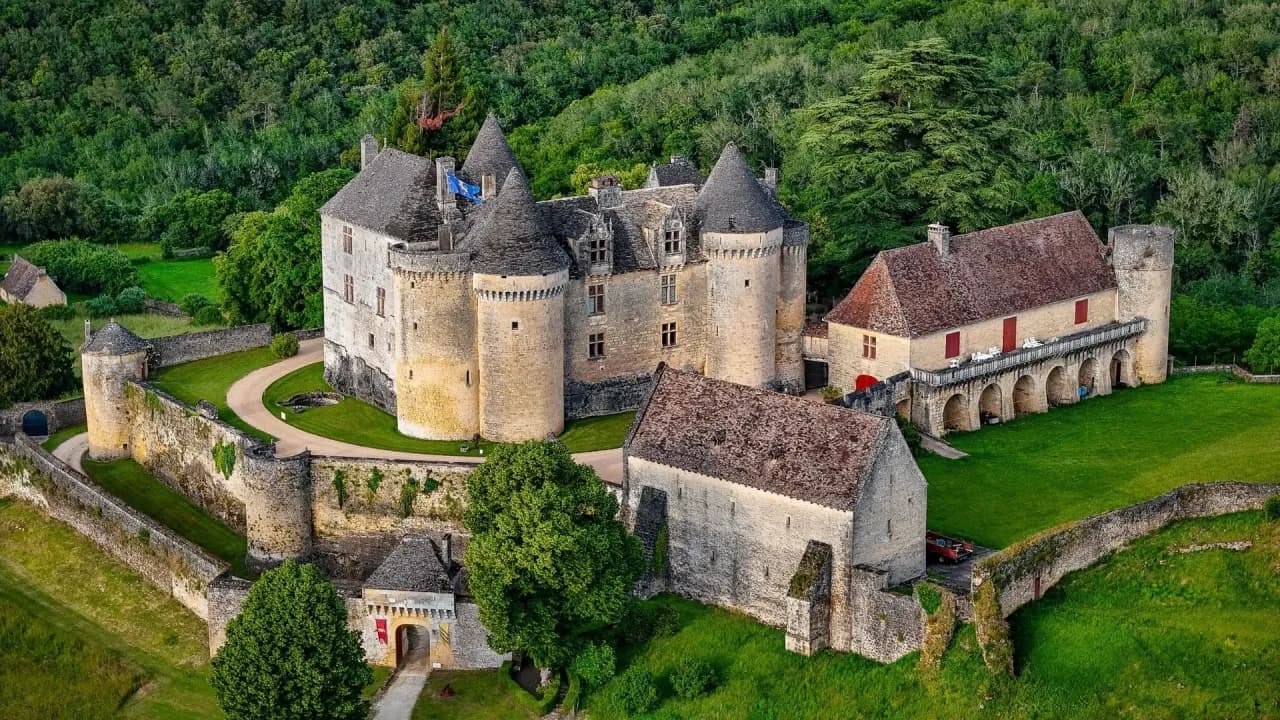
Château de Fénelon
Key facts
ProtectionClassé MH
Classé monument historique: the highest level of heritage protection in France, decided by the national government. Any work on the protected parts needs state approval and is supervised by the state heritage services.
About
François de Salignac de La Mothe-Fénelon, author of The Adventures of Telemachus, was born in 1651 in this fortified castle in the Périgord Noir, and the bed he was born in has never left it. The last Cathar refuge in the area in the 13th century, rebuilt and reshaped until the 1600s, Fénelon has the largest stone-slab roof in the Périgord Noir, above the Dordogne valley. A family bought it around 1990. They are restoring it and have opened it to visitors from year one.
The site of Fénelon has been occupied since Merovingian times, the early Middle Ages, and a first fortified castle appeared here around the year 1000. In the 13th century, Catharism, a Christian movement condemned as heresy and mostly associated with Toulouse and Carcassonne, had spread to the Sarlat area, and Fénelon became a Cathar stronghold. Its lord escaped the crusading army, but a few years later he was denounced before the Inquisition court sitting in Gourdon and convicted of heresy.
The records of that trial survive. They make Fénelon the last Cathar castle in the region, a place where Cathars fleeing persecution knew they would be taken in and fed. The verdict had a drastic consequence: on the king's orders, the fortress from the year 1000 was completely dismantled. The château you see today comes from a rebuilding begun in the late 13th century. Its chapel, set inside a tower whose shape its apse follows, had to be consecrated again.
During the Hundred Years' War, Fénelon fell to a captain of brigands, then to the English. To win it back, the French had to besiege it twice in a row. Legend has it that during the last siege, the English ran out of ammunition, boiled their jam and poured it down from the wall walk. In the archives, the tower it supposedly fell from is called the Jam Tower.
This tower at Fénelon keeps a fine 15th-century chestnut roof frame, which carries a roof of lauzes. The château has the largest lauze roof in the Périgord Noir. These limestone slabs, laid between the battens, weigh 500 to 700 kilograms per square meter on average (about 100 to 145 pounds per square foot), and up to a metric ton. Found only in the Périgord Noir and a small part of the Quercy, they depend on an endangered craft that few companies still master.
The great hall of the keep, the largest room at Fénelon, hosted the lord's receptions and banquets. When the current owners took over the château, its walls were covered in plaster that was falling off in strips. Underneath, 15th-century wall paintings came to light, around the fireplace and in the window recesses, with a heraldic motif of a knotted staff linked to the Virgin Mary.
"When my parents took over the château, this room was covered in plaster that was falling off in strips. And under the plaster, we discovered wall paintings."
Jean-Julien Delautre, owner's family, 2025
In the 17th century, this medieval decor was covered by a new one in the classical style. On each wall, two Ionic columns carrying an entablature formed a portico, so you felt you were standing in the middle of a colonnade. The archives of Fénelon show that some thirty portraits of family ancestors, now lost, hung beneath these porticoes. The walnut parquet, relaid in the early 19th century by an unknown journeyman craftsman, has chevrons cut from the same split plank, with matching knots. The hall now holds 16th-century furniture, including an Italian-style extending table, and a Brussels tapestry showing the triumph of Constantine, part of a set that has since been scattered.
Fénelon was heavily remodeled up to the 17th century. You reach its inner courtyard by a grand horseshoe staircase built in the 1630s, at the same time as the terrace walk with its Louis XIII balustrade, which replaced a fortified medieval wing. An old doorway onto the wall walk can still be made out. The terrace linked the lord's private study to the great reception hall.
The apartment at Fénelon follows the layout used until the 18th century: an antechamber, then the bedroom, where guests were received, then the study, the only truly private space. The study keeps its 17th-century walnut paneling and an iron-bound archive chest with three locks. In the bedroom, the carved walnut fireplace, made by the workshop of the Tournier brothers, who produced many altarpieces in southwestern France, spreads scrolls, cartouches and garlands of fruit, with walnuts slipped in as a nod to the region. Like the château, it has been protected as a historic monument since 1927. Under the plaster of the bedroom and antechamber, test openings have revealed more paintings, large blue-gray scrolls.
"A lot of châteaux lost their painted decor so people could expose, strip back to the actual structure of the wall, which is a historical mistake."
Jean-Julien Delautre, owner's family, 2025
François de Salignac de La Mothe-Fénelon was born in this bedroom at Fénelon on August 6, 1651. His portrait, added at the top of the fireplace in the 18th century, replaced the king's. The canopy bed with twisted columns, listed in the château's archives, has not left the room since the 17th century and keeps its embroidery. A few of its fringes are missing, carried off by visitors.
"When someone asked to visit the room where the writer was born, […] they'd take a little piece of the canopy with them, to leave with a souvenir, and people said: with a little piece of Fénelon's wisdom."
Jean-Julien Delautre, owner's family, 2025
The writer's major works were published after his death. They were the work of his nephew and heir, the marquis de Fénelon, an officer in the royal army and a friend of Voltaire, killed at the battle of Rocourt. Louis XVI, who knew Fénelon by heart by age fifteen, printed at Versailles a small Telemachus, annotated in his own hand, and commissioned a full-length statue of the writer from the sculptor Félix Lecomte, unveiled in 1777 and now kept at the Académie française. The Adventures of Telemachus is said to be the most published work of French literature before The Little Prince. At the Château de Fénelon, a Baroque Brussels tapestry from a Telemachus series designed for the king of Portugal around 1720 to 1730 shows the hero shipwrecked off Calypso's island. Display cases hold Sèvres porcelain figures, snuffboxes and boxes bearing the writer's likeness, for in the 19th century every political camp claimed him.
The kitchen in the keep at Fénelon, once the lower hall, still has its late 15th-century checkerboard floor of rammed earth. It holds cast-iron pots, a reminder of the valley's forges, which cast cannons for the king's navy in the 18th century, a salt grinder carved with a fox, an ember snuffer dated 1785 and heraldic waffle irons from the late 15th century. On the top floor of the keep, a cabinet of curiosities was re-created about twenty years ago.
The upper floors of Fénelon then run through the styles: a Louis XIII bedroom, a Louis XIV antechamber with a paneled desk from the Gobelins royal workshops, a Louis XVI bedroom with a chair from the salon of Madame Élisabeth, sister of Louis XVI, at the Château de Montreuil, and an Empire room. The Romanesque chapel holds an eagle lectern and a 17th-century Spanish Christ. The armory gathers pole weapons, 15th- and 16th-century armor and a rare "spider" helmet worn by a light cavalryman, from the years 1610 to 1640.
Fénelon has belonged for some thirty years, since around 1990, to the Delautre family, who opened it to the public in their very first year. In 2025, the château is still being restored and is open to visitors: the kitchen, the great hall, the 17th-century apartment, the room where the writer was born, the cabinet of curiosities, the roof frame of the Jam Tower, the chapel and the armory. A floor devoted to the 18th century is being fitted out, and the painted decor hidden under the plaster of the apartment has not yet been uncovered.
For future owners
Dreaming of a château like this one?
The founder of So Châteaux has visited more than 500 châteaux in France. He takes no commission on château sales, so he can tell you what he really thinks about any property, completely independently.
See how we help buyersDid You Know?
The birthplace of Fénelon
François de Salignac de La Mothe-Fénelon, the future archbishop and author of The Adventures of Telemachus, was born at the château in 1651.
Gallery
Frequently Asked Questions
It is the birthplace of the writer and archbishop Fénelon, in 1651.