
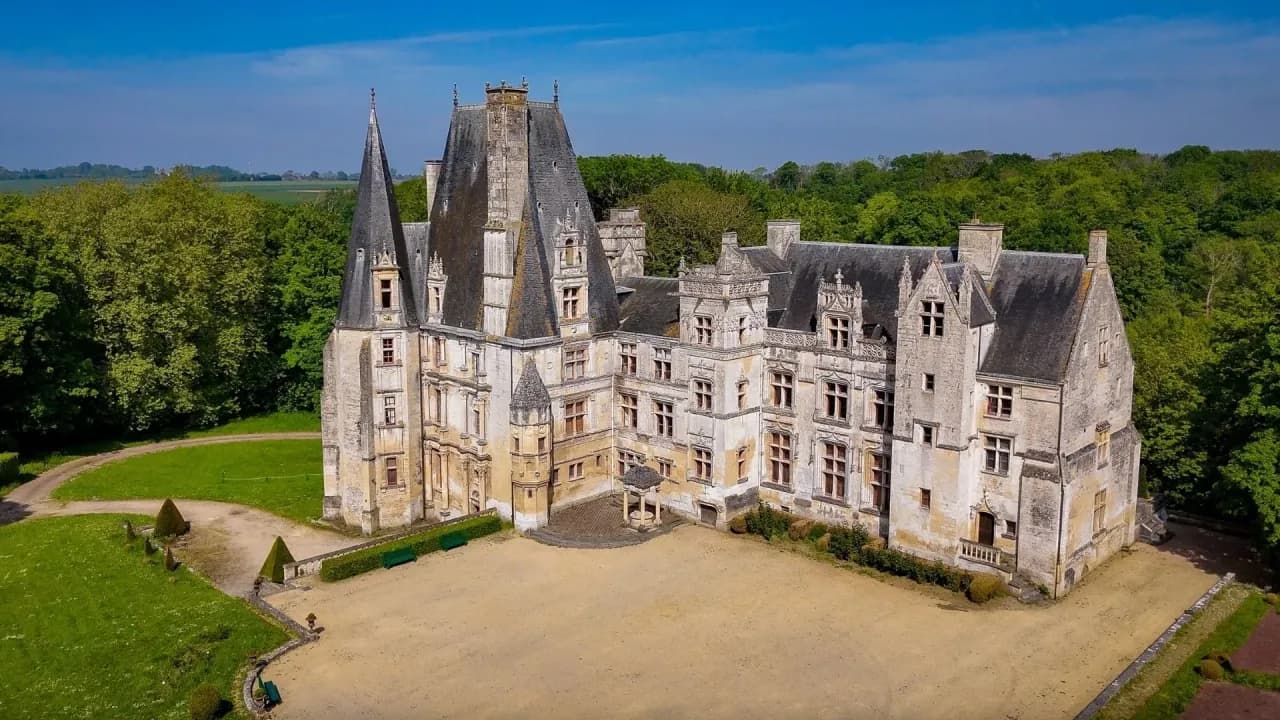
Château de Fontaine-Henry
Key facts
ProtectionClassé MH
Classé monument historique: the highest level of heritage protection in France, decided by the national government. Any work on the protected parts needs state approval and is supervised by the state heritage services.
About
Renaissance facades and huge roofs, among the tallest in France, fool the eye: Fontaine-Henry began as a fortified manor built around 1200 near Caen, with a Gothic chapel and a guardroom. The Harcourt family transformed it from Louis XII to Francis I, with the architect Blaise Le Prestre, and covered it in alchemical carvings. Handed down since the Middle Ages by inheritance and marriage, from the Tilly to the d'Oilliamson, it is now their home and open to visitors.
Fontaine-Henry has often been mistaken for a Loire Valley château that wandered into Normandy, but its Renaissance look is misleading. Around 1200, the site held a fortified lord's compound: a large chapel in early Gothic style, a residence and a great hall. The hall vanished at the end of the Hundred Years' War, no one knows how, and a gatehouse went up in its place. It was built taller, to see farther toward a coastline that had pulled back.
The heart of medieval Fontaine-Henry is the guardroom, with very simple rib vaults from the very end of the 12th century or the start of the 13th. Five staircases lead out of it: to the pantry, to a watchtower, to the lost great hall, to the main courtyard and to the private apartments. The keystones are pierced. They once held pulleys that hoisted platforms to keep food away from damp and rats. Wall fireplaces only appeared at the end of the 13th century, so the room was heated with braziers. A tunnel, now walled up, ran under the ramparts to a friendly house, a cider cellar, so help could be fetched during a siege.
Below the guardroom, Fontaine-Henry's old larder later served as a wine cellar. Charcoal inscriptions on the walls still list a white wine from Auxerre from 1774, a Bordeaux from 1819, and wines from Meursault and Champagne.
Under Charles VIII, Louis XII and then Francis I, the Harcourt family carried out major work at Fontaine-Henry. Pierre d'Harcourt hired Blaise Le Prestre, an architect from Caen, who lived at the château while it was being built. In Caen, Le Prestre had built the Hôtel d'Escoville, a grand town house, for Nicolas Le Valois d'Escoville, a well-known figure in alchemical circles. That circle of friends may explain the château's decoration.
The carvings on the facades of Fontaine-Henry, and others in the Harcourt wings and in the chapel, turned out to be alchemical. Among them is a mustached, bearded face, the Green Man, or "nature in the act of creating," a mask found all over Europe. On a landing, a carved group of Judith and Holofernes bears an inscription on the "smoking" head of the beheaded general. The same subject decorates the Hôtel d'Escoville, and in the language of alchemy, beheading would promise rebirth. A small staircase from the guardroom probably led, from the Renaissance on, to the athanor, the furnace room where experiments took place.
Fontaine-Henry's roof frames are said to be the tallest in France: the great roofs rise about 16 meters (52 feet). These attics were built to be lived in. There are traces of plaster on lath, and every room under the roofs had its own fireplace. Only one is still in place. The others, which can be dated to the 14th century, were taken down and rebuilt in other buildings. A small spiral staircase stops short, and no one knows where it once led.
The house has no single continuous floor, but 52 different levels. The staircase that Blaise Le Prestre built in the gatehouse leads to the main bedchamber, whose fireplace has a flue about 36 meters (118 feet) long. It bears the arms of the Harcourt and Lenoncourt families and the motto Gesta verbis praeveniunt, "deeds come before words." The room is hung with a Brussels tapestry showing Diana and Actaeon.
In 1944, Fontaine-Henry's roofs were pierced by Canadian shells, fired to make sure no machine gun was hidden on the terrace of the northeast tower. From there you can see the Juno Beach sector of the D-Day landings, at Courseulles and Bernières-sur-Mer.
In the great entrance hall of Fontaine-Henry, a fireplace bears the carved and painted arms of every family that has held the lordship since 1200. It was put together in the 20th century from the hearth of the lost great hall, which measured six meters by three (about 20 by 10 feet). The Tilly family died out during the Hundred Years' War and gave way to the Harcourts, from the powerful Beuvron branch, which later held the title of duke. Several related families followed, down to the Marguerye.
During the French Revolution, the lady of the château was an unmarried Marguerye, protected by the villagers. All she had to do was have the coats of arms chiseled off the facades. She adopted a nephew, Henri de Carbonnel de Canisy. The inheritance then passed to the Cornulier family and, through a marriage in 1898, to Pierre d'Oilliamson, one of the founders of the French farm mutual movement, whose name appears on the Maison du paysan in Paris.
Henri de Carbonnel de Canisy was a passionate collector of paintings and an amateur painter himself, and he assembled most of Fontaine-Henry's collections. In the grand salon, a portrait of Louis XIV at age nine as the god Mars, by Pierre Mignard, shows him with a dented shield, to say the boy king is already a warrior. Its proportions look off, but they fall into place when the canvas is tilted, as it was meant to hang. A front-facing portrait of Marie Serre, mother of the painter Hyacinthe Rigaud, is linked to the double profile in the Louvre that served for Coysevox's marble bust. One of the château's galleries, which needs new wiring and new wall hangings, is to become the Canisy gallery.
In 1972, Fontaine-Henry was burglarized. Twenty-two paintings and two pieces of porcelain disappeared, among them a portrait of a little girl by Greuze. It was a hard blow for the current owner's grandmother, who lived at the château then. Much later, the son of the gang's leader came forward to confess what he knew. The works have never been found.
The Cornulier family left Fontaine-Henry another story, social and rural. Gontran de Cornulier, with the Marquis de Croÿ and other hunting men, helped launch trotting races after the war of 1870. The idea was to give farmers extra income by breeding trotters, sturdier than Thoroughbreds. A farm in the village became a large breeding operation for foals, and local racetracks, from Cabourg to Caen, let young horses prove themselves. Gontran and then his son Jean de Cornulier presided over the Société d'encouragement du cheval de demi-sang, the French society for half-bred horses. The Prix de Cornulier, the world championship of trotting under saddle, run at Vincennes in late January, bears the family name.
The Cornulier line nearly ended during the Reign of Terror. Mademoiselle de Saint-Pierre, already in the cart to the scaffold, escaped the guillotine because she was expecting a child. Later, Toussaint de Cornulier came to Mont-de-Marsan, in the Landes, for a few days and stayed twenty-six years. He organized pensions for elderly workers and opened public baths, and people there called him the friend of the poor. His portrait at Fontaine-Henry has been lent to the town.
In 2022, Fontaine-Henry belongs to the d'Oilliamson family, descended through the female line from the successive owners, and it is open to visitors. The Michelin Green Guide gives it two stars. The château is a family home: the family sitting room is the only heated room, and the dining room seats no more than eighteen. The owner also welcomes young stonemasons and students in the fine crafts, who come to draw the Gothic architecture from the time of Charles VIII for their exams. The guardroom, its cellar and its tunnel, with no electricity and dirt floors, are not open to the public.
For future owners
Dreaming of a château like this one?
The founder of So Châteaux has visited more than 500 châteaux in France. He takes no commission on château sales, so he can tell you what he really thinks about any property, completely independently.
See how we help buyersDid You Know?
Record-setting roofs
The attic space at Fontaine-Henry, among the tallest in France, in places exceeds the height of the walls that support it.
Gallery
Frequently Asked Questions
Its roofs, among the tallest in France, and its Renaissance architecture worthy of the Loire Valley.