
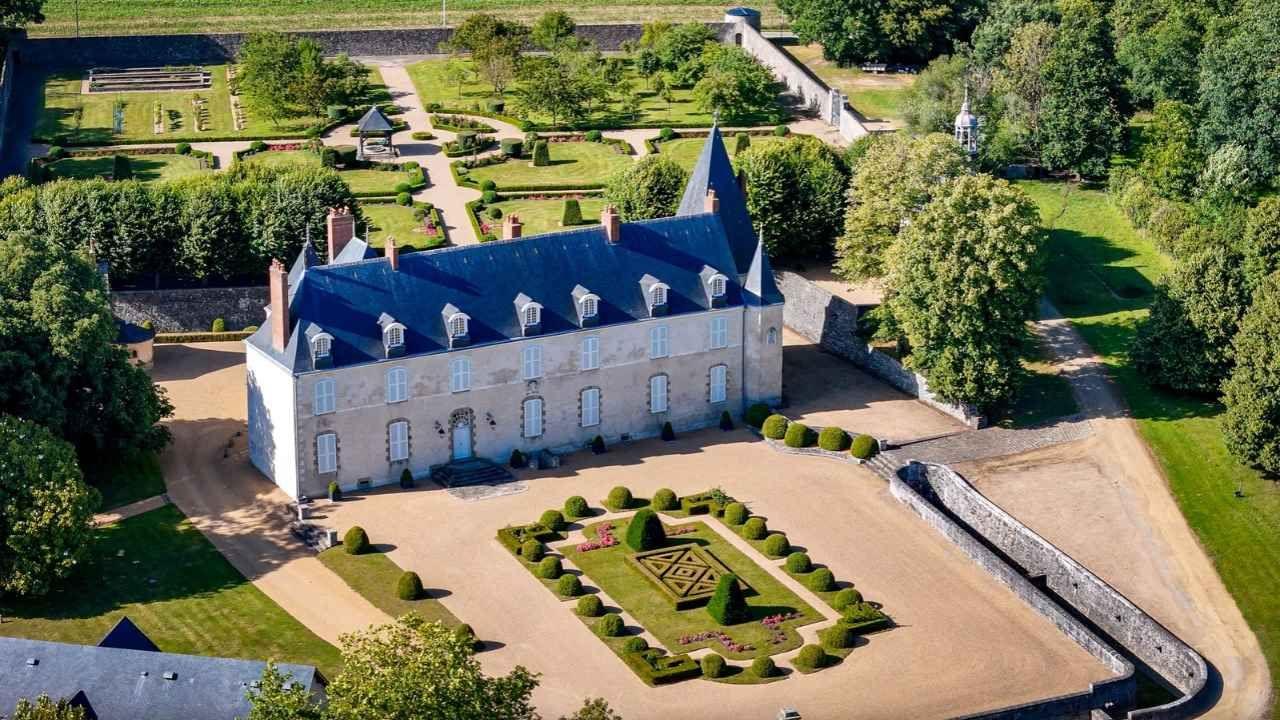
Château de Hauterives
Key facts
ProtectionRegistered historic monumentInscrit MH
Inscrit monument historique: the second level of heritage protection in France, decided by the regional prefect. Owners must notify the state before any work on the protected parts, and the regional heritage authority (the DRAC) reviews it.
About
Château de Hauterives stands in Argentré, a village near Laval in the Mayenne department of western France. First recorded in 1209, the estate passed through the du Bellay and Hautefort families before the Bersets, a wealthy Laval family, rebuilt it in the 18th century. Rescued from abandonment and restored by the Matton family, it was sold in 2025 to an American couple, who began its restoration in 2026.
The history of Château de Hauterives, in Argentré near Laval, can be traced back to September 1209, when Guillaume d’Hauterives acknowledged that he held his manor from Savary d’Anthenaise, lord of Bazougers, to whom he owed mounted, armed service. By the 13th century the lords of Hauterives already held rights to wood in the nearby Forêt de Frageu, and in 1485 the count of Laval released them from their feudal dues.
A document of 1533 describes the house as a dwelling that could serve as a safe refuge, a role it played again in 1616, when valuables from Saint-Céneré were brought here for safekeeping during the unrest of that year. About two centuries after 1209, the estate had passed to the lord of Villiers, then by inheritance to the du Bellay family, one of the illustrious names of the French nobility, later allied with the Hautefort family.
In 1737, a descendant of these families sold Château de Hauterives to Jean-Baptiste Berset, from a Laval family then ranked among the wealthiest in the town, which also owned the Château de Parneau in nearby Parné. Jean-Marie Berset built the present château and its chapel and took the title of seigneur d’Argentré.
The rebuilding gave the house its most striking feature: a wooden staircase dated 1768, unusual in a château of this type, where a stone staircase would be expected. Its steps still creak underfoot. The roof was rebuilt with a technique uncommon at the time: instead of a few massive beams that took up space, the frame relies on many smaller timbers, which freed more room under the roof and cost less to build.
The Revolution caught up with the house in 1795. Republican soldiers led by a man named Gency, sent after the Chouans, the royalist insurgents of western France, came mainly to loot, carrying off linen, furniture, doors, windows and paneling, and sacking the chapel. In September 1802, the bishop of Le Mans allowed Monsieur Berset to have Mass said there again. The turrets on corbels added in the late 18th century were heavily remodeled in the 19th.
Inside Château de Hauterives, the earlier building still shows through. The room that now serves as the dining room was a breezeway in the Renaissance era, when the château was divided in two. An outside doorway into the rest of the house survives, with the hinges of its door still visible on the inner side, along with traces of older fortifications. A small door opens onto a lavabo, the stone basin where hunters washed their hands on their return. Outside, a former horse basin was used to wash the horses after the hunt, its water draining, like that of the garden, into the moat.
The chapel of Château de Hauterives was founded by Thomine de Villiers, lady of La Flotte and of Hauterives, and first built in the 1530s. It was rebuilt in the 18th century along with the château and is crowned by a small, very slender bell tower. Inside lies an unusual grave, that of Count Fitzgerald and his wife, a count who came from Ireland and took over the château. The estate remained in the family through the Fitzgerald and Montalembert families, several members of which were buried in the chapel. The actor Thibault de Montalembert spent part of his childhood at Hauterives before the family sold it in 1975.
The chapel suffered in the years that followed. Its painting is thought to have been stolen in the 1970s; only a photograph records its appearance. Looters also tried to lift the gravestone, without success, and the marks of their crowbar remain. Water has damaged the ceiling, and several beams need replacing.
Built in 1533 and intact since then, the dovecote of Château de Hauterives is one of the oldest structures on the estate. Dovecotes, or pigeonniers, were used to raise pigeons for the table, and the number of nesting holes in the walls depended on the amount of land the lord controlled. From a distance this one looks like a small tower; up close, its size reveals the extent of the former estate. It is being converted into a one-bedroom guest apartment, with parquet de Versailles already laid on both floors.
Château de Hauterives is enclosed by moats and retaining walls, and its formal French gardens offer what its owners consider the finest view of the house. The garden enclosure includes a tower and a monumental central well. A line of pollarded trees marks the path once taken by the priest, who walked each day from the priest’s tower at its end to say Mass in the chapel.
The park also has woods and long avenues. Where two paths cross in the wood, a statue of the Virgin dated 1762 stands on a granite column, and an 18th-century labyrinth near the farmyard was still there around 1940. Beyond the garden wall, in a neighboring field, lies a Roman villa whose existence has been confirmed, a reminder of some 2,000 years of history on the site. Digging there is prohibited.
The attic of Château de Hauterives tells another chapter of the house’s life. In the 19th century, the roof was modified, windows were added and the space was divided into bedrooms for the servants. The partitions are gone, but their outlines remain, and the ceiling still bears scorch marks left by the candles by which servants read or prepared for the next day. On the floor, very small tomettes, the terracotta tiles found in old French houses, are among the oldest in the building: the smaller the tomettes, the older they tend to be. One former servant’s room was deliberately left as it was found, with its collapsing ceiling and exposed beams, to record the state of the house before restoration.
Over the following decades, Château de Hauterives passed through several hands, including Italian owners and, in the 1980s, the printer Yves Floc’h. Until 2007 it stood empty, without heating, electricity or security, and suffered serious looting and damage. Roxanne and Patrick Matton then bought it and restored it with regional craftspeople over more than twenty months, with 82 companies taking part. The cellar, partly used as a wine cellar, reflects the care of that work.
The château is listed as a monument historique (ISMH, inscrit à l’inventaire supplémentaire des monuments historiques, the French register of protected historic buildings), and its current restoration is carried out with the DRAC, the regional office of the French Ministry of Culture that oversees work on protected buildings. Modern floors are being replaced with parquet de Versailles in the main rooms; following the DRAC’s guidance that the minor rooms of an 18th-century château would not have had it, the bathrooms will receive a chevron parquet. The grand salon keeps its original floor and an original painting, whose blues set the palette for the room. The old tomettes are being saved, and the attic chimneys will serve as ducts for air conditioning.
Château de Hauterives now belongs to Richard and Melissa Bryant, an American couple who bought it in 2025 and are making it their home. They have undertaken a major restoration, carried out with the DRAC, to bring the house closer to its 18th-century character, beginning with the dovecote, the first part of the estate to be renovated.
For future owners
Dreaming of a château like this one?
Olivier, the founder of So Châteaux, has visited more than 500 châteaux in France and met more than 300 owners. His experience can make all the difference to your project.
See how he can help youVideos

Gallery
About
Château de Hauterives stands in Argentré, a village near Laval in the Mayenne department of western France. First recorded in 1209, the estate passed through the du Bellay and Hautefort families before the Bersets, a wealthy Laval family, rebuilt it in the 18th century. Rescued from abandonment and restored by the Matton family, it was sold in 2025 to an American couple, who began its restoration in 2026.
The history of Château de Hauterives, in Argentré near Laval, can be traced back to September 1209, when Guillaume d’Hauterives acknowledged that he held his manor from Savary d’Anthenaise, lord of Bazougers, to whom he owed mounted, armed service. By the 13th century the lords of Hauterives already held rights to wood in the nearby Forêt de Frageu, and in 1485 the count of Laval released them from their feudal dues.
A document of 1533 describes the house as a dwelling that could serve as a safe refuge, a role it played again in 1616, when valuables from Saint-Céneré were brought here for safekeeping during the unrest of that year. About two centuries after 1209, the estate had passed to the lord of Villiers, then by inheritance to the du Bellay family, one of the illustrious names of the French nobility, later allied with the Hautefort family.
In 1737, a descendant of these families sold Château de Hauterives to Jean-Baptiste Berset, from a Laval family then ranked among the wealthiest in the town, which also owned the Château de Parneau in nearby Parné. Jean-Marie Berset built the present château and its chapel and took the title of seigneur d’Argentré.
The rebuilding gave the house its most striking feature: a wooden staircase dated 1768, unusual in a château of this type, where a stone staircase would be expected. Its steps still creak underfoot. The roof was rebuilt with a technique uncommon at the time: instead of a few massive beams that took up space, the frame relies on many smaller timbers, which freed more room under the roof and cost less to build.
The Revolution caught up with the house in 1795. Republican soldiers led by a man named Gency, sent after the Chouans, the royalist insurgents of western France, came mainly to loot, carrying off linen, furniture, doors, windows and paneling, and sacking the chapel. In September 1802, the bishop of Le Mans allowed Monsieur Berset to have Mass said there again. The turrets on corbels added in the late 18th century were heavily remodeled in the 19th.
Inside Château de Hauterives, the earlier building still shows through. The room that now serves as the dining room was a breezeway in the Renaissance era, when the château was divided in two. An outside doorway into the rest of the house survives, with the hinges of its door still visible on the inner side, along with traces of older fortifications. A small door opens onto a lavabo, the stone basin where hunters washed their hands on their return. Outside, a former horse basin was used to wash the horses after the hunt, its water draining, like that of the garden, into the moat.
The chapel of Château de Hauterives was founded by Thomine de Villiers, lady of La Flotte and of Hauterives, and first built in the 1530s. It was rebuilt in the 18th century along with the château and is crowned by a small, very slender bell tower. Inside lies an unusual grave, that of Count Fitzgerald and his wife, a count who came from Ireland and took over the château. The estate remained in the family through the Fitzgerald and Montalembert families, several members of which were buried in the chapel. The actor Thibault de Montalembert spent part of his childhood at Hauterives before the family sold it in 1975.
The chapel suffered in the years that followed. Its painting is thought to have been stolen in the 1970s; only a photograph records its appearance. Looters also tried to lift the gravestone, without success, and the marks of their crowbar remain. Water has damaged the ceiling, and several beams need replacing.
Built in 1533 and intact since then, the dovecote of Château de Hauterives is one of the oldest structures on the estate. Dovecotes, or pigeonniers, were used to raise pigeons for the table, and the number of nesting holes in the walls depended on the amount of land the lord controlled. From a distance this one looks like a small tower; up close, its size reveals the extent of the former estate. It is being converted into a one-bedroom guest apartment, with parquet de Versailles already laid on both floors.
Château de Hauterives is enclosed by moats and retaining walls, and its formal French gardens offer what its owners consider the finest view of the house. The garden enclosure includes a tower and a monumental central well. A line of pollarded trees marks the path once taken by the priest, who walked each day from the priest’s tower at its end to say Mass in the chapel.
The park also has woods and long avenues. Where two paths cross in the wood, a statue of the Virgin dated 1762 stands on a granite column, and an 18th-century labyrinth near the farmyard was still there around 1940. Beyond the garden wall, in a neighboring field, lies a Roman villa whose existence has been confirmed, a reminder of some 2,000 years of history on the site. Digging there is prohibited.
The attic of Château de Hauterives tells another chapter of the house’s life. In the 19th century, the roof was modified, windows were added and the space was divided into bedrooms for the servants. The partitions are gone, but their outlines remain, and the ceiling still bears scorch marks left by the candles by which servants read or prepared for the next day. On the floor, very small tomettes, the terracotta tiles found in old French houses, are among the oldest in the building: the smaller the tomettes, the older they tend to be. One former servant’s room was deliberately left as it was found, with its collapsing ceiling and exposed beams, to record the state of the house before restoration.
Over the following decades, Château de Hauterives passed through several hands, including Italian owners and, in the 1980s, the printer Yves Floc’h. Until 2007 it stood empty, without heating, electricity or security, and suffered serious looting and damage. Roxanne and Patrick Matton then bought it and restored it with regional craftspeople over more than twenty months, with 82 companies taking part. The cellar, partly used as a wine cellar, reflects the care of that work.
The château is listed as a monument historique (ISMH, inscrit à l’inventaire supplémentaire des monuments historiques, the French register of protected historic buildings), and its current restoration is carried out with the DRAC, the regional office of the French Ministry of Culture that oversees work on protected buildings. Modern floors are being replaced with parquet de Versailles in the main rooms; following the DRAC’s guidance that the minor rooms of an 18th-century château would not have had it, the bathrooms will receive a chevron parquet. The grand salon keeps its original floor and an original painting, whose blues set the palette for the room. The old tomettes are being saved, and the attic chimneys will serve as ducts for air conditioning.
Château de Hauterives now belongs to Richard and Melissa Bryant, an American couple who bought it in 2025 and are making it their home. They have undertaken a major restoration, carried out with the DRAC, to bring the house closer to its 18th-century character, beginning with the dovecote, the first part of the estate to be renovated.
For future owners
Dreaming of a château like this one?
Olivier, the founder of So Châteaux, has visited more than 500 châteaux in France and met more than 300 owners. His experience can make all the difference to your project.
See how he can help you