
Château de Jaulny
Key facts
ProtectionClassé MH
Classé monument historique: the highest level of heritage protection in France, decided by the national government. Any work on the protected parts needs state approval and is supervised by the state heritage services.
About
A thousand-year-old fortified house in Lorraine, where a stubborn tradition says Joan of Arc lived on as Jeanne des Armoises: Jaulny has overlooked the Rupt de Mad valley since the Middle Ages. The château has kept its armory, its vaulted cellars and a Gothic roof frame, reinforced after World War I. Emmanuel Penetrat and Aurore Thiebaut are restoring it with a team of volunteers and have launched a rescue of its roofs.
Jaulny's story begins in 1060, when knights bearing the name of the place founded a small independent lordship here. A military presence on the site is documented in the 12th century. Facing them across the river, in the Duchy of Bar, lived the Armoises. The two families lived side by side, and for a long time the Armoises tried to take the castle for themselves.
The fortified house of Jaulny took its U shape in the late 15th or early 16th century, with square corner towers and a keep. An outer wall was built around it in the second half of the 17th century. The vaulted cellars, dug under the west wing in the 16th century and descending three levels, are listed as a historic monument by the French state. The drawbridge tower still guards the entrance to the upper courtyard, where two small trees mark the site of the old bridge.
Isolated in the middle of the forests, Jaulny probably owes its survival to this out-of-the-way position. From the top of the château, the view takes in the valley and the surrounding woods, just as the lords saw them a thousand years ago.
The great hall of Jaulny has kept the atmosphere of the late Middle Ages and the early Renaissance. This room is what persuaded the current owners, Emmanuel Penetrat and Aurore Thiebaut, to take on the adventure. Both of the great families of the place, the knights of Jaulny and the Armoises, are represented there. Today the hall serves as the setting for the shows and medieval singing the owners put on.
Under the roofs, a recent discovery shed light on how the fortified house was defended: Jaulny has a wall walk inside the château itself. This narrow passage ran around the tower and led up to the gunports, where firearms were placed.
Jaulny's portrait room draws visitors from all over the world. Above its 15th-century fireplace are two figures: Jeanne des Armoises and her husband, Robert des Armoises, a knight older than she was. According to an old tradition, this Jeanne was none other than Joan of Arc, who supposedly escaped the stake and lived out her life in Lorraine under another name. Tradition also has it that she died at Jaulny, without children. None of this has been proven, but the story is what made the château famous.
The two portraits were found in 1871 under the plaster that covered the fireplace. According to the village mayor at the time, his great-great-grandfather had hidden them before the French Revolution, on the orders of a member of the Armoises family. The same 15th-century fireplace appears again several floors up, in the attic.
Jaulny is also gaining objects entrusted by families who want to see them kept in a fitting place, such as the handsome piece of furniture in the portrait room. For these families, it is a way of honoring their ancestors.
In the 18th century, Jaulny entered a new era. The old medieval keep was hollowed out to hold a monumental stairwell. War was no longer the point. The aim now was to show off the power and splendor of the lords. The staircase railing, like the courtyard gate, is attributed to the ironworker Jean Lamour. The same century saw a pavilion built against the south wall and the main residence remodeled.
Higher up, under the roofs, the attic story housed the servants' quarters, which are still in poor condition.
During World War I, Jaulny served as a military hospital. A large red cloth in the shape of a cross, stretched across the roof, marked it as one. Occupied by the Germans, the château escaped destruction this way, but a bomb fell right in the middle of the building, above the staircase.
At the end of the war, instead of tearing the château down, workers reinforced the old oak beams with fir beams and iron, including railroad rails. Unlike oak, the fir aged badly and was attacked by insects.
The American soldiers who liberated Jaulny rolled up a painting and took it home to the United States. Stricken with remorse, they sent it back in 1919 with a short note of apology on the back. It has returned to its place in the Empire bedroom, where it shows the château as it looked two hundred years ago.
Jaulny's Empire bedroom, with its high ceiling, has been restored to welcome newlyweds. The work took three months and involved at least six people. They had to choose the wallpaper, recreate paneling that no longer existed and bring together period furniture, 18th-century and Empire. A Baccarat crystal set, used for the orange blossom water people drank on sleepless nights, is on display.
This work is done by the "do-it-yourself knights," volunteers who come every week, all winter long, to help the owners restore the château.
"It's a human adventure. It's people who come of their own free will to help us restore this place."
Aurore Thiebaut, owner, 2025
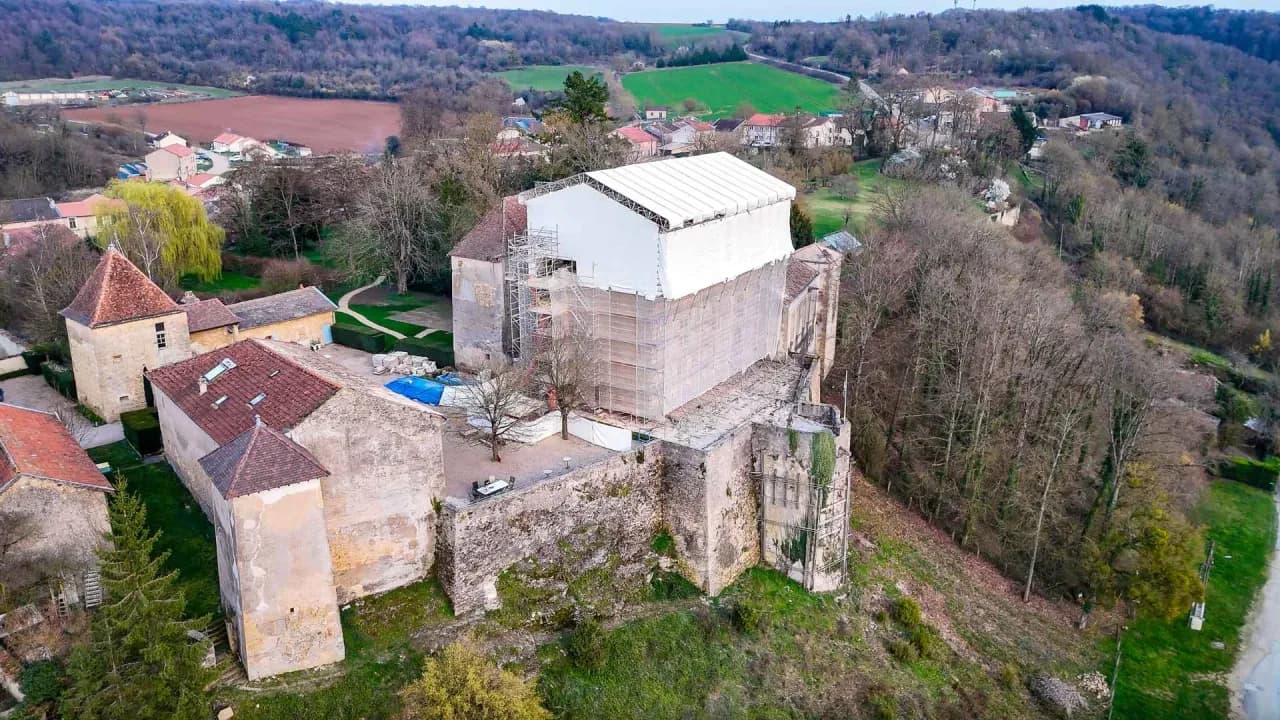
In 2025, Jaulny launched a major €2.2 million project on its roofs. The roof leaked everywhere, water ran through the stone gutters all the way down into the listed cellars, and the structure was wearing out. A giant scaffold covers the château so the craftsmen can work in any season.
The roof frame of Jaulny shows the skill of Gothic carpenters. Instead of a single wall plate laid on top of the wall, two beams clamp the masonry between them, joined by crosswise timber blocks that carry the trusses and spread the load. The same technique appears in the first Gothic churches. Big hand-forged nails still hold joints in timber that may be four or five centuries old. But the roof has sagged 50 centimeters (20 inches) and the ridge beam has broken. The old handmade tiles sometimes still bear the fingerprints of the people who made them.
"The craftsmen who worked on it told us: listen, you know, it was maybe a matter of 5 to 10 years before all of that, before all of that came crashing down. So it was about time."
Emmanuel Penetrat, owner, 2025
Removing the 10,000 tiles and some of the beams released the pressure that was holding the walls in place. A very thick wall, loaded with stone gutters weighing more than a ton each and ending in gargoyles, split open in the middle and is pushing one of the trusses outward. Work had to stop for two months. The chosen fix is to hang the roof frame from a beam above it while the wall underneath is rebuilt, then set it back down. The cost overrun: €80,000.
"Especially when you have a château, you need a strong stomach, you have to be bold and tell yourself that […] we'll get there."
Emmanuel Penetrat, owner, 2025
Jaulny is a private château, and its owners lead guided tours from the armory to the portrait room by way of the keep. Shows, medieval festivals and exhibitions are held here, and the park, bordered by ramparts above the Rupt de Mad valley, hosts weddings. In 2021, Jaulny was selected as one of the endangered sites of the heritage mission known as the Loto du patrimoine, a national heritage lottery. In 2025, its owners were looking for backers to fund the rest of the roof project.
For future owners
Dreaming of a château like this one?
The founder of So Châteaux has visited more than 500 châteaux in France. He takes no commission on château sales, so he can tell you what he really thinks about any property, completely independently.
See how we help buyersGallery
Frequently Asked Questions
Its oldest sections date back to the 11th and 12th centuries.