
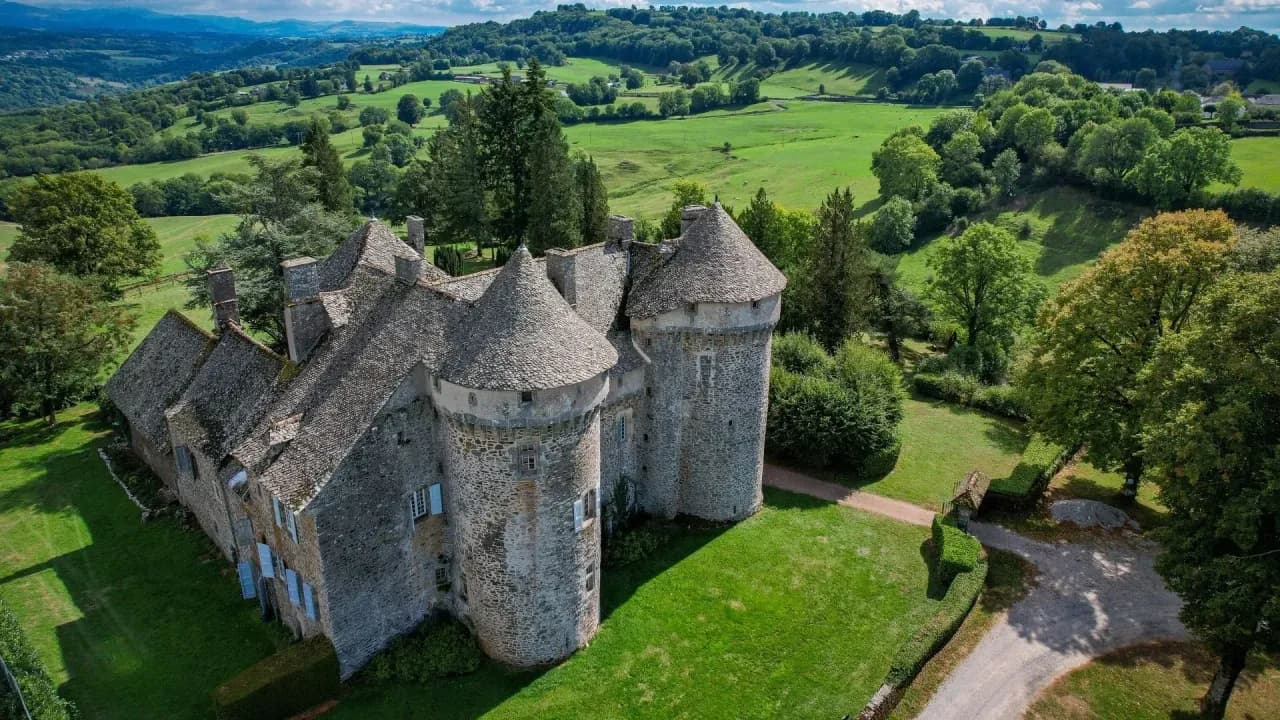
Château de la Vigne
Key facts
ProtectionInscrit MH
Inscrit monument historique: the second level of heritage protection in France, decided by the regional prefect. Owners must notify the state before any work on the protected parts, and the regional heritage authority (the DRAC) reviews it.
About
France has only three studioli, the painted study rooms where a Renaissance lord withdrew to read and think: one at Blois, one at Le Lude, and one at La Vigne. Built in the 15th century by the Scorailles family on an old vineyard facing the Cantal mountains, this small stone-roofed fortress opened onto a south-facing courtyard in the 18th century. The du Fayet de la Tour family, descendants of the builders, live there, open it to visitors and host guests.
La Vigne is the last in a line of castles built in the commune of Ally, in the Xaintrie area, at 700 meters (2,300 feet) above sea level, on the old border between Auvergne and Limousin. A first stronghold, the castrum Scoraliam, stood 300 meters (about 1,000 feet) below. Pepin the Short and Charlemagne took it from Duke Waifer of Aquitaine in 767.
In the 11th century, the Scorailles family, an old Auvergne line that traces its roots back to the year 1000, built its castle in the village of Escorailles. That castle, held jointly by several lords and co-owners, came out of the Hundred Years' War badly damaged. The lord then suggested that his eldest son build a new house on the family vineyard. That is where the name La Vigne, "the vineyard," comes from, in the 15th century.
La Vigne began as a small fortress, at a time when people in upper Auvergne were still building them. The main house, flanked by four towers, ringed by moats and pierced by very few openings, keeps its machicolations with triple molded corbels, its small mullioned windows and its arrow slits. These defenses targeted bandits more than armies, still common after the Hundred Years' War.
La Vigne's roofs are covered in lauzes, slabs of volcanic schist laid like fish scales and pegged into the boards of 15th-century roof frames. Their steep pitch lets the snow slide off. In the big square tower, the main staircase, one of the widest in the region, is built of volcanic tuff, each step carved from a single block. It is a defensive staircase. It turns the "wrong" way, with the handrail on the left, so an attacker climbing sword in hand is blocked by the central column while the defender moves freely. It serves every floor and links the 15th-century part of the house with the 18th-century part.
At the top of La Vigne's tower, behind two metal doors, is the studiolo created in 1530 by François de Scorailles, the château's second lord. Like those at Blois and Le Lude, it is a small, richly decorated room at the very top of the house, with a single window.
"It's a place for the master of the house, where he can withdraw to study, to work, to meditate. It's also a bit of a secret garden for him."
Georges-Henri du Fayet de la Tour, owner, 2022
The wall paintings at La Vigne, done in the Italian Renaissance manner, tell the life of the man who commissioned them. They show the château itself in 1530, its oldest known image, next to the Château de Montal, home of his father-in-law: François de Scorailles married Anne de Montal in 1525. The main scene is the hunt of Saint Hubert, from small game to the great stag hunt, ending with the hunter's conversion before the cross that appeared between the stag's antlers, with an angel holding a banner. Higher up, Ovid's Metamorphoses tell the story of Pyramus and Thisbe. Pyramus wears the dress of the time of Francis I, and the lord, who fought beside the king in the Italian Wars and wore the Order of Saint Michael, probably painted himself into the scene. A son born of an affair, Guillaume de Scorailles de Mazerolles, was later legitimized by the pope and the king. In the central medallion, one of the daughters of Minyas turns into a bat. Above the stone fireplace are the Scorailles arms, three gold bands on blue. The paintings were restored about ten years before 2022 with the Fondation François Sommer, the foundation behind the Musée de la Chasse et de la Nature in Paris.
La Vigne's great Renaissance halls were divided up in the 18th century. A painted frieze, visible above the windows of the Directoire bedroom and the Renaissance bedroom, shows they were once a single room. On May 14, 1650, in the middle of the Fronde, the princes' revolt against the regency, Jean de Scorailles hosted Claire-Clémence de Maillé-Brézé, Princess of Condé, for dinner there. Her husband was locked up at Vincennes, and she was crossing France to reach Bordeaux, escorted by 200 musketeers and the Dukes of Bouillon, Duras and La Rochefoucauld. That evening, an envoy of the King of Spain promised her his master's support against the regency.
In 1743, Anne-Charlotte de Scorailles brought La Vigne as her dowry to Bertrand d'Humières, who made it more elegant. He built massive walls to hold up the terrace, added a wing at a right angle to create a south-facing courtyard, opened up the windows and created the paneled rooms. According to a strong local tradition, Antoine Balthazar d'Humières welcomed Jean-Jacques Rousseau in 1769, then an outlaw on the move, who came to put together a herbarium. The Louis XV bedroom that bears his name keeps its carved paneling, a gold-leaf mirror, a portrait of the Grande Mademoiselle, Louis XIV's cousin, and a screen covered in fabric from the Summer Palace of the Emperor of China.
After the Humières, La Vigne passed by marriage to the La Tour d'Auvergne family, then to the Raffin de La Raffinie and the du Fayet de la Tour, who also descend from the builders. Shortly after World War I, Gabriel de Raffin de La Raffinie had a bedroom decorated in the Troubadour style, a romantic take on the Middle Ages, probably one of the last Gothic Revival interiors in France. Its stained glass shows François de Scorailles returning from the Italian Wars and the union of the Raffin de La Raffinie and du Fayet de la Tour families. The coffered ceiling bears the arms of local families. On the fireplace, Gabriel had his arms carved along with an Annunciation, a nod to the archangel whose name he bore, and he hid a secret door in the paneling that opens onto a concealed staircase.
The same owner added a Gothic Revival fireplace trimmed with Delft tiles to La Vigne's Louis XV paneled dining room, and commissioned an Orientalist painter to do four overdoor paintings of neighboring châteaux: Pesteils at Polminhac, the Tours de Merle, the ruins of Branzac and the Manoir de la Jourdanie in Salers. The room brings together a sideboard set with a Minton service, Flemish tapestries, including a 16th-century Alexander series, and an 18th-century Dutch chandelier.
La Vigne's salon is dominated by two Aubusson tapestries from the late 17th century. They too come from Ovid's Metamorphoses and stay with the theme of the hunt: Actaeon, turned into a stag and torn apart by his own dogs for surprising Diana at her bath, and Meleager offering Atalanta the head of the Calydonian boar. Above the doors hang portraits of the Raffin de La Raffinie family and one of the first lady of the château, Geneviève de Scorailles, in a tall cone-shaped hennin headdress.
La Vigne's castle chapel dates from the 15th century. On June 10, 1551, François de Scorailles obtained the right to have a daily mass said there in perpetuity, and the village archives record many weddings and baptisms of the Scorailles and Humières families. At the end of the 19th century, it was turned into a Moorish parlor, following the Orientalist fashion of the day. It went back to being a chapel in 1979 and once again hosts masses, engagements and baptisms.
In 1980, paintings of angels carrying the instruments of the Passion were discovered. Above the altar, a tetramorph shows God the Father giving his blessing, surrounded by the symbols of the four evangelists. The Christ on the tabernacle is in faience from Malicorne-sur-Sarthe, and a stained-glass window of Saint Michael weighing souls comes from the Lorin workshop in Chartres. The family estimates that some 110,000 masses have been said in the chapel since it was founded.
In 2022, La Vigne belongs to the du Fayet de la Tour family, whose coat of arms hangs over the door of the square tower. Georges-Henri du Fayet de la Tour had just taken over the family château, keeping the spirit his parents gave it. The château is open for tours and offers guest rooms, including the one known as Jean-Jacques Rousseau's room. His father's collection of model cars, more than 4,500 pieces, from old Citroën toys to Dinky Toys, traces the history of the automobile and is part of the visit.
"We're happy to carry the torch. […] I feel a bit like the guardian of something, of a heritage that's bigger than me."
Georges-Henri du Fayet de la Tour, owner, 2022
"What matters to me is opening it up to as many people as possible, letting them enjoy all these beautiful things. And at the same time, there's the challenge of keeping it up these days and passing it on to future generations."
Georges-Henri du Fayet de la Tour, owner, 2022
For future owners
Dreaming of a château like this one?
The founder of So Châteaux has visited more than 500 châteaux in France. He takes no commission on château sales, so he can tell you what he really thinks about any property, completely independently.
See how we help buyersGallery
Frequently Asked Questions
It was built in the 15th century, with painted decor from the 15th and 16th centuries.