
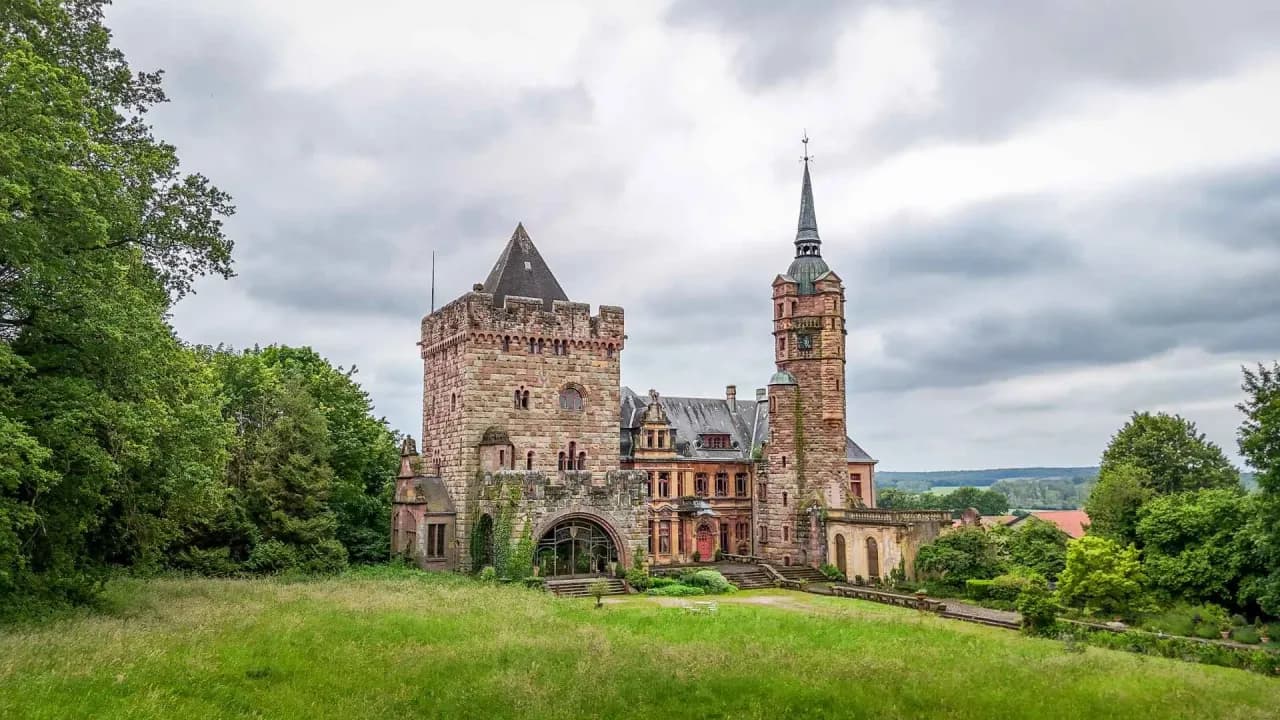
Château de Landonvillers
Key facts
About
To give himself a fortress worthy of Germany's great dynasties, John von Haniel, a Ruhr notable settled in German-annexed Lorraine, had Bodo Ebhardt rebuild Landonvillers from 1904 to 1906, with stone shipped by train from around Paderborn. Behind its neo-medieval towers, the house hides a cellar with a wine fountain and an initiation temple. Norbert Vogel, who took it on abandoned in 1993, is restoring it and has gathered a collection of old icons there.
The first château at Landonvillers was built around 1580 by Thomas Le Duchat, the first lord of the place, a few kilometers from Metz. Altered in the 17th and 18th centuries, it passed through families of the Lorraine nobility, among them the chevalier Michel de Saint-Blaise, whose coat of arms the village still uses. At that point it looked nothing like the fortress you see today.
After the Franco-Prussian War of 1870-1871, the Moselle was annexed to the German Empire and, together with Alsace, became an imperial territory. Settling on this newly conquered land was well regarded among German notables. Kaiser Wilhelm II bought the Château d'Urville, a few kilometers away, in 1890, and in 1891 Dr. John von Haniel, a senior official in the Ruhr, bought Landonvillers. His family's fortune came from mining, ironworks, coal and shipping on the Rhine. Boats named Franz Haniel, after the founder of the dynasty, still sail the river today. Ennobled in 1899, John von Haniel was also the village mayor.
From 1904 to 1906, John von Haniel had Landonvillers transformed by Bodo Ebhardt, the architect then rebuilding Germany's medieval castles, a German Viollet-le-Duc. The owner wanted his own Haut-Koenigsbourg, the great medieval castle of Alsace. He turned down the local Vosges sandstone and had stone from his native region, around Paderborn in northern Germany, brought in by train.
Landonvillers thus combines medieval architecture with modern techniques. The winter garden, carried on steel beams, has lost its stucco vault, which soaked up water because it was never sealed. Two Carrara marble statues there celebrate where the Haniel money came from: Hercules in the underworld, with the German miners' greeting, Glück auf, and Vulcan at work with the Cyclops. The château's Renaissance core, capped by the new construction, opens through a neo-Renaissance door. Its stained glass, in the Viennese Art Nouveau style, shows the architect as a knight facing his wife.
Landonvillers's great Knights' Hall has the imperial eagle on its keystone, and its stained-glass windows line up the shields of great German dynasties, which the newly ennobled owner was probably eager to be associated with. According to local tradition, Wilhelm II never came, since his own Château d'Urville was far more modest than his subject's, and the Kaiser was not fond of John von Haniel. Tall sliding oak doors could close off the hall, where the men talked business, from the music room where the ladies withdrew.
The Landonvillers music room holds an Érard piano described as the twin of the one Richard Wagner had in Venice, at the Palazzo Vendramin. It also has a theremin, an instrument invented in the 20th century by the Russian engineer Léon Theremin. It is played without being touched, and 1950s science-fiction movies made its sound famous.
Below Landonvillers, at the level of the old kitchens and pantries, lies the Trinkstube, a German-style room for drinking with friends. Its walls are painted with drinking scenes and bunches of grapes, dry-painted murals that are turning to powder. Its wine fountain, a rarity, was fed by a barrel in the pantry on the floor above: pull a handle and the wine flowed freely.
Next door, the Landonvillers chapel was probably no chapel at all. John von Haniel moved in esoteric and Masonic circles, and the château's stonework carries many symbols. One capital pairs a cross with an inverted triangle, a figure for the spiritual and the earthly planes. It is thought to have been an initiation temple. In 1993 the room was filled with garbage to head height, and it took whole dumpsters to clear it.
"I found this cross under all that garbage, I hung it up there, and I said to myself, this will be the chapel."
Norbert Vogel, owner, 2024
During World War I, John von Haniel's widow set up a rest home at Landonvillers for nurses from the nearby front. In 1918 she was thrown out with her four daughters, 2,000 reichsmarks and a small suitcase. The French state gave the château to a hero of French aviation, who died in 1932 and left it to the public hospitals of Metz, now the Metz-Thionville regional hospital. By the late 1980s, the hospital had other priorities than maintaining an old château.
Norbert Vogel arrived at Landonvillers in 1993. The library at the top of the keep was then in very poor shape. All the rotten plaster of the ceiling was scraped off and four tons of new plaster put up, and the medallions of the sciences and arts were saved by a painter who had worked in Venetian palaces. Where water had wiped everything out, the restorer painted the owner's initials and the date 1993.
Landonvillers's old library has since housed the collection of Byzantine and Russian icons that Norbert Vogel began gathering at sixteen. It spans nearly five centuries, from an Old Testament Trinity dated 1450, in which Abraham receives three angels, to the Russian Revolution of 1917. It is considered one of the largest private collections of old icons in France.
"I'm neither Russian nor Orthodox. […] And I was moved by the beauty of these icons."
Norbert Vogel, owner, 2024
The collection includes feast-day icons, among them the Anastasis, painted face by face under a magnifying glass, and narrative icons designed to teach Scripture to believers who could not read. There is a 19th-century Saint Petersburg icon inspired by Raphael, travel icons, a folding iconostasis carried onto battlefields and a travel triptych with silver initials belonging to Franz-Josef Röder, a former minister-president of the Saarland.
Landonvillers also keeps a private suite devoted to Ludwig II of Bavaria, more poet king than mad king in its owner's eyes. Its furniture, in the style of Neuschwanstein, is the work of Anton Pössenbacher, the king's favorite cabinetmaker, and is said to have been intended for Falkenstein Castle, which was never built. The bed carved with scenes of birth and burial, a revolving prayer cabinet, a replica of the Grail made in Bayreuth, the king's death mask and ivory miniatures from his grandfather's Gallery of Beauties, Lola Montez among them, share the space with a portrait of Sophie-Charlotte, his fiancée. She later became the Duchess of Alençon and died in the fire at the Bazar de la Charité in Paris.
In 2024, Landonvillers has belonged to Norbert Vogel for about thirty years. He lives there, has his office in the old vestibule where Mayor Haniel once sat, and keeps the work going: the wiring in the old kitchens still needs to be redone. The château is private. It opens for European Heritage Days and for groups, and its owner hopes to welcome individual visitors again. The Knights' Hall occasionally hosts small concerts.
"That's where I threw myself into this crazy adventure of taking this house in hand. And we've been working hard ever since!"
Norbert Vogel, owner, 2024
For future owners
Dreaming of a château like this one?
The founder of So Châteaux has visited more than 500 châteaux in France. He takes no commission on château sales, so he can tell you what he really thinks about any property, completely independently.
See how we help buyersGallery
Frequently Asked Questions
Built in the 16th century, it was transformed into its current appearance between 1903 and 1905.