
Château de Losse
Key facts
ProtectionClassé MH
Classé monument historique: the highest level of heritage protection in France, decided by the national government. Any work on the protected parts needs state approval and is supervised by the state heritage services.
About
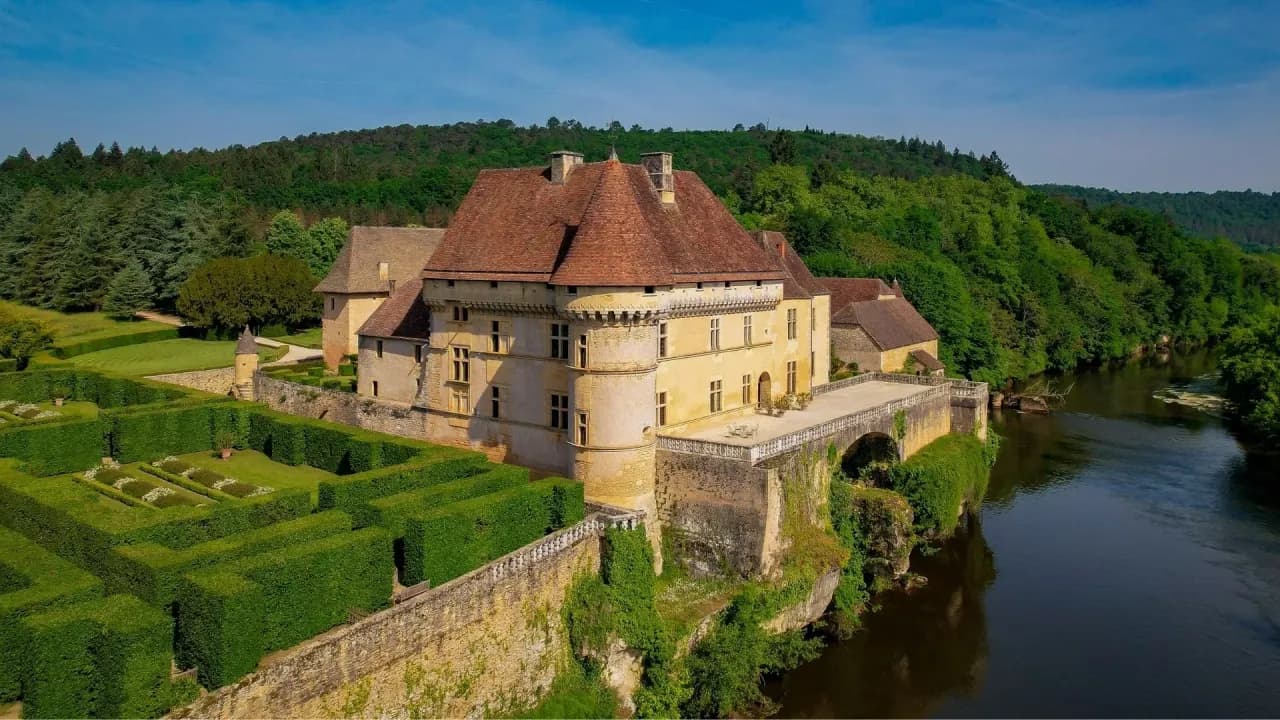
Losse has been reborn twice. Around 1570, Jean II de Losse, captain of the Scots Guard and governor of Périgord, turned a stronghold on the Vézère River into a pleasure house. In the 20th century, Guy and Jacqueline Van der Schueren found it smothered in ivy and gave it back its splendor. Behind its medieval gatehouse, this Renaissance house in the Black Périgord, in the Dordogne, has recovered its gardens, and its furniture and tapestries, following an inventory of 1602.
Losse rests on a 14th-century medieval base, built when the site was at its military peak, during the Hundred Years' War. You still enter through a large gatehouse, then over a bridge across deep moats. The approach is so awkward that it has complicated every building project down to the present day. Of the fortress, much altered, the spur tower survives intact, named because it juts out from the walls like a spur. Only the walls that linked it to the rest were torn down, to let in the light the Renaissance was after.
The passage leading to the main house at Losse reuses a medieval passage, but it already frames a view. It lines up with the gatehouse, the great alley of cedars and the landscape the terrace looks out on. Half indoors, half outdoors, it belongs to the Renaissance that came from Italy, like the loggias and open staircases of the Loire Valley châteaux.
Jean II de Losse is the most important figure in his family. A soldier and strategist close to the royal family, he was governor of Périgord and Limousin, lieutenant general of Guyenne, tutor to the future Henry IV, then Prince of Béarn, and the first Frenchman to command the Scots Guard of the kings of France. He also knew prison, in the jails of the Emperor Charles V. Late in life, around 1570, he settled at Losse and began building a Renaissance pleasure house on the base of the medieval castle.
A lead inscription above a south window at Losse reads "Losse 1576," the year the main house was finished. In the same room, a Latin motto, Cum sudore sanguine et carcere, "with sweat, blood and prison," is said to be Jean II's own, summing up a life of work, battles and captivity. The facade and the door with its columns, and the straight staircase with flights stacked one above the other, which replaced the medieval spiral stair, show the new taste. Carved figures probably once stood above the door. They have not been put back.
At Losse, the upstairs Hall of Coats of Arms probably served as a study in the private apartments. Its floor is pisé, a pebble technique common in modest buildings in Périgord, but this one is exceptional twice over: it forms large rosettes, and it is laid on an upper floor, which means enormous weight. A Renaissance fireplace, a beamed ceiling whose beams were hoisted by crane over the moats, and stained glass with the Losse arms, nine gold stars on a blue field, complete the room. Behind the fireplace, safe from the damp, a strong room closed by a metal door held the property deeds, the family's real fortune. A cat flap let the cat in to keep the mice away.
To carry that floor, the architect of Losse built a vault underneath with five keystones. In the 19th century it was covered with plaster, as was the fashion. During the work of the 1980s, the decision was made to scrape the plaster off, with no way of knowing whether the vault would come down with it.
"But it was a bit of a risky bet […] And we would've ended up with the room upstairs down here."
Martin de Roquefeuil, manager, 2024
The bet paid off. The vault reappeared, along with the carved, dated inscriptions that mark the history of Losse.
In the early 17th century, when Jean III de Losse died, his wife had an inventory of the château drawn up to pass it on to their son. That 1602 inventory still exists, and it served as a guide for putting furniture and tapestries back in their places. Guy Van der Schueren brought in furniture and objects from his own family, then filled out the collection by following the document.
Losse thus holds two pieces of early marquetry, both dreaming of an ideal city, symmetrical and geometric: an Italian chest with Mediterranean buildings and a Flemish sideboard with houses of the north. The 16th-century tapestries are remarkably well preserved. One, The Preparation for the Tournament, woven in Brussels, carries the double B of Brussels in Brabant and the weaver's initials. Another, from the late 15th century, is one of the oldest in the château. The Yellow Bedroom, turned toward nature, has a bed attributed to Androuet du Cerceau and a tapestry without figures showing the tulip, then a newcomer to Europe. A chest of drawers, still designed like luggage, faces a traveling trunk. In the armory, a 17th-century Nuremberg chest hides its real lock, with eleven bolts, under a button in the lid. A local craftsman made a new key for it.
Losse keeps a wax portrait of Henry IV, modeled when the king came to the throne by his official sculptor, Guillaume Dupré, as a model for medals and coins. These waxes were not meant to last. This one was framed in silver and tortoiseshell in the 17th century, and that saved it. A portrait of the king is listed in the 1602 inventory.
The green salon at Losse has recovered its 16th-century color. The room had been partitioned and remodeled many times, and its paneling stained with walnut. Under the successive layers, traces of a pale water green, widely used at the time, turned up on the walls.
At Losse, the bedroom of the captain of the Scots Guard recalls a story that began at the end of the Hundred Years' War. Among the Scots who came to fight beside Joan of Arc was one Thomas Houston. Once crowned, Charles VII created a guard of twenty-four Scottish archers to thank them. When Jean II de Losse became captain of that guard, he met a descendant of Thomas, known for certain only by his initial, A. Houston, and recruited him for the garrison at Losse.
A. Houston wrote a great deal from Losse: a book, L'Écosse française (French Scotland), and letters to the Prince of Wales, one of which ends: "from the Château de Losse, May 10, 1607."
In the garden at Losse, a building long used as a wine store, with its barrels and the wine from the hillside vines, turned out in 2011 to be a stable given by Catherine de Médicis to Jean II de Losse. It copies the stables she had built at the Tuileries in Paris, which she gave to several great figures of her day, and the plans match. The windows open on one side only, so the light falls on the horses' hindquarters while they face a blank wall, and the vault in lava stone stays the same temperature all year round. Today it serves as an orangery. The Renaissance gardens, entirely recreated, are the work of Jacqueline Van der Schueren.
To build the great terrace at Losse, above the Vézère, the medieval keep came down, the symbol of a family's power over its land. Facing east, shaded in the evening and cooled by the river, the terrace looks up and down the valley, over the gardens and the countryside.
"They tear down this medieval period that, in the end, they can't stand anymore. And they put in a terrace that stands for the art of living."
Martin de Roquefeuil, manager, 2024
In 2024, Losse is open to the public, who visit its furnished rooms, its gardens and its terrace. Some rooms, such as the old stables, open only rarely. The round tower has been reroofed. The next big project at Losse is the roof of the spur tower, covered in lauzes, flat stone slabs, which must be redone entirely, despite the difficult access to the site and the shortage of craftsmen.
"This roof is lauze, that stone roofing that's so special to Périgord, but the craftsmen are getting scarce, so finding someone skilled, who's available and affordable, is really hard."
Martin de Roquefeuil, manager, 2024
For future owners
Dreaming of a château like this one?
The founder of So Châteaux has visited more than 500 châteaux in France. He takes no commission on château sales, so he can tell you what he really thinks about any property, completely independently.
See how we help buyersGallery
Frequently Asked Questions
Its Renaissance manor house was built in 1576 by Jean de Losse.