
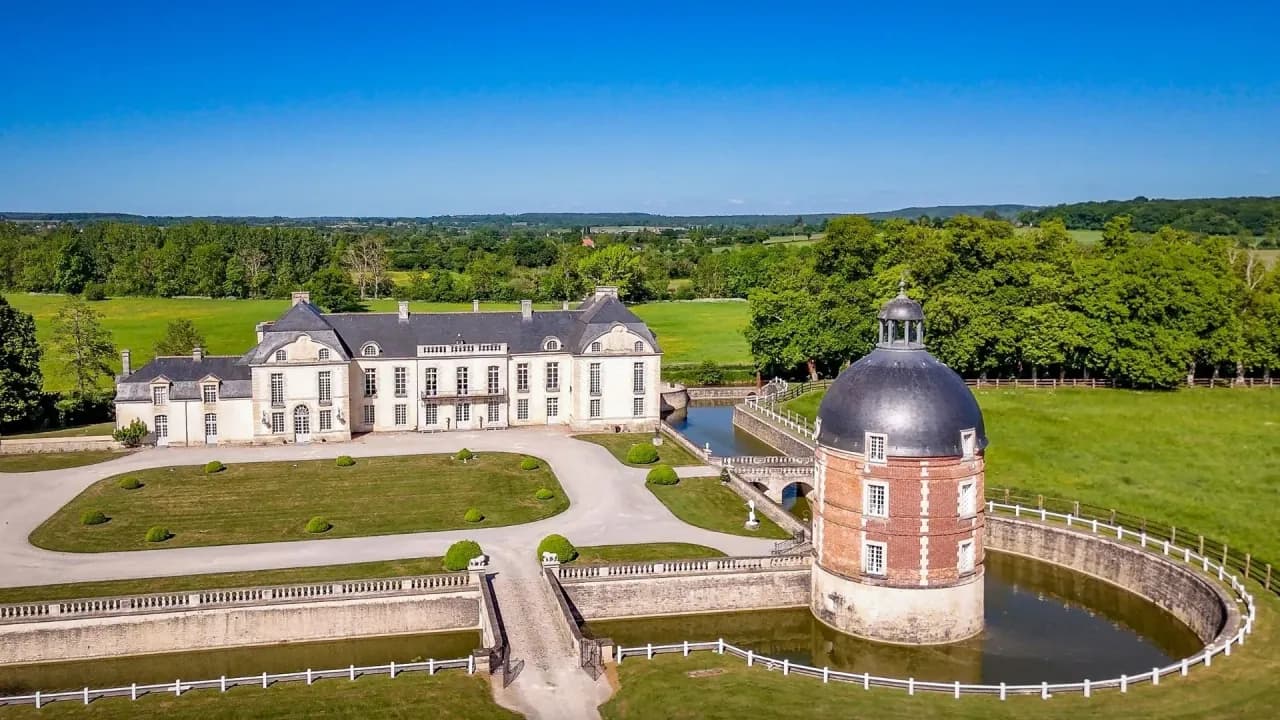
Château de Médavy
Key facts
ProtectionClassé MH
Classé monument historique: the highest level of heritage protection in France, decided by the national government. Any work on the protected parts needs state approval and is supervised by the state heritage services.
About
Built on the ruins of a medieval keep, then enlarged in the 18th century by Thiroux de Montregard, Médavy was home for three centuries to the Rouxel de Médavy family, who gave France two marshals. For some twenty years, Jean-Louis Charon and his wife have been restoring this château in the Orne, in southern Normandy, filling it with atlases, globes and old masters. The fire of September 2025 destroyed two-thirds of it. They chose to carry on and rebuild.
Médavy's origins go back to 1070. But the château owes its look to the Rouxel de Médavy family, who arrived around 1420 and died out in 1728. For three centuries, these governors of the nearby town of Argentan built and rebuilt the house, and gave several bishops to Sées, the neighboring diocese about ten kilometers (six miles) away. Louis XIII had allowed them to raise a regiment, the Grancey regiment, which was usually stationed on the estate.
That regiment is the reason for the present château. Around the 1640s, through a careless accident, the gunpowder stored in the great medieval keep blew up, and the house had to be rebuilt. The map room on the second floor dates from those years of rebuilding and keeps a 17th-century feel. Painted joists in the Moat Pavilion, dated 1615, are the oldest decoration found from the building campaign on the medieval fortress, of which two towers survive. One of them houses the chapel, moved there from inside the fortress walls before 1722. According to the same documents, the stud farm had been built by that date.
The most famous figure of the line is the maréchal de Médavy, whose portrait from the workshop of Hyacinthe Rigaud, the great portraitist of Louis XIV, hung in the map room. Second in command of the French army in Italy, he appears in an engraving of the battle of Cassano, fought in 1705, behind the prince de Vendôme and alongside his younger brother, the marquis de Grancey. His victory at Castiglione, won in Italy in 1706 against the prince of Hesse, earned him the rank of marshal of France under Louis XV.
In the second half of the 18th century, Médavy belonged to Pierre Thiroux de Montregard, superintendent of the postal and relay service of France. He bought up the feudal rights of fourteen surrounding parishes and persuaded Louis XV to raise the estate to a county. The estate map he had drawn up in 1760 shows six hectares (15 acres) of formal French gardens, with flower beds, groves, a maze and a Chinese pavilion.
He added the entrance hall, the dining room, the small Chinese drawing room, the great drawing room and a ceremonial staircase. It is the work of the architect Joseph Brousseau, who built four in the region, the first for the bishop's palace at Sées. The portrait of his wife, the first comtesse de Médavy, painted by Van Loo, turned up by chance at an antiques dealer's. In the 20th century, the général de Grancey, one of Jean-Louis Charon's predecessors, restored the great drawing room. He put back the paneling and had the overdoor panels painted, around an original parquet floor of precious wood marquetry that has become one of the house's emblems.
At Médavy, Jean-Louis Charon, a lover of classical art, and his wife assembled collections set out in the restored rooms. In 2025, the map room held two Coronelli globes dated 1686, from the same period as the pair given to Louis XIV and now kept at the Bibliothèque nationale de France, the national library. The great drawing room displayed a 1619 atlas reproducing the maps of Ptolemy and the Peutinger Table, an ancient Roman road map. It was one piece of a collection of atlases and globes that defines the house. The galleries brought together an Adoration of the Magi by Veronese, perhaps one of the two he is thought to have painted, the one believed lost, a Flight into Egypt by Luca Giordano, a Pietà by Luis de Morales, a Virgin and Child by Perugino and a Virgin and Child carved by Benedetto da Maiano around 1480.
All the chandeliers come from the Hôtel Pozzo di Borgo, a Paris mansion. One guest room is named after Elizabeth II. Its Renaissance Revival bed from the 1840s, in solid walnut, comes from Glamis in Scotland, the castle of the Queen's mother. The Cormeilles Tower, which had collapsed several times, was rebuilt and made livable. The couple lived there for four or five years before they could move into the château.
In 2025, Médavy was "a little less than halfway" through restoring its interiors. The ground-floor gallery was finished, with its guest rooms. The entrance hall, the dining room and the Chinese drawing room were still waiting for their faux marble. In the Moat Pavilion, the painted joists from 1615, found more or less by chance, were due to go to a restoration studio, and the château's own cabinetmaker and joiner was rebuilding the paneling of a future bedroom. Outside, a stone half-circle facing the Orne river, whose existence no one suspected, had been found and restored, and the stud farm was to become an event hall for weddings, banquets and exhibitions.
The great central avenue, closed off during the Revolution, has been reopened: 1.1 kilometers (0.7 miles) long and 27 meters (89 feet) wide, lined with replanted oaks. In the 18th century it was called the avenue d'Ô, because it led to the lands of the marquis d'Ô, a neighbor a few kilometers away.
"The oaks we replanted aren't as mature as two-hundred-year-old oaks yet, but in 200 years, they'll be fine."
Jean-Louis Charon, owner, 2025
In 2025, the château was open year-round by reservation, and for guided tours in July and August. It offered three guest rooms. The park, listed as a historic monument by the French state, keeps features laid out by the Rouxel de Médavy in the days of Le Nôtre, Louis XIV's gardener, later completed by Thiroux de Montregard, and its walks follow the Orne.
The fire at Médavy broke out around 9:30 p.m. on September 24, 2025. Ninety firefighters brought it under control around 5 a.m., with the prefect of the Orne, the state's top official in the department, and the president of the department council on site. The moat, which the insurer had counted as a water source, fed the hoses, and its level dropped by a meter (three feet). A week later, the fire, which had been smoldering between the dining room floor and the next room, flared up again. It was very contained and quickly put out.
A year later, the toll at Médavy is heavy. Two-thirds of the château burned: three-quarters of the third floor and the attic, about 40 percent of the ground floor. The staircase pavilion and the owners' apartment were destroyed, and only the stone held. Three to four months of making the site safe, required by the experts, the insurers and the police, came before an "umbrella" went up at the end of January: a large metal cage that shelters what is left of the stairwell.
In the dining room and the staircase pavilion at Médavy, nothing survived: an exceptional château sideboard, two Atlas figures by Piazzetta, a 16th-century Italian harpsichord, porcelain from the French East India Company, two Venetian statues and two large still lifes. The burned apartment held the 32 maps of the Ptolemy atlas printed in Ulm in 1482.
"Over 22 years, I'd managed to bring together all 32 maps of that atlas. And sadly, all of it burned completely. So I'll never be able to put that set of maps back together."
Jean-Louis Charon, owner, 2026
Beyond that, the fire stopped: at the great drawing room on the second floor, and at the staircase on the ground floor. Working through the night, the firefighters and the château staff carried out most of the furniture, damaged by water, smoke and soot, but not burned. The Jacob armchairs and the Nicolas Sageot wardrobe from the Chinese drawing room are being restored, as is the bed from the Elizabeth II room, which was saved. All the paneling has been taken down to dry. The Moat Pavilion was not touched.
"My wife and I […] decided that life shouldn't stop there, at Médavy."
Jean-Louis Charon, owner, 2026
Despite the financial uncertainty, Jean-Louis Charon chose to keep Médavy's seven full-time employees. In 2026, they are pressing on with the Moat Pavilion, where an elevator will make the château accessible and a fireplace has been rebuilt from drawings by Christophe Amiot, chief architect of historic monuments. They are also finishing the ha-ha, a sunken barrier, at the entrance to the property. After the fire, the DRAC, the regional heritage authority, granted funds to restore the room with the painted ceilings.
The funding comes from the insurance, held with an American company, and from fundraisers launched with the Ministry of Culture, the Fondation du patrimoine, La Demeure historique and Vieilles Maisons françaises, along with a private sponsorship campaign. Médavy was named Normandy's flagship monument for 2026. The timetable announced in 2026: a first phase reopening in summer 2027, perhaps the Moat Pavilion, part of the main building in summer 2028, and the staircase pavilion in 2029.
For future owners
Dreaming of a château like this one?
The founder of So Châteaux has visited more than 500 châteaux in France. He takes no commission on château sales, so he can tell you what he really thinks about any property, completely independently.
See how we help buyersArticles

Gallery
Frequently Asked Questions
The current château was built from 1704 to 1725 by Marshal de Grancey.
About
Built on the ruins of a medieval keep, then enlarged in the 18th century by Thiroux de Montregard, Médavy was home for three centuries to the Rouxel de Médavy family, who gave France two marshals. For some twenty years, Jean-Louis Charon and his wife have been restoring this château in the Orne, in southern Normandy, filling it with atlases, globes and old masters. The fire of September 2025 destroyed two-thirds of it. They chose to carry on and rebuild.
Médavy's origins go back to 1070. But the château owes its look to the Rouxel de Médavy family, who arrived around 1420 and died out in 1728. For three centuries, these governors of the nearby town of Argentan built and rebuilt the house, and gave several bishops to Sées, the neighboring diocese about ten kilometers (six miles) away. Louis XIII had allowed them to raise a regiment, the Grancey regiment, which was usually stationed on the estate.
That regiment is the reason for the present château. Around the 1640s, through a careless accident, the gunpowder stored in the great medieval keep blew up, and the house had to be rebuilt. The map room on the second floor dates from those years of rebuilding and keeps a 17th-century feel. Painted joists in the Moat Pavilion, dated 1615, are the oldest decoration found from the building campaign on the medieval fortress, of which two towers survive. One of them houses the chapel, moved there from inside the fortress walls before 1722. According to the same documents, the stud farm had been built by that date.
The most famous figure of the line is the maréchal de Médavy, whose portrait from the workshop of Hyacinthe Rigaud, the great portraitist of Louis XIV, hung in the map room. Second in command of the French army in Italy, he appears in an engraving of the battle of Cassano, fought in 1705, behind the prince de Vendôme and alongside his younger brother, the marquis de Grancey. His victory at Castiglione, won in Italy in 1706 against the prince of Hesse, earned him the rank of marshal of France under Louis XV.
In the second half of the 18th century, Médavy belonged to Pierre Thiroux de Montregard, superintendent of the postal and relay service of France. He bought up the feudal rights of fourteen surrounding parishes and persuaded Louis XV to raise the estate to a county. The estate map he had drawn up in 1760 shows six hectares (15 acres) of formal French gardens, with flower beds, groves, a maze and a Chinese pavilion.
He added the entrance hall, the dining room, the small Chinese drawing room, the great drawing room and a ceremonial staircase. It is the work of the architect Joseph Brousseau, who built four in the region, the first for the bishop's palace at Sées. The portrait of his wife, the first comtesse de Médavy, painted by Van Loo, turned up by chance at an antiques dealer's. In the 20th century, the général de Grancey, one of Jean-Louis Charon's predecessors, restored the great drawing room. He put back the paneling and had the overdoor panels painted, around an original parquet floor of precious wood marquetry that has become one of the house's emblems.
At Médavy, Jean-Louis Charon, a lover of classical art, and his wife assembled collections set out in the restored rooms. In 2025, the map room held two Coronelli globes dated 1686, from the same period as the pair given to Louis XIV and now kept at the Bibliothèque nationale de France, the national library. The great drawing room displayed a 1619 atlas reproducing the maps of Ptolemy and the Peutinger Table, an ancient Roman road map. It was one piece of a collection of atlases and globes that defines the house. The galleries brought together an Adoration of the Magi by Veronese, perhaps one of the two he is thought to have painted, the one believed lost, a Flight into Egypt by Luca Giordano, a Pietà by Luis de Morales, a Virgin and Child by Perugino and a Virgin and Child carved by Benedetto da Maiano around 1480.
All the chandeliers come from the Hôtel Pozzo di Borgo, a Paris mansion. One guest room is named after Elizabeth II. Its Renaissance Revival bed from the 1840s, in solid walnut, comes from Glamis in Scotland, the castle of the Queen's mother. The Cormeilles Tower, which had collapsed several times, was rebuilt and made livable. The couple lived there for four or five years before they could move into the château.
In 2025, Médavy was "a little less than halfway" through restoring its interiors. The ground-floor gallery was finished, with its guest rooms. The entrance hall, the dining room and the Chinese drawing room were still waiting for their faux marble. In the Moat Pavilion, the painted joists from 1615, found more or less by chance, were due to go to a restoration studio, and the château's own cabinetmaker and joiner was rebuilding the paneling of a future bedroom. Outside, a stone half-circle facing the Orne river, whose existence no one suspected, had been found and restored, and the stud farm was to become an event hall for weddings, banquets and exhibitions.
The great central avenue, closed off during the Revolution, has been reopened: 1.1 kilometers (0.7 miles) long and 27 meters (89 feet) wide, lined with replanted oaks. In the 18th century it was called the avenue d'Ô, because it led to the lands of the marquis d'Ô, a neighbor a few kilometers away.
"The oaks we replanted aren't as mature as two-hundred-year-old oaks yet, but in 200 years, they'll be fine."
Jean-Louis Charon, owner, 2025
In 2025, the château was open year-round by reservation, and for guided tours in July and August. It offered three guest rooms. The park, listed as a historic monument by the French state, keeps features laid out by the Rouxel de Médavy in the days of Le Nôtre, Louis XIV's gardener, later completed by Thiroux de Montregard, and its walks follow the Orne.
The fire at Médavy broke out around 9:30 p.m. on September 24, 2025. Ninety firefighters brought it under control around 5 a.m., with the prefect of the Orne, the state's top official in the department, and the president of the department council on site. The moat, which the insurer had counted as a water source, fed the hoses, and its level dropped by a meter (three feet). A week later, the fire, which had been smoldering between the dining room floor and the next room, flared up again. It was very contained and quickly put out.
A year later, the toll at Médavy is heavy. Two-thirds of the château burned: three-quarters of the third floor and the attic, about 40 percent of the ground floor. The staircase pavilion and the owners' apartment were destroyed, and only the stone held. Three to four months of making the site safe, required by the experts, the insurers and the police, came before an "umbrella" went up at the end of January: a large metal cage that shelters what is left of the stairwell.
In the dining room and the staircase pavilion at Médavy, nothing survived: an exceptional château sideboard, two Atlas figures by Piazzetta, a 16th-century Italian harpsichord, porcelain from the French East India Company, two Venetian statues and two large still lifes. The burned apartment held the 32 maps of the Ptolemy atlas printed in Ulm in 1482.
"Over 22 years, I'd managed to bring together all 32 maps of that atlas. And sadly, all of it burned completely. So I'll never be able to put that set of maps back together."
Jean-Louis Charon, owner, 2026
Beyond that, the fire stopped: at the great drawing room on the second floor, and at the staircase on the ground floor. Working through the night, the firefighters and the château staff carried out most of the furniture, damaged by water, smoke and soot, but not burned. The Jacob armchairs and the Nicolas Sageot wardrobe from the Chinese drawing room are being restored, as is the bed from the Elizabeth II room, which was saved. All the paneling has been taken down to dry. The Moat Pavilion was not touched.
"My wife and I […] decided that life shouldn't stop there, at Médavy."
Jean-Louis Charon, owner, 2026
Despite the financial uncertainty, Jean-Louis Charon chose to keep Médavy's seven full-time employees. In 2026, they are pressing on with the Moat Pavilion, where an elevator will make the château accessible and a fireplace has been rebuilt from drawings by Christophe Amiot, chief architect of historic monuments. They are also finishing the ha-ha, a sunken barrier, at the entrance to the property. After the fire, the DRAC, the regional heritage authority, granted funds to restore the room with the painted ceilings.
The funding comes from the insurance, held with an American company, and from fundraisers launched with the Ministry of Culture, the Fondation du patrimoine, La Demeure historique and Vieilles Maisons françaises, along with a private sponsorship campaign. Médavy was named Normandy's flagship monument for 2026. The timetable announced in 2026: a first phase reopening in summer 2027, perhaps the Moat Pavilion, part of the main building in summer 2028, and the staircase pavilion in 2029.
For future owners
Dreaming of a château like this one?
The founder of So Châteaux has visited more than 500 châteaux in France. He takes no commission on château sales, so he can tell you what he really thinks about any property, completely independently.
See how we help buyersArticles
Gallery
Frequently Asked Questions
The current château was built from 1704 to 1725 by Marshal de Grancey.