
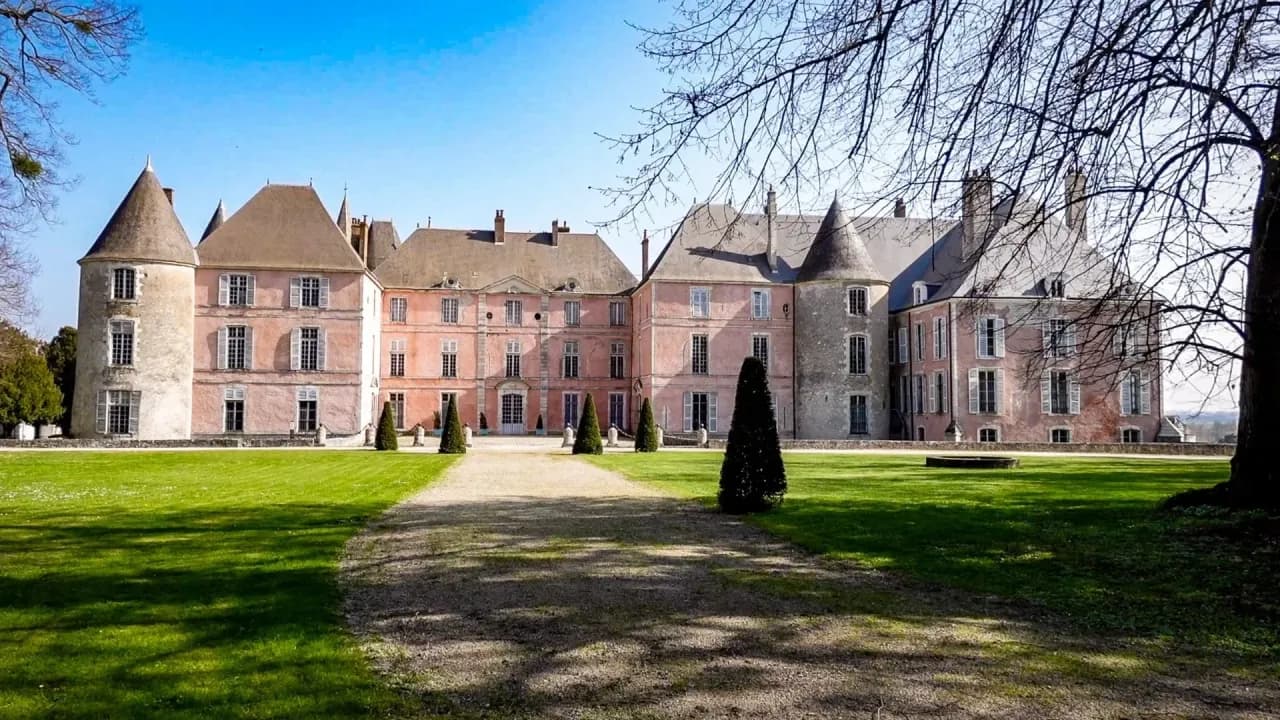
Château de Meung sur Loire
Key facts
ProtectionClassé MH
Classé monument historique: the highest level of heritage protection in France, decided by the national government. Any work on the protected parts needs state approval and is supervised by the state heritage services.
About
For almost six centuries, Meung-sur-Loire was the residence of the bishops of Orléans: a fortress of 1209 visited by Joan of Arc and Louis XI, where the poet François Villon was jailed, then made into a little Versailles by an exiled bishop. On the town side, the château keeps its medieval face. On the park side, it shows a classical facade painted red. Abandoned after World War II, it has been restored for a dozen years by Xavier Lelevé and is open to visitors.
Meung's religious history begins with Saint Liphard, who came as a hermit in the 5th century to the ruins of Magdunum, laid waste by the Vandals, on a site that was probably already sacred to the pagans. Tradition credits him with slaying a dragon and with a spring that restored sight, images of the region's conversion to Christianity. A pilgrimage grew up around his tomb, canons settled there, and the bishops of Orléans made Meung their residence. Until 1791, fifty-six bishops and six cardinals lived here and adapted the place to their needs.
Three castles have stood at Meung, one after another. Of the first, all that is known is that a treaty was signed there in 861. It probably lies buried under the present site. The second, built by Bishop Manassès de Garlande, can be recognized by its two towers set against the porch of the collegiate church. Well equipped, with a monumental fireplace and latrines, it served for only about fifty years before becoming a meeting room, then a courtroom and, in the 19th century, a pigsty. The third, the château that stands today, dates from 1209.
In the Middle Ages, Meung was a stopping place for kings on the move: Charles VII, Louis XI, then Francis I and his mother, Louise of Savoy, all stayed here. During the siege of Orléans, the château served as a rear base for the English. Salisbury, who led the siege, came here and died here. After freeing Orléans, Joan of Arc took back Meung as well.
Originally, the château of Meung was a closed square flanked by four towers. In the 15th century, a new building doubled the central residence. A pavilion raised on a 15th-century base, which still has arrow slits adapted for culverins, early small cannons, held the apartments of Louis XI and those of the bishops. Tree-ring dating has placed the attic roof frame in 1478.
Meung is known as the château with two faces. On the town side, it keeps its medieval look. On the park side, in the 18th century, the square was hollowed out to create a main courtyard in the old moats, flanked by two pavilions, in the manner of the Marble Court at Versailles. The medieval openings were blocked and large windows cut in. A horizontal stone on the second floor still marks the top of the fireplace in the old synod hall.
The classical facade of Meung was painted. Traces of old limewash, protected from the rain behind the shutters, and reused stones found during the work revealed an oxblood red limewash with yellow window surrounds. The château, listed under that name by the French Ministry of Culture, was known as the Red Château. Working with the DRAC, the regional heritage authority, the owners gave the south pavilion back this color, a rare case of a French monument recovering its original paint scheme.
Meung's 18th century belongs to Louis-Sextius de Jarente de La Bruyère, bishop of Orléans and minister to Louis XV, whose portrait by Nonnotte hangs in the library. A close ally of Choiseul, he was confined to his château after the minister fell from favor. He spent his fortune turning it into a little Versailles, amid the brilliant, pleasure-loving society of the other exiles nearby: Choiseul at Chanteloup, not far from Ménars, the château of Madame de Pompadour. He made the south pavilion his residence, with bedrooms, dressing rooms and an antechamber.
On 7 hectares (17 acres) in the middle of town, Jarente laid out a delicate garden at Meung. A LiDAR survey, compared with 18th-century plans, has located the French formal beds, the watercourses and an artificial mountain with cascades fed by a hydraulic machine. At the far end of the park, the architect Le Camus de Mézières built him a music pavilion, now in very poor condition. Around 1780, the same machine supplied the bishop's baths, a rare and well-preserved set of rooms: a changing cabin, a footbath, a large tub with drainage for used water, a boiler room and an alcove where water was poured over heated stones for a steam bath scented with Hungary water, an early perfume.
The neoclassical chapel at Meung, dedicated to the Virgin Mary, probably opened in 1784. Its light wells, square at the bottom and round at the top, and its colonnades were inspired by the villas of Pompeii and Herculaneum, then newly rediscovered. Tradition attributes the painted canvas at the back, with its golden flowers, to Ingres, who lived in Meung for seventeen years, though there is no proof. Jarente died buried in debt in 1788. During the Revolution, the townspeople, who were his creditors, protected the château in order to recover what they were owed. The very detailed revolutionary inventory now tells us what each room was used for.
The underground rooms of Meung, 7 meters (23 feet) below ground, date from the early 13th century. They hold a wine press used until 1940, a cellar where Baron Le Couteulx du Molay, a Napoleonic-era banker who had sold Malmaison to Joséphine, kept Madeira and wines from around the world, and a rib-vaulted storeroom. They also served as a state prison. Churchmen could not shed blood, so interrogation meant forcing the prisoner to swallow pints of water.
Meung's most famous prisoner was François Villon, the poet. Arrested by Bishop Thibaut d'Aussigny, probably for yet another theft, he was tortured and thrown into the cells. In October 1461, Louis XI, passing through Meung at the time of his accession, set him free, perhaps at the request of Charles d'Orléans. Villon then wrote his Testament, where he recalls how harsh his prison was, and vanished in 1463.
"When people talk about the Renaissance, you think the Renaissance starts with men like that, who think about man apart from God. It's almost Baudelaire's spleen before its time."
Xavier Lelevé, owner, 2022
Meung was never a family château. When a bishop died, his property went to the king. Each room had a specific purpose, which the tour brings back to life with more than 2,000 everyday objects. In the 19th century, Baron Le Couteulx du Molay bought the château and fitted out a smoking room in a medieval spirit, with old paneling. The guardroom, more than 100 square meters (1,080 square feet) with no pillars, was meant to impress visitors. The rib-vaulted 15th-century refectory was later left to the servants.
At Meung, the great kitchen has its fireplace back, after it had half collapsed. In summer, a PhD historian cooks old recipes there, drawn from the 150 or so medieval cookbooks, which never give quantities. The apothecary's apartment, from the 15th century and remodeled in the 18th, prepared remedies for the 150 people who lived on the estate. In the attic, reopened after 26,000 new slates went on the roof, the great autumn laundry day is recreated.
"I often say there were two revolutions. There's the French Revolution and the washing machine revolution."
Xavier Lelevé, owner, 2022
Occupied by the German command during World War II, Meung had since been left without a steward and in a dreadful state. As of 2022, its owners had been restoring it for about twelve years. Dry rot had destroyed the floors of the south pavilion, whose restored drawing rooms have become private living spaces. The work is paid for by visitors' tickets, with support from the DRAC and the Loiret department.
"For […] twelve years now, we've had our hearts set on trying to restore this château, to bring back a bit of its splendor, or at least to help it hold its head up again, so we can hand this building on to future generations."
Xavier Lelevé, owner, 2022
In 2022, the Château de Meung-sur-Loire is open to visitors and offers candlelight tours and plenty of activities for children. A 13th-century tower has just received its windows after its cracks were stabilized. The north tower, with no floors left and its fireplaces stolen, is still waiting to be restored.
For future owners
Dreaming of a château like this one?
The founder of So Châteaux has visited more than 500 châteaux in France. He takes no commission on château sales, so he can tell you what he really thinks about any property, completely independently.
See how we help buyersDid You Know?
Villon's prison
The poet François Villon is said to have been imprisoned in the château's dungeons in 1461, on the orders of the bishop of Orléans.
Gallery
Frequently Asked Questions
Because it was remodeled in the 18th century: one facade is medieval, the other dates from the Age of Enlightenment.