
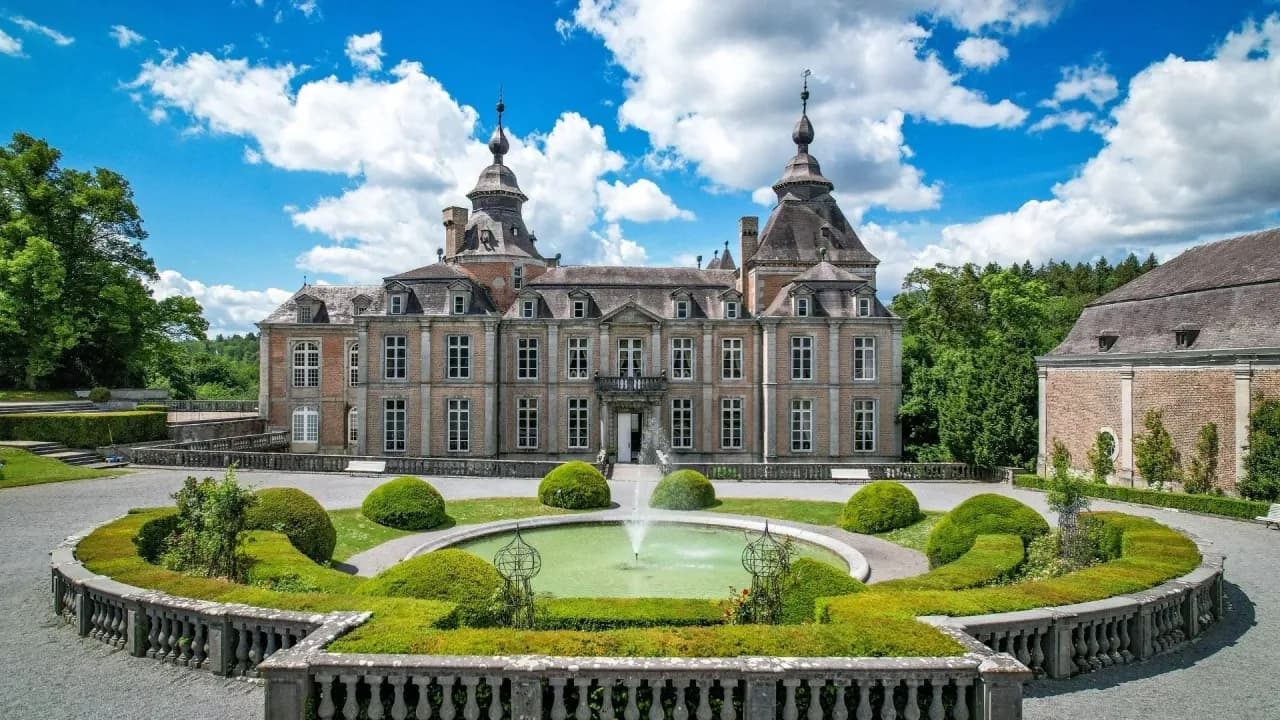
Château de Modave
Key facts
About
An 11th-century keep on a rocky spur above the Hoyoux river became, in the mid-17th century, a showpiece home in French style. Modave is the work of the comte de Marchin, a soldier who returned to his ancestors' land in the principality of Liège, now Belgium. Its stucco ceilings and original furniture have earned it the rank of exceptional heritage of Wallonia. Owned since 1941 by Vivaqua, which draws part of Brussels's water from under the estate, it is open to the public.
Modave owes its look to Jean-Gaspard-Ferdinand de Marchin, who set out in 1653 to turn a ruined fortified keep into a showpiece residence. A military adviser and diplomat in the service of France, close to the Prince de Condé, the great French general, he had made his name in campaigns in France and Spain. Yet when he came home late in his career to the principality of Liège, in what is now Belgium, he was oddly little known on his own lands. Marchin, as it happens, is the next village over from Modave.
The count wanted French classical architecture of the mid-17th century. His only concession to the local style, later called Mosan after the Meuse valley, was the pairing of red brick with Vinalmont limestone, the local stone of the region's buildings. The outbuildings around the inner courtyard and the two neighboring farms date from the late 17th century.
Modave's site was no accident. The Hoyoux, a small river that winds below before flowing into the Meuse, was one of the main routes to the town of Huy and one of the gateways to the principality. A fortified keep went up here as early as the 11th century. The terrace that now overlooks the valley was most likely the fourth tower of the medieval castle. Marchin did not rebuild it, nor an entire side of the inner courtyard. The closed square opened onto nature: defense was no longer the priority.
Modave's largest room, the guardroom, has a ceiling bearing the arms of the comte de Marchin. Across it spreads his family tree, traced back through his ancestors. Little known in his own region, the count wanted to be received with the honors due his rank, so he put his family's nobility on display. The work was done in 1666-1667 by a Dutch stucco artist, Jan Christian Hansche, who worked in several parts of the château.
The room keeps a monumental 17th-century fireplace in black Mazy marble, highly prized at the time because it shows few reflections and few white veins.
At Modave, the tapestry salon is wrongly called the Gobelins salon, so thoroughly did the Paris workshop lend its name to every old tapestry. Its three pieces were in fact woven in Brussels: the lower right corner of the largest one bears the two Bs of Brussels and Brabant. They show the reign of Caesar, who parades his troops in Alexandria to impress Cleopatra, then stands before the head of his rival Pompey. Their place on the north facade, the hardest to heat, is a reminder that a tapestry was first of all insulation.
The stuccowork on the ceiling and the mantelpiece tells the twelve labors of Hercules. The cycle continues in the large dining room next door, where the fireplace shows the hero's marriage.
"Here we have […] very likely […] a little megalomania in the man, since here he's trying to identify with that hero of mythology, Hercules."
Benoit Van Hespen, director, 2021
Modave's dining room is furnished with a set of 18th-century Dutch chairs, their marquetry of flowers and foliage highlighted with mother-of-pearl and ivory. The table holds part of the service ordered from the Gien pottery in the 1870s, with every piece marked Château de Modave, and glassware from Val-Saint-Lambert, the crystal works in nearby Seraing. Some of the champagne coupes are engraved with hunting scenes. In the family salon, wall paintings attributed to a Dutch painter show the countryside around Rome. Most of the furniture belonged to the successive owning families, and very few pieces were brought in from elsewhere.
The Duke of Montmorency's bedroom at Modave served other owners too, but it keeps his name because the alcove furniture dates from his time. Among his countless properties, the duke owned this château in the principality of Liège, and he took refuge here during the turmoil of the French Revolution, together with the comte de Provence. Some historians have concluded that Modave might have served as a fallback during Louis XVI's flight, since the king's brother was staying there at the invitation of the Montmorencys.
The alcove holds a bed and four chairs the duke ordered from Chevigny. It is one of the last known sets by this craftsman, and it keeps its original blue Chinese silk, woven with gold thread. Upstairs, the bedroom of the Duchess of Montmorency, where her portrait hangs, showcases 18th-century French styles. In the music room, known as the Louis XIV salon, the portrait of Baron Arnold de Ville, owner in the first half of the 18th century, is the only surviving portrait of any owner of the château.
In the 19th century, Modave belonged to the Lamarche family. The industrialist, a very powerful man in the Liège area, founded the Ougrée steelworks, which would go on to compete with Cockerill. He bought the château to host hunts and banquets. He also brought back the Far Eastern objects scattered through the rooms, the chinoiseries fashionable at the time, such as the Japanese porcelain vases above the fireplace in the family salon.
Modave's smoking room was not just where guests sipped an Armagnac after dinner. Business was discussed here, and many contracts of the 19th-century Liège steel industry were signed in this room. In the center, an Indo-Portuguese games table has a chessboard inlaid with ivory. Flip the top over and another design appears.
"It really was an estate full of game, and the hunts here had a reputation that reached well beyond the region. So a lot of people dreamed of getting invited by the Lamarches."
Benoit Van Hespen, director, 2021
Modave's grand staircase was the first indoor staircase in the principality of Liège built of stone rather than wood. The comte de Marchin gave it a wrought-iron railing and straight steps 14 centimeters (5.5 inches) high, so that everyone could move up and down with elegance. A 19th-century chandelier in bronze and Baccarat crystal, with sixty lights and weighing about 300 kilos (660 pounds), fills the stairwell. The music room holds a fully restored 1868 Herz piano in rosewood, on which concerts are regularly given. A small 18th-century bathroom keeps its tub carved into the rock.
The comte de Marchin's apartment at Modave was restored in the winter of 2016-2017, after nearly ten years of preliminary studies. In the 19th century, much of the château had been divided up to add bedrooms and bathrooms and put up guests after dinners. The apartment has recovered its 17th-century proportions and revealed a ceiling from 1666-1667 that recalls the count's military career. Because the château is listed as exceptional heritage of Wallonia, the French-speaking south of Belgium, inside and out, every choice was weighed with the heritage commission.
"It's more than likely that here, in the 17th century, there was Cordoba leather. Obviously, it's impossible to cover the walls with Cordoba leather again."
Benoit Van Hespen, director, 2021
Modave's chapel is a Neoclassical building from the 19th century, because the original chapel was burned during the French Revolution. The Neoclassical style is rare for a private chapel. The four Evangelists in its niches, by Luc Fayd'herbe, a pupil of Rubens, had been saved from the fire by the villagers, who brought them back when the chapel was rebuilt.
Since 1941, Modave has belonged to Vivaqua, the company that supplies water to Brussels. It bought the whole estate to protect its water sources. Every day, 60,000 cubic meters (nearly 16 million gallons) of water leave the ground beneath the château to supply the capital. It is the largest underground water source in Wallonia and 20% of the company's output. The estate forms a 450-hectare (1,110-acre) nature reserve, protected under the European Natura 2000 network, in the heart of the Condroz area, about 35 kilometers (22 miles) from Liège.
In 2021, Modave was open to the public every day from April 1 to November 15. Each visitor receives an audio guide for the roughly 25 rooms. Allow a good hour for the interior, plus the gardens and a walk through the nature reserve. The château hosts concerts and shows. For the 400th anniversary of Molière's birth, Le Tartuffe was to be staged here for the whole month of July, in the setting of the apartment of the comte de Marchin, a contemporary of the playwright.
For future owners
Dreaming of a château like this one?
The founder of So Châteaux has visited more than 500 châteaux in France. He takes no commission on château sales, so he can tell you what he really thinks about any property, completely independently.
See how we help buyersDid You Know?
The forerunner of the Machine de Marly
The water wheel installed at Modave around 1668 by Rennequin Sualem inspired the Machine de Marly, which supplied the fountains at Versailles.
Gallery
Frequently Asked Questions
Built on a medieval site, it was rebuilt from 1655 to 1657.