
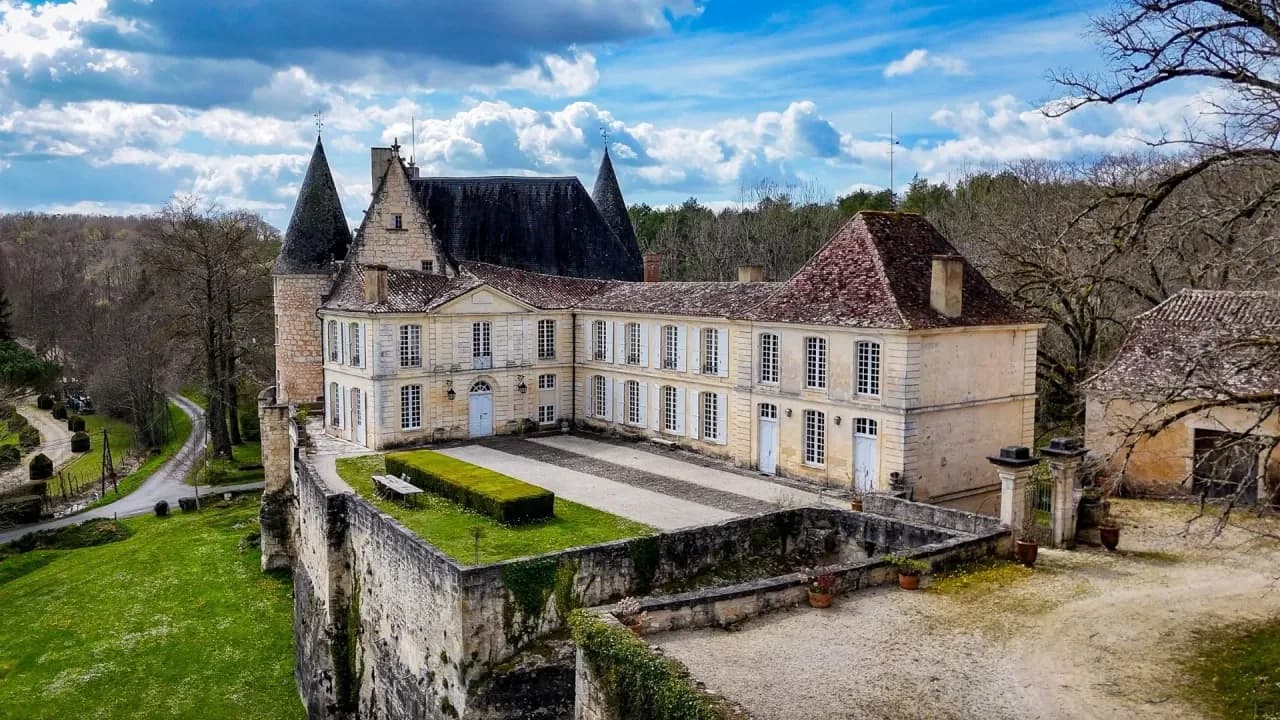
Château de Montastruc
Key facts
ProtectionInscrit MH
Inscrit monument historique: the second level of heritage protection in France, decided by the regional prefect. Owners must notify the state before any work on the protected parts, and the regional heritage authority (the DRAC) reviews it.
About
Montastruc, from the Latin monte astrucus, is the hill under a lucky star: a rocky spur near Bergerac, lived on since antiquity, where caves sit beside a late 13th-century Gothic château and its Louis XV wing in Bordeaux-style stone. Its 1475 roof frame and 18th-century interiors have survived almost intact. Nearly in ruins when Philippe de Fitte and his wife Ségolène, born de Marcellus, bought it in 1998, this Dordogne château has been restored by them ever since.
The rock of Montastruc commands the ancient road that linked Agen to Périgueux, the Roman towns of Agenus and Vesunna, and ran right below its walls. On the plateau where the dovecote stands today are the remains of a Roman lookout post. Lower down, bastions cut and built in terraces enclose a very old cave-dwelling site. Carved into the wall of the main cave is an Earth Venus that archaeologists date to the 5th century: a fertility figure already crowned with a halo, somewhere between druidic heritage and the Christianization of Périgord. A more finely carved fox probably dates from the Wars of Religion, but no written record confirms it.
After the Franks annexed Aquitaine in the early 6th century, the people of Montastruc left the caves and bastions for the tip of the spur. They dug a ravine by hand to cut off that tip, turning it into a rocky island reached by a wooden bridge. Around the year 1000, the log fort gave way to stone, and the oldest wall of the château, under the machicolations, dates from that time. The site keeps its defensive logic: machicolations, openings for dropping missiles, on the side of the road where the enemy was expected, and water-filled moats on the west side to slow attackers down.
From 1280-1300, the lord's château of Montastruc went up at the end of the medieval courtyard: two slate-roofed wings forming an L, joined by a stair tower. A loggia facade, Italian in idea but French Gothic in style, then opened onto the landscape, with ribbed vaults on slender columns and a balcony of stone lace. In the 1430s, Bertrand d'Abzac, the great lord of the place, sided with the English in Aquitaine. Charles VII, as he won back the territory, had him beheaded as an example, then ordered Montastruc destroyed. In the middle of the Hundred Years' War, the men sent to do it simply holed the roofs and smashed whatever broke easily. The balcony ended up in the moat.
Louis XI, eager to restore Aquitaine's trade and tax revenue, ordered by royal letters patent the rebuilding of places damaged by the war. The small budget granted was enough for a massive wall pierced with four mullioned windows, which gives the west facade its stern look. No artists were brought back to rebuild the vaults, of which only the springing stones survive in the present oratory. Later, Montastruc came through the Wars of Religion without major damage, though it was besieged. On Christmas night 1568, Montluc forced the surrender of the Protestants who held it.
The roof frame at Montastruc is one of the few still entirely from the 15th century. The letters between Jeanne de Beynac, widow of Bertrand d'Abzac, and her carpenter survive in the archives. Asked whether she wanted 500-year-old or 800-year-old oaks, she chose the older ones. The trunks, whole trees about 15 meters (50 feet) long, therefore sprouted after the reign of Clovis, the first king of the Franks. Set in place around 1475, the frame has not moved since. In the tower, three stacked platforms bring the forces back to the center, so the weight comes straight down on the walls instead of pushing them apart. When the frame began to lean over the second wing, beams set diagonally stopped it, and that emergency repair has held for more than five centuries.
In the 18th century, Montastruc gained a Louis XV extension and a neoclassical facade with rusticated stonework very typical of Bordeaux. The Gothic stair tower was torn down and replaced by a stairwell with a wrought-iron railing, where the curved imprint of the old spiral stair still shows. The aula, the hall where the lord dispensed justice, became the dining room in the 19th century, and every wing leads back to it. Its paneling has recovered its original color: a limewash in five coats, from very dark blue to pale gray, finished by saponification. In the grand salon, the panels of the four seasons needed no retouching at all once their varnish came off, and the period floor mixes squares of walnut and red pine from southwest France.
Nothing at Montastruc was added after the 18th century, apart from a few marble fireplaces put in around 1860 by the Marquise de Lostanges, who felt the cold. Behind them, the Louis XV or Louis XVI jambs are still there. The gallery leads to the bedrooms of the count and countess, with furniture built into the paneling: the count's writing desk, a linen cabinet. The count's cupboard held the family papers and its feudal rights, still kept by the descendants by marriage of the d'Abzac de Montastruc family. In the basement, the great kitchens, more than 6 meters (20 feet) high under the vault, fed about forty people. The roasting spit still turns, next to the small oven where petits fours, literally "small ovens," were baked.
The portraits in the grand salon at Montastruc belong to the family of Ségolène de Fitte, born de Marcellus. The Count of Marcellus, known as the Blue Man, died in a duel in 1788. His widow, Angélique de Piis, who managed the family lands along the Garonne between Marmande and Bordeaux, was guillotined in Bordeaux in 1793. The local people, whom she had protected, had won a release order from the revolutionary judge in Marmande, but it arrived too late. Her children were saved. Her grandson, Lodoïs de Marcellus, negotiated the purchase of the Venus de Milo and brought it to France, where it was presented to Louis XVIII, who gave it to the Louvre.
At the Château de Marcellus, in the Lot-et-Garonne, a plaster Venus, the first cast the Louvre made to thank the count, stands in the ballroom. There, at 26, Philippe de Fitte noticed four young women at the foot of the statue, posed by their father for a photograph. Four years later he married one of them, Ségolène. For their thirtieth wedding anniversary, he obtained from the Louvre a life-size resin Venus with the exact patina of the original. It stands on the staircase at Montastruc.
"I answer him in the same joking tone: 'Already done,' because right in front of me I see a pair of eyes that just bowls me over. I have absolutely no idea who she is."
Philippe de Fitte, owner, 2025
In May 1940, after Germany invaded Luxembourg, the French secret service spirited Grand Duchess Charlotte and her family out of the country and brought them to Montastruc in two days. They stayed there for several months under French protection, waiting for a way out. Franco's Spain had closed its border, and Salazar's Portugal had forbidden its consuls to issue transit visas. The grand duchess's husband, Félix of Bourbon-Parma, was reunited there with his sister Zita, widow of the last emperor of Austria. Habsburgs and Luxembourgers waited together in the grand salon for rescue, which came from Bordeaux: the Portuguese consul Aristides de Sousa Mendes defied his orders and stamped thousands of visas, which allowed them to reach Portugal in a convoy.
Philippe and Ségolène de Fitte bought Montastruc in 1998, when it was almost in ruins, and launched a major restoration, mostly from 2000 on, working with the French historic monuments service. By 2025 the project has come full circle: work done twenty-five years earlier is now being redone. The family's grand salon has been stripped of its plaster, revealing its medieval ceiling and its great fireplace from 1280. The Louis XIV stables, designed around the use of a carriage, have recovered their pale golden stone. The 18th-century facade on the moat side is still in the state the main courtyard was in back in 1998. Still to be restored are the water system, the moats, the facades along them, the bastions and the caves.
"Being a château owner in 2025 means a lot of sacrifices. […] but at the same time, it brings tremendous joy, including living in a setting like this."
Philippe de Fitte, owner, 2025
Montastruc is a family home whose library has seen many students cram for France's competitive exams. The château is rented out from time to time, especially for weddings, and the dovecote, converted into a bedroom, hosts wedding nights. It opens free of charge to the public on the European Heritage Days, with help from the local book club.
"You have to be passionate and crazy and not too good with numbers. And if you've got all three, it's worth carrying on with this project, hoping the next generations will have the same streak of madness."
Philippe de Fitte, owner, 2025
For future owners
Dreaming of a château like this one?
The founder of So Châteaux has visited more than 500 châteaux in France. He takes no commission on château sales, so he can tell you what he really thinks about any property, completely independently.
See how we help buyersDid You Know?
A grand duchess in exile
During World War II, the château hosted Grand Duchess Charlotte of Luxembourg, who had been driven from her country.
Gallery
Frequently Asked Questions
Built in the 13th century, it was rebuilt in 1475 and then remodeled in the 18th century.