
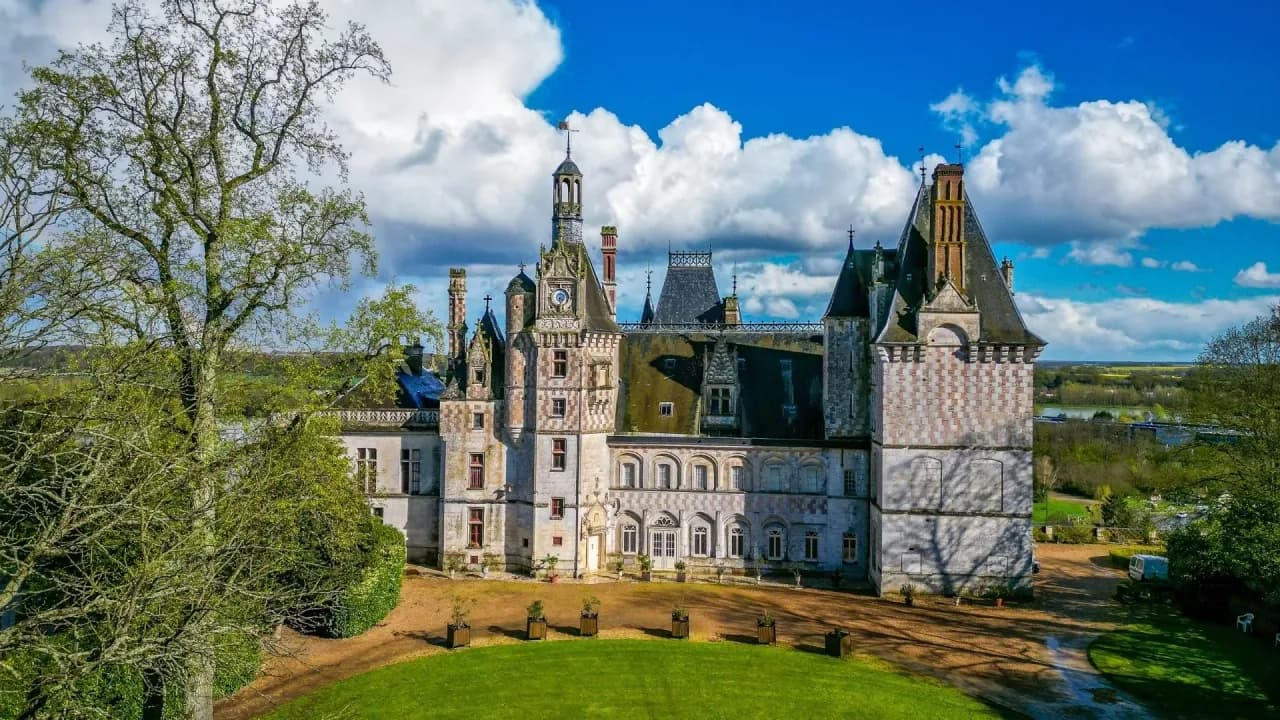
Château de Montigny-le-Gannelon
Key facts
ProtectionInscrit MH
Inscrit monument historique: the second level of heritage protection in France, decided by the regional prefect. Owners must notify the state before any work on the protected parts, and the regional heritage authority (the DRAC) reviews it.
About
Two French kings, Louis XII and Francis I, dined at Montigny-le-Gannelon, and the staircase built to receive them still has a carved ceiling worthy of Blois. Rebuilt in 1495 after the Hundred Years' War, enlarged in the 19th century, this Loire Valley château combines Renaissance towers, a Gothic cloister and drawing rooms full of memories. Heirs of the Montmorency and Lévis-Mirepoix families, owners since 1831, have lived there and shown it to visitors for seven generations.
Several fortresses stood one after another on the site of Montigny-le-Gannelon. In the 12th century, towers roofed with tiles went up here, and the Hundred Years' War destroyed the castle. Jacques de Renty rebuilt it in 1495, with his brother Guyot according to family tradition: two towers, the Clock Tower and the Ladies' Tower, joined by a Gothic cloister. About fifty years later, a second cloister was added, which hides a fine Renaissance dormer window.
The 1495 cloister at Montigny feels like a church, but it is secular architecture. It was originally open: the true wall of the château is the inner one, and on the outside only columns held up the ceiling. In the 19th century, since the French had grown taller, the floor was lowered by three steps so people would stop hitting their heads on the lintels. From the road, you see the facade of the 19th-century restoration. You have to walk around the château and climb the hill to discover the late 15th-century part.
The main staircase at Montigny-le-Gannelon was built for the visits of two kings of France, Louis XII and then Francis I, who came in 1543, two years before his death, according to the family. The quality of its carved ceiling compares with the Louis XII wing of the Château de Blois, one of the great royal châteaux of the Loire Valley: the same artists worked on both. But the decoration stops dead at the upper floor.
"These two kings only came for one meal each. So the beautiful ceiling stops right where you can't see it anymore from the ground floor."
Aymar de La Motte Saint-Pierre, owner, 2023
The stone garland climbs to the second floor, to honor the guests who stayed at the château. The staircase walls hold the portraits of the eleven marshals of the Lévis-Mirepoix family. The first lived under Louis XV and defended Canada against the British during the Seven Years' War, the conflict Americans know as the French and Indian War. His marshal's baton is scattered with fleurs-de-lis. Another, from the 13th century, carries crosses: he was a marshal of the faith, a title given to the family during the crusade against the Albigensians, the Cathar heretics of southern France.
Montigny-le-Gannelon was bought in 1831 by Adrien de Montmorency-Laval, ambassador of Louis XVIII and Charles X. The restored monarchy sent him to Spain to the court of Ferdinand VII, to the Vatican under Pius VII and then Leo XII, who gave the relics of Montigny's church, and to London under George IV and William IV, the uncles of Queen Victoria. His portrait in the full dress of the Order of the Holy Spirit hangs in the dining room. His son Henri died in Italy in 1819, unmarried and childless, so his sister took over and married the Duke of Lévis-Mirepoix. The ambassador's granddaughter, Félicité de Lévis-Mirepoix, died at Montigny at 18.
Both lines left their coats of arms all over the house. The Montmorency arms, a red cross between sixteen small blue eagles, recall the banners brought to King Philip Augustus at the Battle of Bouvines in 1214. Their battle cry, Aplanos, means "without stain" in Greek. The Lévis carry three black chevrons on a gold field and the motto "God help the second Christian Lévis": according to family tradition, a Lévis was the first person baptized after Clovis, the first Christian king of the Franks. In 1895, the Countess of Lévis traveled to Canada for the inauguration of the town of Lévis, on the St. Lawrence River, named in honor of the chevalier de Lévis. A small book preserves the speeches given that day.
For more light and comfort, Montigny-le-Gannelon gained a new château in 1834, built against the old house, which holds the billiard room and the dining room. The huge, larger-than-life portraits had no room in the 1495 château. The Gothic Revival facade was paid for later by the Countess of Lévis, born de Crillon, whose parents lived in the Hôtel de Crillon on Place de la Concorde in Paris, and by her husband. In the dining room, the oak table is edged in black in memory of Louis XVI and the family's ancestors who were guillotined. A marble picture, a puzzle of colored stones, shows its joints only when seen at an angle.
The columned drawing room at Montigny keeps a large landscape painted for it in 1832, a view of Auvergne on the banks of the Allier near Brioude. Its road and its cart seem to turn with the visitor who walks across the room. Two large 19th-century paintings show weddings of the house of Montmorency, that of Mathieu I in 1138 and that of Mathieu de Montmorency in 1221. Madame Récamier, the celebrated Paris hostess, often stayed at the château, and her bedroom still exists on the second floor, which is closed to the public.
The Ladies' drawing room at Montigny-le-Gannelon holds only portraits of women, all ancestors of the family. It has a 17th-century Italian cabinet in tortoiseshell, gilt bronze, ebony and ivory, built like a palace facade. Its doors open onto an inner courtyard staged like a little theater, and secret drawers hide behind the windows. The Louis XVI armchairs are covered in 18th-century Beauvais tapestry based on La Fontaine's fables, and a 17th-century fountain in Nevers faience stands on the mantelpiece.
In the grand salon, the portrait of Lydiane de La Motte Saint-Pierre's great-great-great-great-grandmother has one peculiarity: wherever you stand, her eyes and even her face follow you.
"It's the only room where […] we never dared get up to any mischief, because ever since we were tiny we were told that Bonne-Maman was watching us."
Lydiane de La Motte Saint-Pierre, owner, 2023
When the Prussians set fire to the nearby town of Châteaudun on October 18, 1870, during the Franco-Prussian War, Montigny-le-Gannelon was turned into a hospital. Two paintings in the cloister show Châteaudun's central square. During World War II, while the men were at the front, the women of the family served with the Red Cross and drove ambulances, a memory kept alive by a painting in the Duchess of Lévis-Mirepoix's bedroom.
In 2023, Montigny-le-Gannelon is home to Lydiane de La Motte Saint-Pierre, the seventh generation of the family, who was born at the château, and to her husband Aymar, who has lived there for 45 years. They were married there in 1977. The château is open to visitors. In 1992, the family received the national award for the best welcome in a privately owned historic house. That year, Lydiane de La Motte Saint-Pierre's parents opened a new guest book, shortly before her father's death on August 7, 1993.
"I'm the seventh generation […] and I fully intend to spend the rest of my days here. I can't see myself living anywhere else."
Lydiane de La Motte Saint-Pierre, owner, 2023
The estate includes a large riding hall from the Baltard era, the age of 19th-century iron architecture, with its stables, a former orangery and a small restored drawing room. The church at Montigny, usually open, keeps the relics given by Pope Leo XII and the reliquary of Saint Felicity, considered one of the finest in France.
For future owners
Dreaming of a château like this one?
The founder of So Châteaux has visited more than 500 châteaux in France. He takes no commission on château sales, so he can tell you what he really thinks about any property, completely independently.
See how we help buyersGallery
Frequently Asked Questions
The current château was rebuilt around 1495, in the Renaissance style.