
Château de Pesteils
Key facts
ProtectionClassé MH
Classé monument historique: the highest level of heritage protection in France, decided by the national government. Any work on the protected parts needs state approval and is supervised by the state heritage services.
About
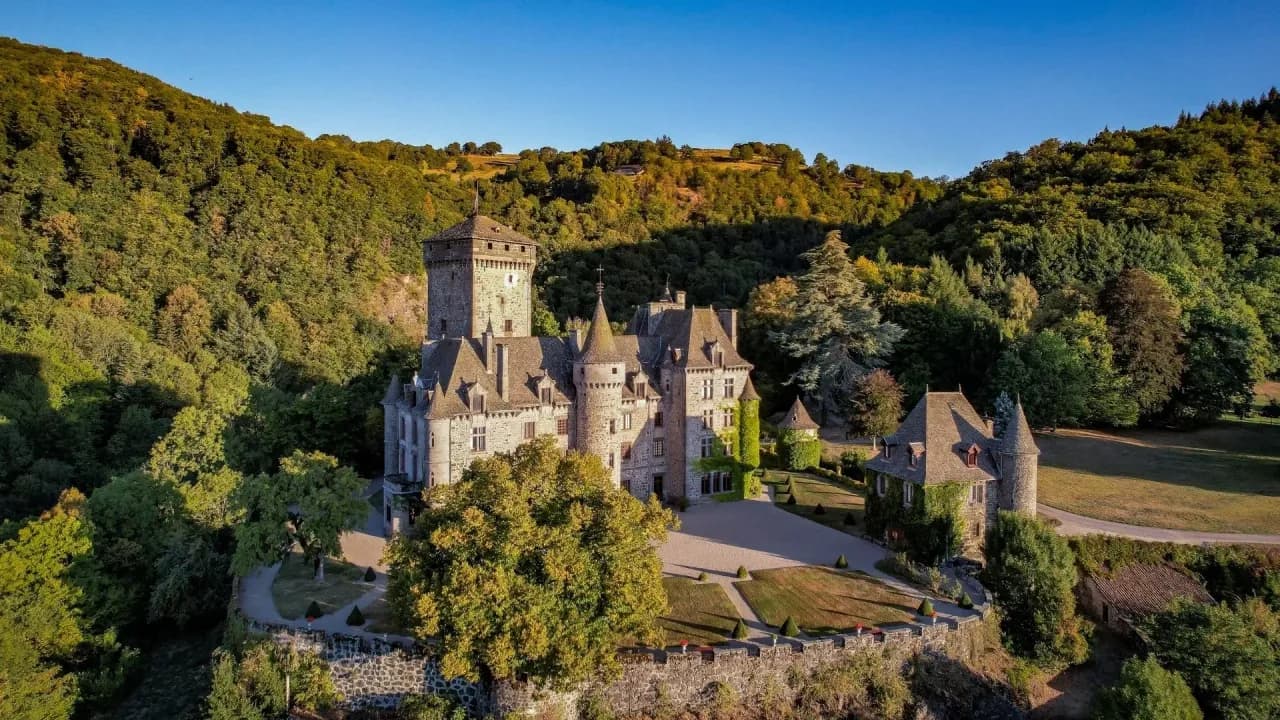
Never sold, only handed down through marriage from one family to the next, Pesteils left its family just once, during the French Revolution. Once the fortress of Polminhac, this mountain château in the Cantal, in the heart of Auvergne, watches over the Cère valley from a 40-meter keep with 15th-century frescoes, amid 19th-century additions. The Cassagnes de Beaufort de Miramon, heirs of the Pesteils since 1608, live here, marry their children here and open it to visitors.
Four families have followed one another at Pesteils, without a single sale: each time, the château passed down through marriage. Above the entrance, a carved tympanum joins the arms of two of them, including the rearing lions of the Montamat family. The Cassagnes de Beaufort de Miramon, who came from the Rouergue, where they owned several châteaux, settled at Pesteils around 1608, when one of them married a young lady of the Pesteils family. Louis XV later raised the Pesteils estate to a marquisate under the name of Cassagnes de Beaufort. The title of marquis is attached to the château, and its archives keep the royal letters that created it.
During the Revolution, Pesteils was seized and sold as national property, and it left the family for about eighty years before an ancestor of the current owners bought it back. The daughters of the house could not always find a match powerful enough to marry, so the family had founded a convent at Vic-sur-Cère for those who took holy orders. In the archive room, set up in the keep, a family tree, manuscripts signed by several kings, passports, estate registers and assignats, the paper money of the Revolution, trace that history.
The keep at Pesteils, the oldest part, rises 40 meters (130 feet) and has about a hundred steps. It was where the local people and the garrison gathered in case of invasion. Under the lord's bedroom, a storeroom held provisions, and the springs on the site supplied water. The fortress of Polminhac went through several sieges. One of them, in 1425, set fire to part of the main building. Until the 19th century the keep stood apart from the living quarters. A footbridge has linked them ever since.
The lord's bedroom at Pesteils keeps two 15th-century frescoes: the Four Worthies, the heroic knights often painted in keeps of the 14th and 15th centuries, and the master and his pupil. They were already retouched in 1913, to the taste of the day, with captions and small, very precise flowers, and they were copied for the Musée des Monuments français at the Trocadéro in Paris. When they had to be restored because they were fading to white, the question arose: go back to the 15th century, or restore the early 20th-century version? A small star was discovered during that work. Higher up, a guardroom could take a removable ceiling set on pillars, to pack in more people. The second floor, once a guardroom, became a chapel in the 19th century, furnished with the prie-dieux of the marquis de Miramon, brought from the church of Polminhac. At the top, the wall walk takes in the Cantal mountains and the Cère valley, which the château was built to protect.
Two bedrooms on the second floor at Pesteils were redecorated in the early 17th century. The arms of the Miramon and the Bardonnin de Sansac families, joined by marriage, date their painted ceilings to around 1608. The first shows Fame, with hair turned into snakes, surrounded by the Miramon daughters who became nuns. The second shows Icarus fallen into the Aegean Sea after flying too close to the sun, beneath a frieze of flowers. Remains of other painted ceilings, from two rooms removed in the 19th century, can still be seen in the staircase. In one bedroom, a portrait of the owner's husband's aunt, who entered a convent very young, shows her dressed for her last ball. Pieces of that outfit, including the fan, were recently found in a trunk.
In the late 19th century, Pesteils was transformed by massive works led by the architect Émile Lemaigre for the marquis and marquise de Miramon. Two wings were added on either side of the main house. The Gothic Revival entrance hall replaced an old kitchen. To fit the double spiral staircase, two floors of bedrooms had to be removed and the bedrock dug out, and the rock is still visible. A painting shows the ceremony that launched the works, with the prefect, the bishop of Saint-Flour, the architect and the Miramon family.
"The grandparents had put a little bit of gold in the foot of one of the buildings. And I can tell you that all the children of every generation, my children, my grandchildren, everybody went at it with a pickax, absolutely terrifying, but nobody ever found a thing."
Yvonne de Miramon, owner, 2022
The guardroom at Pesteils, the oldest part of the main building, was pierced in the 19th century with Orientalist openings leading to the new wings. Its fireplace was moved to the dining room, and its paneling, designed by an architect from Aurillac, bears the Miramon arms. The great drawing room, in a wing that was rebuilt from scratch, was only finished around 1913. Its Art Nouveau decor of twisting roots depicts the five senses. Its 15th-century fireplace comes from Branzac, another Pesteils château, now in ruins.
The entrance hall at Pesteils displays a 16th-century tapestry, Judith and Holofernes, found by chance in the carriage house, where it was covering an old horse-drawn carriage.
"It was covering an old horse-drawn carriage, like it was some ordinary tapestry, when actually it was a beautiful 16th-century tapestry."
Yvonne de Miramon, owner, 2022
The great drawing room at Pesteils brings together a portrait by Dubufe, painter of Empress Eugénie and of the tragic actress Rachel, two paintings by Carle Van Loo and a copy after Élisabeth Vigée Le Brun: a cousin of the family took the original. Wax figures from the Musée Grévin, the Paris wax museum, donated by the museum in Aurillac when it closed, re-create a scene with Lafayette that took place at Pesteils. Others bring the chapel and the kitchen to life.
During World War II, Pesteils served as a set for the movie L'Éternel Retour (The Eternal Return), directed by Jean Delannoy from a screenplay and dialogue by Jean Cocteau, starring Jean Marais and Madeleine Sologne. A room in the keep is devoted to it, with thank-you letters from the cast and crew for the welcome they received. The family knows little more: no one from that time is left to tell the story. The château has hosted other movie crews since. One of them redecorated one of the bedrooms with painted ceilings about fifteen years ago.
The kitchen at Pesteils, created around 1900, was in use until 1995. It was restored exactly as it was and in 2002 won the La Cornue prize for the most beautiful kitchen of the year. It has a cantou, the traditional open hearth of the Cantal, with wooden benches that stored the salt, where the grandmothers sat. There is also the old range, the pipes of the water tank, the servants' bells and the scullery. The liveries on the wax figures, found in storage, have buttons bearing the Miramon arms. The hand-cranked service elevator from the late 19th century still works.
In 2022, Pesteils is the only château the Miramon family still owns. They live here and open it to visitors. The Gothic Revival dining room, furnished in Aurillac for the château, and the family sitting room stay private. The chapel and the château still serve for the big moments of family life.
"We baptize our children in the chapel. We marry off our children here very regularly."
Yvonne de Miramon, owner, 2022
For future owners
Dreaming of a château like this one?
The founder of So Châteaux has visited more than 500 châteaux in France. He takes no commission on château sales, so he can tell you what he really thinks about any property, completely independently.
See how we help buyersGallery
Frequently Asked Questions
Its keep dates from the late 14th and 15th centuries, with the residence enlarged in the 17th century.