
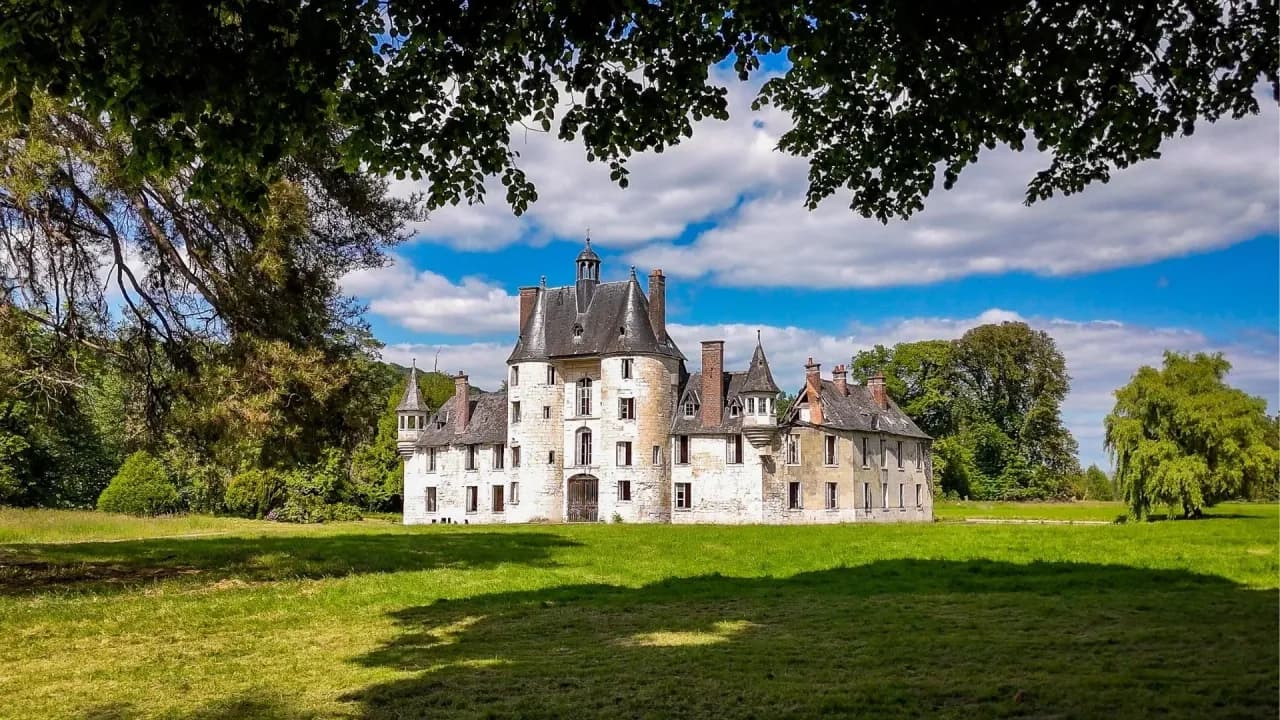
Château de Pont Saint-Pierre
Key facts
ProtectionNon classé
The château is not protected as a historic monument (MH, monument historique) by the French state.
About
Five centuries standing, then twenty-five years of neglect nearly finished off Logempré, a small moated château built around 1490 of white Seine stone and flint, on a site long fought over by the Normans and the English. Stripped of its interiors and left without upkeep, it saw its roof frames collapse one by one. In late 2023, Kristell Chedru and her husband Antoine, a farmer in Pont-Saint-Pierre, bought it to save it, backed by an association of Andelle valley locals.
The main house of Logempré as it stands today dates from the late 15th century, around 1490, on the threshold of the Renaissance. But a castle already stood on the site by 1200. It sat on the border between the duchy of Normandy and England. It fell to the English and was taken back twice by the French, and it was burned and rebuilt several times, because in those days castles were burned to be retaken.
The barons of Pont-Saint-Pierre, lords of the estate, were close to the kings of France. For one of those rebuildings, Charles V granted them a loan of 20,000 gold francs. Later, in 1590, Henry IV stayed at Logempré when he came to accept the surrender of Pont-de-l'Arche. Local tradition still wonders whether his mistress Gabrielle d'Estrées came with him, though nothing confirms it.
Logempré is built of the stone typical of the Seine valley: a very white limestone studded with flint, quarried from the cliffs nearby, very strong and very hard to carve. A few sections are in softer stone from the Oise. There is no half-timbering on the outside. The château's original defensive purpose shows in these stone walls, in the two big towers that frame the entrance and in the moat that rings the building. The central porch was cut wide enough for carts.
Plans from 1725 show a square courtyard closed by a fourth wing. That wing disappeared between the 18th and 19th centuries, for reasons still being studied. A fire is one possibility, since the neighboring wing was entirely rebuilt while the other still has its original half-timbering on the courtyard side. It was also the era when fortified castles were becoming country houses, and courtyards were opened up to look out on the park. The facades therefore mix the late 15th century with 18th- and 19th-century repairs. Beneath the corner turret, which looks 19th-century, the foundations go back to the 15th century.
Logempré is a small château and was never designed for vast spaces. On the second floor, the old chapel still shows its past: a pointed-arch window, later replaced by a rectangular one, and above all a floor of decorated tiles typical of the Pré-d'Auge workshops in the 15th century. The owners want to keep and restore them, and one day give the window back its pointed arch. Beyond the chapel, a long row of connecting rooms probably held a bedroom and a sitting room.
The kitchens and the old dining room were on the ground floor. An 18th-century staircase, which the new owners hope to save, leads to the upper floors, now too dangerous to walk through. Archival records make it possible to piece together how some of the rooms were used, and the friends of the château association is preparing a book on the history of the site.
Logempré was lived in until at least 1998, perhaps until 2001. It then belonged to a major industrial family from northern France, which sold it in 2001 to a real estate developer that wanted to divide the park into building lots. The project never went through, which saved the park, but the château was left to itself. Before it was abandoned, all its interiors, fireplaces and paneling were removed and probably sold. The parquet floors and the tiles were torn out and the floors dug out below their level, which weakened the structure.
In the 2000s, part of Logempré's roof was stripped to be redone. The work was never finished, and the frame was left under a tarp, which gave way after two or three years. Water got in, and the roofs that were still sound, with no upkeep, followed.
"All this damage happened in 25 years, which is really, really fast, when you think this château has been here for 500 years and in 25 years it can be brought down."
Kristell Chedru, owner, 2025
Kristell Chedru and her husband Antoine, a farmer who worked the neighboring land, bought Logempré in late 2023, when the château came up for sale. The roof frames were still holding. Three weeks later, a first section collapsed, then another at Christmas. Masons and roofers, called in to tarp and prop it up, judged the structure too unstable to work on without a major project.
"I'll let you imagine the shock of showing up one morning, looking at the château, and seeing a hole in the middle of the roof."
Kristell Chedru, owner, 2025
A heritage architect assessed which parts of Logempré were stable and which were not. The rescue plan has two stages. First, take down what is falling or about to fall, set aside the pieces that can be reused, and brace the walls with wall plates and props. Then make the building weathertight, rebuilding the roof frames and laying a natural slate roof, with the windows closed off by temporary structures. The moat complicates the work: cranes and lifts have to operate from outside before small machines can get in through the porch. This structural work comes to about €500,000, out of an overall budget of €1.6 million that includes restoring the outbuildings.
The château is not listed as a historic monument at any level, which means it gets no state funding. In 2025, Logempré was selected by the Mission Bern, the national program that funds endangered heritage through a special lottery, as a flagship site for Normandy, for its state of danger, its long-term plan and the community gathered around it.
"Every day counts, and the château can't go through one more winter without help."
Kristell Chedru, owner, 2025
Logempré's moat is full of fish, because its water keeps moving. It is fed by a canal dug in the 19th century, when fulling mills were multiplying along the Andelle, to regulate water power and sluice gates. The canal runs higher than the river and spills into the moat, which flows on into the Andelle, a trout stream. The park covers 23 hectares (57 acres): two large meadows on either side of the château, the canal, a stretch of forest, wooded and grassy areas, and the outbuildings. Deer are regular visitors.
Logempré's orchard, whose apple trees had long gone unpruned, was brought back during a training day led by the pomological association of Haute-Normandie. Since 2024, it has produced the château's own apple juice. A grapevine runs along the south-facing cob wall, which the association plans to shore up in 2026, where lime trees knocked it down.
Kristell Chedru and her husband's plan rests on Logempré's outbuildings, separate from the château's old farm. The small chapel is to become a welcome space for visitors, the cart shed a seminar room, the old cider press a reception hall for private and corporate events, and the stables vacation rentals. The gamekeeper's and river warden's house already has a new roof and small-paned windows, painted the rusty red of traditional Norman houses. A mid-20th-century swimming pool, a tennis court and one of the first padel courts in the Eure, built between 2000 and 2010, complete the estate.
In June 2024, the owners founded an association, which had 150 members in 2025, 80 percent of them from the village and nearby towns. Since only specialized firms can work on the château itself, its volunteers take on projects in the park, the orchard and the outbuildings, including the frame and roof of the pool house. In 2025, a fundraiser for Logempré opened with the Fondation du patrimoine, France's national heritage foundation.
For future owners
Dreaming of a château like this one?
The founder of So Châteaux has visited more than 500 châteaux in France. He takes no commission on château sales, so he can tell you what he really thinks about any property, completely independently.
See how we help buyersGallery
Frequently Asked Questions
The current château dates from the 15th century, built on a much older fortified site.