
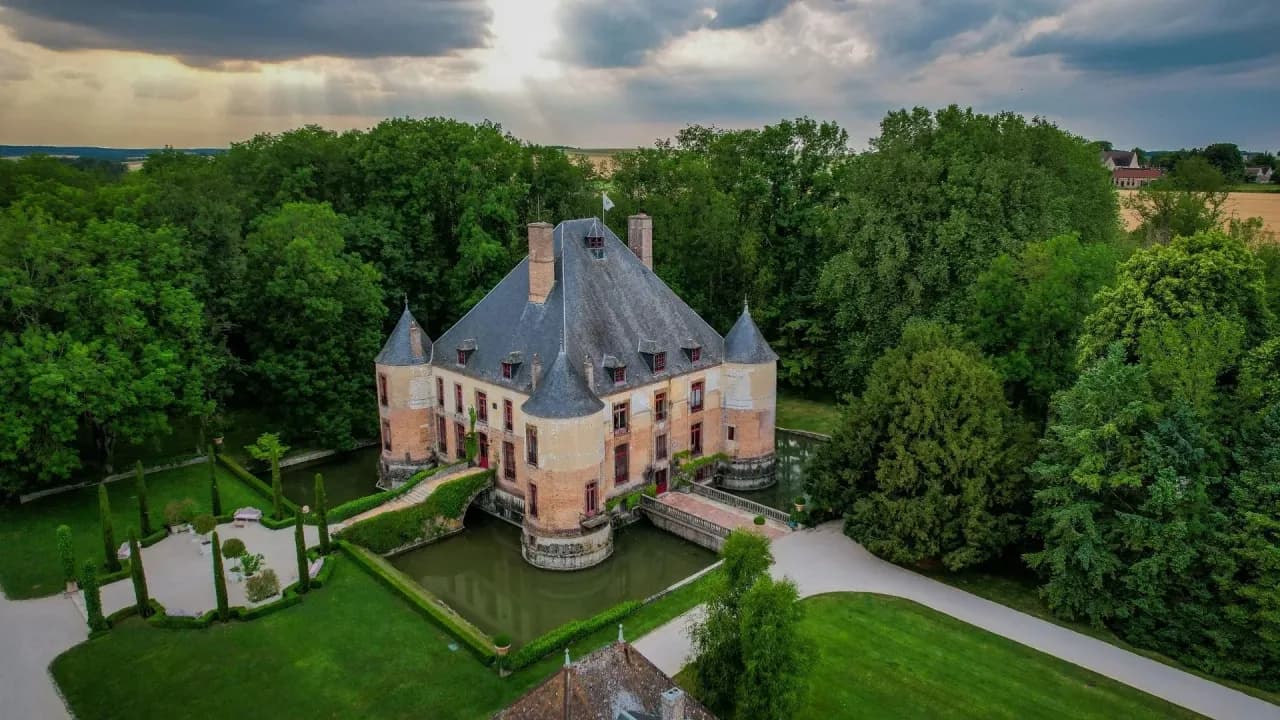
Château de Pouy-sur-Vannes
Key facts
ProtectionInscrit MH
Inscrit monument historique: the second level of heritage protection in France, decided by the regional prefect. Owners must notify the state before any work on the protected parts, and the regional heritage authority (the DRAC) reviews it.
About
A cube capped by a tall tiled pyramid and flanked by four towers, Pouy-sur-Vannes wears eight centuries of history on its facades, from a 12th-century fortress built to defend Sens to the changes of the 17th and 18th centuries. Home of the Le Bascle d'Argenteuil family, then a hotel of the Legion of Honor, this château in the Aube was bought by the interior designer Juan Pablo Molyneux. He restored its 18th-century plan and decorated it as his own home.
The oldest parts of Pouy-sur-Vannes go back to the 12th century, to a fortress built to defend Sens, about 20 kilometers (12 miles) away. Local tradition links it to the Knights Templar. At the foot of the château, the stone base of the walls rises straight out of the moat, and the vaulted cellar is still called the Templars' Hall.
Sens was then one of the major cities of the kingdom. Driven out of Rome, Pope Alexander III lived there for three or four years, and Pouy keeps the memory of his visit. In August 1239, Saint Louis, King Louis IX, received Christ's Crown of Thorns at Villeneuve-l'Archevêque, four kilometers (2.5 miles) away, and the château's lore holds that he stayed at Pouy for the occasion.
The facade of Pouy-sur-Vannes reads like a cross-section of time. Above the medieval stone comes a section of brick, still part of the fortress. The upper story dates from the 15th and 16th centuries, and the great pyramid roof from the late 16th or early 17th century. The windows were cut in the 17th century, with a few added in the 18th.
Pouy's facades were once faced with dressed stone, lost over the centuries to fires and wars. Clues remain: a walled-up window in a tower, framed in stone, corner quoins, and two pilasters with small neoclassical capitals around one opening. The facade still carries the arms of the Le Bascle d'Argenteuil, marquis d'Argenteuil.
"It's extraordinary to be able to see all these 800 years of history in this house, in the facade. It's like the face of a very, very old person who is still beautiful."
Juan Pablo Molyneux, owner, 2023
Pouy-sur-Vannes belonged to the Le Bascle d'Argenteuil family, whose last member at the château was governor of Troyes in the 18th century. The interior layout of that period, a governor's residence, served as the reference for the recent restoration.
In the 20th century, the comtesse de La Noë left Pouy to the Legion of Honor, France's highest order of merit. The château became a hotel for members of the order, where weddings were also held. To make it pay, the rooms were partitioned: there were seventeen bedrooms and several restaurant rooms, and guests came in by a staircase that ran down the central gallery.
Juan Pablo Molyneux, a Chilean-born American interior designer, bought Pouy-sur-Vannes from the Legion of Honor and moved in with his wife in the early 2010s. The decision came during a visit to the attics, still covered in earth.
"It just clicked. Right here I picked up my phone, I called my office in Paris, and I said: Make the offer!"
Juan Pablo Molyneux, owner, 2023
The work at Pouy took eighteen months and involved about a hundred people. The partitions came down and the 18th-century plan was recovered. Two doors were cut through very thick walls to connect the salon with the library and the entrance with the dining room, and the seventeen bedrooms became five, each with its own dressing room. The 17th-century floors were kept. Radiant floor heating, full insulation of the attics, where daylight once showed through the roof tiles, and an elevator rising from the kitchen give the house a comfort its owner describes as strongly influenced by the American model.
Rather than replace the damaged decoration, Pouy kept it. The paneling in the entrance hall was repainted in four shades of gray. The late 17th-century paneling in the salon, which the restorers consulted judged beyond saving, was sheathed in silk velvet, moldings and all. The library, a former dining room painted pink, received faux wood and panels of Cordoba leather. In the dining room, the missing moldings are painted in trompe-l'oeil, next to a deliberately clumsy faux marble and a carefully done faux porphyry.
The furniture at Pouy-sur-Vannes mixes the centuries. The entrance hall brings together a portrait of the Duchess of Orléans by Rigaud and a red lacquer chinoiserie commode by the cabinetmaker Riesener. Other pieces by Riesener, including a commode with a royal provenance, furnish the main bedroom. The salon holds a Louis XIV desk, an armchair from Versailles and a painting by a 16th-century German artist. It belonged to Madame Royale, Louis XVI's daughter, and stayed with her all her life after she arrived in Austria.
In the library, a piece by the cabinetmaker of Louis XVI's library at Versailles stands next to a table by Renzo Mongiardino whose sides reproduce Michelangelo's design for the facade of San Lorenzo in Florence, never built. One tower is painted with panels in the manner of Josep Maria Sert, on the theme of hot-air balloons. The walls hang with works by Lurçat, Cocteau and Picasso. Under the roof frame, fabrics reproduce Piranesi's Prisons, engraved around 1750, at the scale of the real beams. The attics hold a studio, a bar, a table for forty and some thirty speakers.
"It's the mix of someone who lives here. It's not a museum, it's not a historical restoration."
Juan Pablo Molyneux, owner, 2023
The four towers of Pouy-sur-Vannes, little used until then, were stripped back to the stone. One holds an office, another a breakfast room under a small dome of local stone, and the others bedrooms. In a guest room, a stone left bare carries the signature of Gustave Eiffel.
Beneath the château, Pouy's Templars' Hall lines up six vaulted bays, lit by windows at the level of the moat. A door opens onto a small landing stage. The owner and his wife hold their Christmas lunch there. In 2023, the moat and the nearby river were due to be drained so that the 12th-century foundation walls could be repaired.
The Pouy-sur-Vannes estate has about 60 hectares (150 acres) of forest, battered by recent storms and replanted. Facing the south entrance, a terrace is decorated with obelisks given by the town of Pietrasanta, in Tuscany. An avenue of plane trees leads between the pond and the woods to the entrance gate. Beyond, the church path leads to the château chapel, opened about twice a year for a Mass or a wedding.
Pouy's outbuildings have changed use. The longhouse, a former chapel that became the estate manager's house, holds an apartment, the one Juan Pablo Molyneux lived in during the work. A barn houses a spa, a gym and an indoor pool. A former parking lot, freed of a concrete slab about a meter (three feet) thick, has become a French formal garden, and two tennis courts, one grass and one clay, open onto the grounds without fencing. The garden's trees were all planted after the owners arrived. In 2023 an alley of green arches and a reflecting pool were in the works, and peacocks roamed freely in an enclosure.
In 2023, Pouy-sur-Vannes is the private residence of Juan Pablo Molyneux and his wife. The château is not open to the public, though its owners sometimes show it to visitors who ask.
For future owners
Dreaming of a château like this one?
The founder of So Châteaux has visited more than 500 châteaux in France. He takes no commission on château sales, so he can tell you what he really thinks about any property, completely independently.
See how we help buyersGallery
Frequently Asked Questions
It was built in the early 17th century by Hector de Saint-Blaise.