
Château de Puymartin
Key facts
ProtectionPartiellement classé MH
Only some parts of the château (for example a facade, a roof, a room or the gardens) are classé monument historique, the highest level of heritage protection in France. The other parts have a lower protection or none.
About
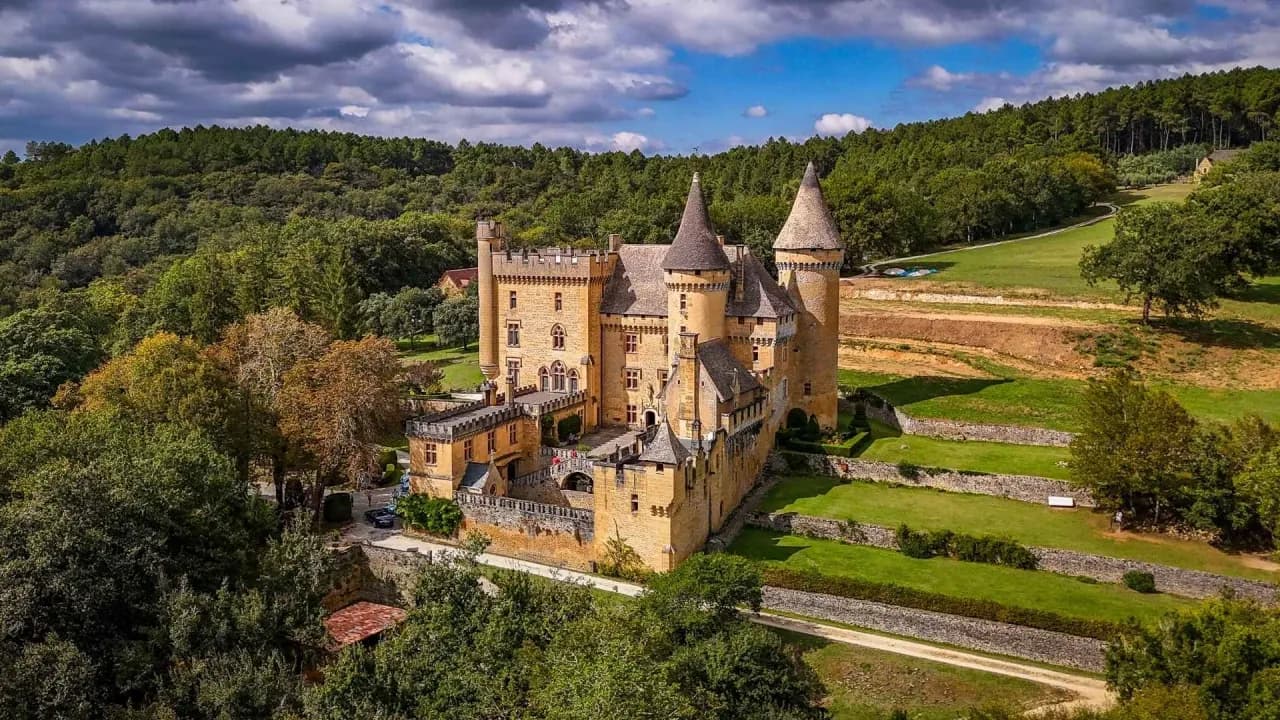
Never sold since it was rebuilt around 1450, at the end of the Hundred Years' War, Puymartin raises its storybook towers in the Périgord Noir, a few kilometers from Sarlat. This Dordogne château keeps a mythological cabinet painted in 1679, one of the few in France, 17th-century tapestries and the legend of its White Lady. The family that inherited it still lives there and has opened it to visitors since the early 1970s.
Puymartin's origins go back to the 13th century, but most of the château you see today dates from the 15th, 16th and 17th centuries. Radulphe de Saint-Clar rebuilt it in 1450, at the end of the Hundred Years' War. It has never been sold since. The house has passed down by inheritance, from the Saint-Clar family to the Carbonnier de Marzac family, then to the Chérade de Montbron family.
In the 16th century, during the Wars of Religion between Catholics and Protestants, Raymond de Saint-Clar made Puymartin a Catholic stronghold. He drove back the Protestants and helped retake Sarlat from the Huguenots. In the following century, a forty-year quarrel pitted Suzanne de Saint-Clar against her brother Jean before she became the owner of the château.
With its towers and pointed roofs, Puymartin looks like a château out of a storybook. It owes that partly to the 19th century, when the marquis Marc de Carbonnier de Marzac carried out major restorations in the Gothic Revival taste of his day. These successive campaigns, and upkeep that has never stopped, explain the château's excellent condition, which visitors notice as soon as they arrive.
Puymartin has remained a château on a human scale. The family lives in a small part of it and looks after the whole place day to day.
"You can feel it's a living château. It's not a museum, we live in it."
Bernadette Rouchon, co-owner, 2025
Puymartin's rarest room is its mythological cabinet, a small private room on the second floor. In 1679, the painter Philippe Lemaire, from Laon, covered eight wooden panels here with mythological scenes painted in grisaille, shades of gray, after engravings from a book published in 1655. The patron may have been Henry-Claude de Lapleynie, abbot of Puymartin, though the question has not been settled. Very few rooms of this kind exist in France.
The cabinet at Puymartin has been listed as a historic monument by the French state since 1977, as a 17th-century paneled room. The château itself has been on the supplementary heritage register since 1948. In 2025, the painted panels left for restoration at a workshop in the Maine-et-Loire, with help from the Fondation du patrimoine. A reproduction lets visitors see the room until their return, expected before the end of the year.
The great hall at Puymartin is hung with a set of 17th-century tapestries. They came to the château in the dowry of a family ancestor, a daughter of Scipion Sardini, a financier of Tuscan origin, and Isabelle de Limeuil, a former maid of honor to Catherine de' Medici. The château has also kept its archives and furniture for centuries.
Puymartin's legend goes back to the late 16th century, during the Wars of Religion. As the story goes, Thérèse de Saint-Clar was caught by her husband in the arms of her lover. She saw the lover put to the sword, then was locked in a small room in the north tower for the rest of her days. Her ghost, the White Lady, is said to have haunted the château ever since.
At Puymartin, nobody laughs it off: the father of the present family said he had seen her several times. When the château still offered two guest rooms, a guest staying below the White Lady's room said she saw a white figure along the ceiling joists on the fourth night of her stay, while her husband saw nothing. Many visitors arriving in Sarlat ask for the White Lady's château rather than for Puymartin.
"She's not an evil spirit. She watches over the château, after all, and in the end she gives the château good publicity."
Bernadette Rouchon, co-owner, 2025
Because it welcomes the public, Puymartin must meet French safety rules for buildings open to visitors: emergency lighting, fire extinguishers checked every year, and an annual inspection of the electrical system, which was recently brought up to code. The château has fire detection linked to a remote monitoring service. A few months before the 2025 drill, sanding a wall was enough to set off the alarm and send out the fire crews, who were called back at once when the owner phoned.
The Sarlat firefighters know Puymartin well. They hold its emergency response plan, with access routes for their trucks, water points and power shutoffs, and they come here for drills. The cultural property safeguard plan, drawn up by the family, sets the top priority: the mythological cabinet. It cannot be moved, so it must be protected in place with fire-resistant tarps before the works on the ground floor are evacuated. The facades can be reached by an aerial ladder, an advantage not every château in the Périgord has. The main circuit breaker, at the top of the keep, is one of the things that still needs improving.
Puymartin has been open to visitors for about fifty years, since the early 1970s. In 2025, the château also offers summer events, costumed theatrical tours and an escape game built around the White Lady and the knights. Above all, it remains a family château, one its owners intend to keep.
For future owners
Dreaming of a château like this one?
The founder of So Châteaux has visited more than 500 châteaux in France. He takes no commission on château sales, so he can tell you what he really thinks about any property, completely independently.
See how we help buyersDid You Know?
The White Lady
According to legend, Thérèse de Saint-Clar, a 16th-century châtelaine, was locked in the north tower for sixteen years for adultery; her ghost is said to haunt the château.
A filming location
Ridley Scott shot interior scenes there for his 1977 movie The Duellists.
Gallery
Frequently Asked Questions
A small study painted in grisaille in 1679 by Philippe Lemaire, depicting mythological scenes.