
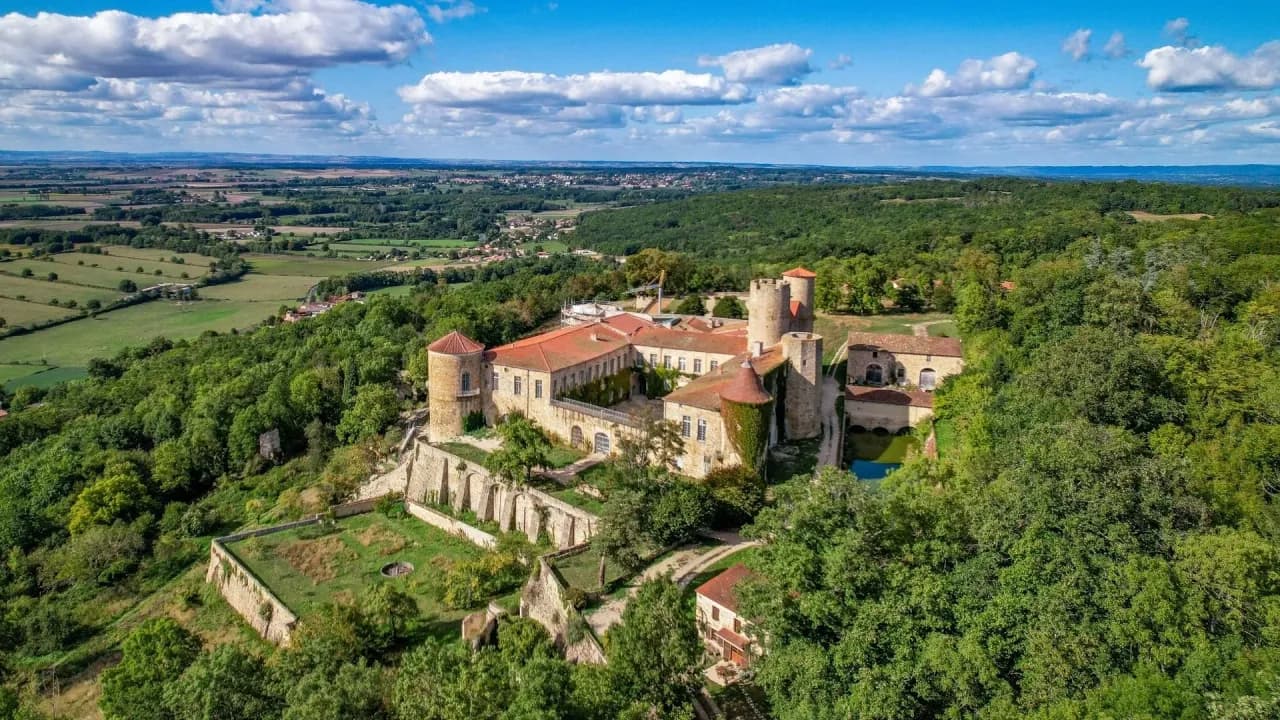
Château de Ravel
Key facts
ProtectionClassé MH
Classé monument historique: the highest level of heritage protection in France, decided by the national government. Any work on the protected parts needs state approval and is supervised by the state heritage services.
About
A royal fortress given by Philip the Fair to his chancellor Pierre Flote, then home to Admiral d'Estaing, Ravel overlooks the Limagne plain, facing the Chaîne des Puys volcanoes in Auvergne. Under centuries of partitions, stables and hay, the château hid a 13th-century hall with its painted decoration almost intact. Joseph Achkar and Michel Charrière, who bought it in 2015, are restoring it room by room and have given it back its original furniture and colors.
Ravel stands on a Gallo-Roman site, about 40 kilometers (25 miles) from Clermont-Ferrand, in Auvergne. The local lord built the château between the 11th and 12th centuries. In the 13th century, the fortress was bought by Philip III the Bold, son of Saint Louis, then lived in by Philip IV the Fair, who gave it to his first chancellor, Pierre Flote. Flote's descendants kept it until the end of the 18th century.
At the end of the 18th century, Ravel passed by inheritance to Admiral d'Estaing. In 1806, the Riberolles family, old Auvergne nobility, bought the château from the admiral's half-sister and kept it into the 20th century. Joseph Achkar and Michel Charrière bought it in 2015 from the Brochot family.
The great discovery at Ravel is the Hall of the Estates General, a large 13th-century hall. It was split in two in the 15th century, then transformed in the 17th century when the stables moved into the main house: a low level served as a store for farm equipment, an upper level as a hayloft. That is what saved it, because it no longer followed the fashions. When they took down the 15th-century wall, the new owners uncovered a painted column and the beam that had vanished into the partition.
At Ravel, nearly 80 percent of the 13th-century painted decoration has survived. The walls bear the arms of Philip the Fair, Edward II of England, the Valois, the Bourbons and Auvergne, a set the owners present as the oldest known heraldic decoration in France. The ceiling, boarded over rather than showing its beams and joists, is decorated with medallions bearing the arms of the king and the great families. The restoration repainted nothing where the decoration had disappeared: everything you see is original.
The small windows of the hall are those of the 13th-century fortress. The large ones date from the 15th century, when a kingdom at peace no longer required narrow openings. The floors are from the 15th century. A 27-meter (89-foot) run of furniture, dated and by a known joiner, has been installed there.
Above the Hall of the Estates General, Philip the Fair's bedroom had been turned into two floors of four rooms each by the time the current owners of Ravel arrived. A fire had gutted them, leaving only medieval elements. With the DRAC, the regional heritage authority, and the historic monuments service, the choice was to follow what remained. The 13th-century fireplace was brought back to light, along with tracery windows found bricked up, fragments of which had been built into the fireplace. The room is now fully restored.
In the anteroom to the king's bedroom at Ravel, the ceiling had been plastered over, the room cut in two and the window bricked up, and an 18th-century paneling looked as if it had always been there. While clearing the walls, the owners found the original chimney flue and, sitting on a ledge, a letter dated May 20, 1924. In it, Louis Barthélemy de Riberolles, the owner at the time, explained that he had moved this paneling, made in the 18th century by a joiner from Pont-du-Château, from another room to make it his dining room.
"So we were able to take it out without any guilt, if you see what I mean."
Joseph Achkar and Michel Charrière, owners, 2022
The king's bedroom at Ravel, in its early 17th-century state, had been restored in the 1970s by the previous owners. It holds a painting by Isaac Moillon considered one of his masterpieces, a French-style canopy bed from the Louis XIII-Louis XIV period, which the owners had bought some thirty years earlier without having a room big enough for it, and an 18th-century ebony cabinet.
Ravel keeps Admiral d'Estaing's original library, from the Louis XIV period with Chinese-style decoration, with 2,000 books bearing his arms, as well as a set of eight armchairs and a sofa he ordered from Courtois. In the genealogy room, whose paneling and original colors were left unrestored, hang the d'Estaing ladies of the late 16th century, the admiral as a child painted by Desportes, and the ancestors of the Riberolles family, one of them by the Lyon painter Donat Nonnotte.
The great gallery, an indoor promenade from the early 17th century, became the room where the admiral displayed the battles he had won against the British, painted at his request.
"Too bad the ones he lost aren't here. There were a lot more of those, and we'd have had a lot more paintings."
Joseph Achkar and Michel Charrière, owners, 2022
The gallery also holds the admiral's father painted by Largillierre, a portrait of Admiral de Châteaurenault by Rigaud, a painting by Bourdon and a console table from a set of the four elements, the one for water. Its original stucco is still waiting to be restored. It opens onto a boudoir, with a Polish-style bed by Tilliard and chairs by Brizard, and onto the music room, created in the late 18th century inside a medieval defensive tower. Its decoration is original stucco, its furniture by Nogaret. A gouache bought in the early 19th century by a Riberolles shows the admiral receiving his tenant farmers in this room, which made it possible to recreate the curtains. It was from this balcony that the admiral's young son, the last of the d'Estaings, fell to his death.
At Ravel, Admiral d'Estaing's winter bedroom has recovered its 15th-century proportions, its floors and its period fireplace. Following a common 15th-century practice, its walls are lined with braided straw, over which hang five 17th-century tapestries, joined by a sixth from the same series found at a dealer's. The bed is dressed in a late 17th-century brocatelle.
The Plain Bedroom, named on the plans for its view, had lost its parquet and fireplace. An alcove was recreated, a 17th-century parquet laid, 18th-century painted canvases mounted on the walls, and a bed by Boulard installed. In its anteroom, test patches and analyses revealed the original colors, and the coved ceiling, on a game theme of boar's heads and hunting dogs, has been restored. In 2022, a 15th-century room hung with canvases of sea scenes is set to become a cabinet of curiosities devoted to the navy and to Admiral d'Estaing.
From the terrace at Ravel, the view takes in the Limagne plain, protected from any building, the Puy de Dôme volcano, the Chaîne des Puys and, farther off, the Sancy. In 2022, a tower is being restored, and the owners are moving forward room by room in a project they compare to Admiral d'Estaing's battles, a race against time.
"And we hope that one day we'll get to the end of this enormous ocean liner."
Joseph Achkar and Michel Charrière, owners, 2022
For future owners
Dreaming of a château like this one?
The founder of So Châteaux has visited more than 500 châteaux in France. He takes no commission on château sales, so he can tell you what he really thinks about any property, completely independently.
See how we help buyersDid You Know?
The setting for Les Choristes
The château served as the setting for the video Les Choristes, shot during the summer of 2003.
Gallery
Frequently Asked Questions
Construction began in 1147; it was transformed in the 17th and 18th centuries.