
Château de Sarzay
Key facts
ProtectionClassé MH
Classé monument historique: the highest level of heritage protection in France, decided by the national government. Any work on the protected parts needs state approval and is supervised by the state heritage services.
About
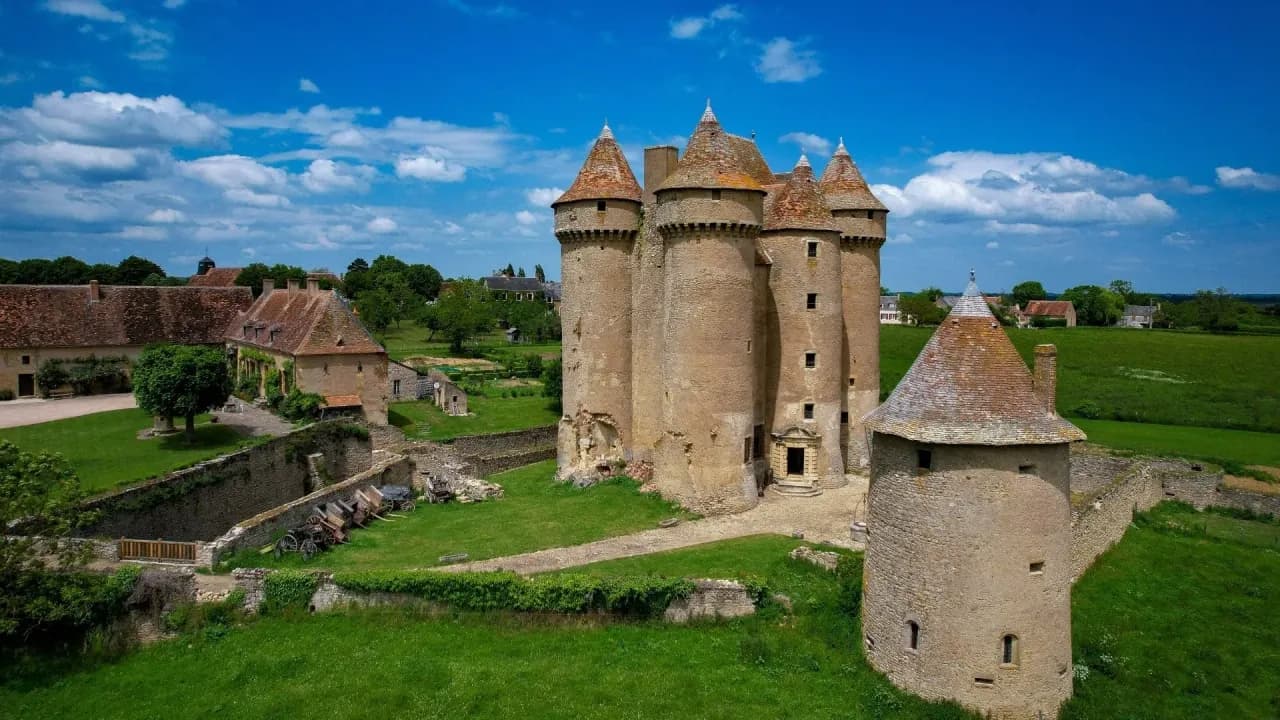
A fortress in the Berry whose coat of arms George Sand described in her novel The Miller of Angibault, Sarzay once had 38 towers. It keeps a tall main house flanked by towers, its monumental fireplaces and its roof frame. When Richard Hurbain bought it in 1984, the ground floor was a pigsty and the upper floors had no floorboards. Since then, this former utility worker from the Paris suburbs has restored it with his family, down to its water-filled moats.
For four centuries, Sarzay was the château of the Barbançois family, who lived here until the 17th century before selling and moving away. The fortress was huge: it originally had 38 towers, and the sites of several are known. The family's arms, three severed leopard heads, decorated the fireplaces, and George Sand, the 19th-century novelist of the Berry, preserved their memory by describing them in her novel Le Meunier d'Angibault (The Miller of Angibault).
From that description, the arms were carved again on a ground-floor fireplace at Sarzay. The owners also believe Joan of Arc probably passed through after the capture of Orléans, on the road to Boussac. A statue of the saint, given by a priest from Thevet-Saint-Julien, now stands in the great hall where visitors were received.
Richard Hurbain came to Sarzay in 1984. Nothing had prepared him to own a château. He grew up in Seine-Saint-Denis, a working-class suburb north of Paris, and was then a meter reader for EDF, France's national electric company. The château he bought was in a sorry state. The ground floor had been paved with cement to serve as a pigsty, the upper floors had no floorboards left, and the furniture had disappeared long before.
"Doesn't look too good, does it. A château owner who reads meters."
Richard Hurbain, owner, 2023
The principle for restoring Sarzay was set from day one: bring the château back as close as possible to its original state, working from the traces left by what had vanished. The work has been a family affair, carried out with his children over forty years.
At Sarzay, every floor has been redone. On the ground floor, the cement gave way to old terracotta tiles salvaged from the countryside, and the ceilings were rebuilt. The great fireplaces have their mantels back, recut from old stone, some bought in Burgundy, others found on site, and all of them work. In the kitchen, a pit emptied by hand turned out to be not a dungeon but a food store. Protected by a grate, it now collects visitors' coins, like a Trevi Fountain.
On Sarzay's upper floors, the tile floors were remade from fragments found in the corners, the stone window seats were recut from old stone, and the beams and floors were put back. The plaster, on the other hand, is original. The northeast tower held the latrines on every level. With no furniture left, the château was furnished with pieces hunted down in the region and beyond: a Breton cabinet, four-poster beds, a 17th-century sideboard, a table drilled with holes for cracking walnuts and, on the fourth floor, a wardrobe hoisted up by winch before the floors were laid.
"Forty years since I bought the château. […] It's a marathon. With no finish line. And if you stop running, you're disqualified."
Richard Hurbain, owner, 2023
Sarzay's top floor is the one that holds visitors longest: the roof frame. Its floor was entirely relaid in oak boards by Gilles, the owner's youngest son, who prefers oak to chestnut, the wood some say the frame is made of. At the top of each tower, a ring of beams radiates like the spokes of a wheel. The chimney flues were rebuilt from the ground floor to the roof in small salvaged bricks. Near the wall walks, large baskets called bourolles were used to keep dried fruit for a year.
From up there, the view takes in the vegetable garden, the village, the farmyard and a barn nearly 100 meters (330 feet) long. The garden's boxwoods, almost a hundred years old, come from a house in Le Raincy, outside Paris, that was demolished by Portuguese friends of the owner, who dug them up and replanted them.
Outside the main house, Sarzay's biggest project was the moats. A castle with water-filled moats is rare. After locating the base of the walls with a contractor, Richard Hurbain rebuilt them with his children, and the water came back. It stays, even when rain is scarce. Of the 38 original towers, six have been restored, four of them in the moats, at the entrance.
One of these towers at Sarzay has recovered all three of its uses: a small fortified chapel on the ground floor, the chaplain's lodging above it, and a guardroom on the floor above that. Arrow slits cover every angle. The stained glass was donated by a benefactor, and the floor is laid with medieval terracotta tiles from the Château de Pomponne, which had been turned into a barracks for the CRS, the French riot police.
In 2023, Sarzay is open to visitors, and almost all of the main house has been brought back close to its original state. Projects remain: restoring the latrines in the northeast tower, patching the damaged plaster, rebuilding more towers whose sites are known. After forty years of work, Richard Hurbain is handing over to his children, and it is his youngest son, Gilles, who now keeps the work going.
For future owners
Dreaming of a château like this one?
The founder of So Châteaux has visited more than 500 châteaux in France. He takes no commission on château sales, so he can tell you what he really thinks about any property, completely independently.
See how we help buyersDid You Know?
Sarzay as seen by George Sand
George Sand drew inspiration from the château for her novel Le Meunier d'Angibault, published in 1844.
Gallery
Frequently Asked Questions
It was built in the 15th and 16th centuries.