
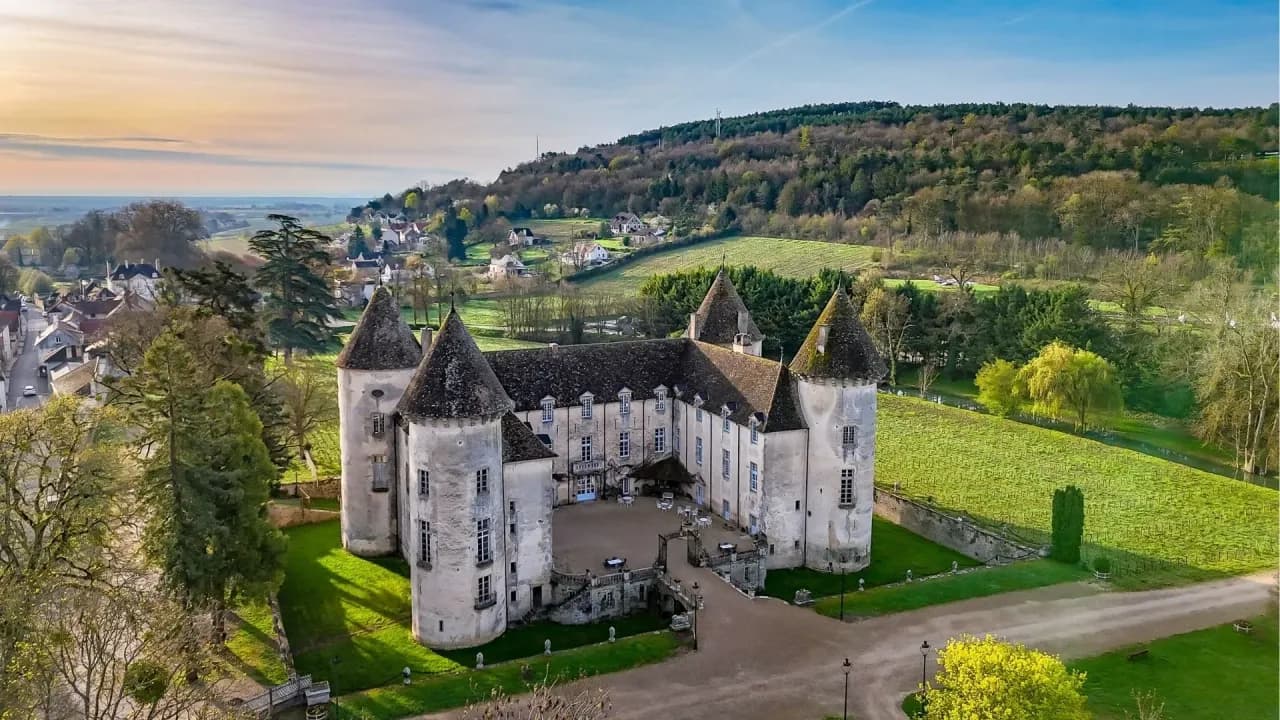
Château de Savigny lès Beaune
Key facts
ProtectionInscrit MH
Inscrit monument historique: the second level of heritage protection in France, decided by the regional prefect. Owners must notify the state before any work on the protected parts, and the regional heritage authority (the DRAC) reviews it.
About
A 14th-century fortress torn down and rebuilt around an open courtyard in the 15th, the Château de Savigny-lès-Beaune once held the Duchess of Maine under house arrest. Today it is one of the most unusual collections of machines in Europe. The Pont family, winemakers on the Côte de Beaune, bought it in 1979 after it had been stripped bare. They filled it with fighter jets, vintage motorcycles and Abarth prototypes, and open it to visitors amid their vines.
Savigny-lès-Beaune began as a feudal castle closed around its courtyard, ringed by water-filled moats that the river flowed through. In the 15th century, the river was diverted and the fortress dismantled, probably because its lord had backed the wrong side. The château was then rebuilt around an open courtyard, as a more middle-class residence, and the drawbridge disappeared. The passage that served as the castle's entrance survives on the ground floor, behind an iron gate.
Traces of the fortress remain at Savigny-lès-Beaune: some of the vaults and parts of the building go back to the 14th century. On the ground floor, a row of old storerooms includes one original room, with its bread oven and fireplace, thought to have been the guardroom. Former owners had covered it in plaster, and the stone has since been uncovered.
The upper floors of Savigny-lès-Beaune are reached by a wide, easy staircase with stone and marble steps, copied from a design by the architect Mansart. The second floor bears witness to the Renaissance. One of its rooms was once hung entirely with hand-tooled Cordoba leather. One of the last owners tore it down to sell it and destroyed whatever he could not sell. A series of five portraits, bought back from a secondhand dealer, has returned to the room.
In the next room, a painting recalls that the Duchess of Maine, daughter-in-law of Louis XIV, was placed under house arrest at Savigny-lès-Beaune. A portrait of the Comte de La Loyère, owner in the 19th century, hangs at the far end. The original Versailles-pattern parquet has stood the test of time: today, wedding guests slide across it in their shoes.
Before 1979, Savigny-lès-Beaune belonged to the Comte de Vaulchier, who had no heirs. His library, on the third floor, was then said to be one of the finest in Burgundy, filled with very valuable books. The count protected it in his own way: owls lived there and ate the rats that ate the books.
In 1959, a theater company wanted to stage Corneille's Le Cid, starring the actor Gérard Philipe, in the main courtyard. The Comte de Vaulchier worried that the spotlights would scare off the owls. The company performed in front of the courtyard, not inside it. The old chapel is on the same floor, next to the library.
The Comte de Vaulchier sold Savigny-lès-Beaune, under circumstances that remain unclear, to an English buyer who sold off everything: furniture, books, stone statues from the park. Only the heavy entrance gate defeated him. He came alone to take it down for a local antiques dealer and had to give up because of its weight. This was the empty château that Christophe Pont's father bought in 1979.
"We bought a completely empty shell."
Christophe Pont, owner, 2024
In the 1980s, Savigny-lès-Beaune was closed to the public, and the work was enormous, in the park as well as inside. The roofs were redone. The family chose not to refurnish the château as it had been, since the scattered furniture could not be found and they lacked the means. The state rooms were restored to host receptions, and the château was meant above all for visitors.
Christophe Pont's father collected everything, and Savigny-lès-Beaune shows it. The park holds some 80 fighter jets, gathered over about fifteen years. On the third floor, in a room where justice was handed down, according to the village elders, about 200 vintage motorcycles are on display. The one dearest to the family is a Durandal, a motorcycle made in Dijon between 1926 and 1936, which belonged to the grandfather. In the old library, also looted, motorcycle engines have taken the place of the books. On the staircase walls hang posters of the Saint-Vincent Tournante, the region's winemakers' festival held in a different village each year.
"My father, he kept everything, he had this absolutely incredible hunger for collecting."
Christophe Pont, owner, 2024
Other museums round out the Savigny-lès-Beaune collection. There are some thirty Abarth prototypes: the founding owner had raced cars from 1965 to 1973 and bought them back when nobody wanted them. There are some thirty vineyard tractors, in tribute to the grandfather, who invented the first straddle tractors, machines that ride over the rows of vines, just after World War II. And there are a few fire trucks, shown with the help of a Beaune manufacturer of emergency vehicles.
Facing the main château of Savigny-lès-Beaune, the "petit château" groups the outbuildings put up in the late 17th century: stables, cowsheds, a pigsty and probably housing for the estate's workers. One section, built in a curve on the exposed bedrock, makes it an unusual building. Today it serves as the welcome center for visitors and customers, and partly as housing.
The owning family's trade is still wine. It farms ten hectares (25 acres), from Volnay to Meursault by way of Beaune, Pommard and Savigny, and the vines around the château produce the Clos du Château wine, offered for tasting and sale at the petit château.
When his father died, Christophe Pont, the only one of five children who wanted to take over the estate, bought Savigny-lès-Beaune outright, after forty-five years of working at his side. He brought in his wife and three daughters. In 2024, the youngest, Marie, runs the events business. Savigny-lès-Beaune hosts weddings and receptions in its state rooms, and visitor tickets pay for the ongoing restoration. The château will probably never regain its feudal form or its original furniture, but more work is planned, and the motorcycle museum is to be redesigned around the grandfather's Durandal.
"It's a family project that means a lot to me, and we're going to carry it as far as we can, because there's no way this heritage is going to end up with who knows who, who knows where."
Christophe Pont, owner, 2024
For future owners
Dreaming of a château like this one?
The founder of So Châteaux has visited more than 500 châteaux in France. He takes no commission on château sales, so he can tell you what he really thinks about any property, completely independently.
See how we help buyersGallery
Frequently Asked Questions
A wine estate and museums: fighter jets, Abarth cars, motorcycles, and winemaking equipment.