
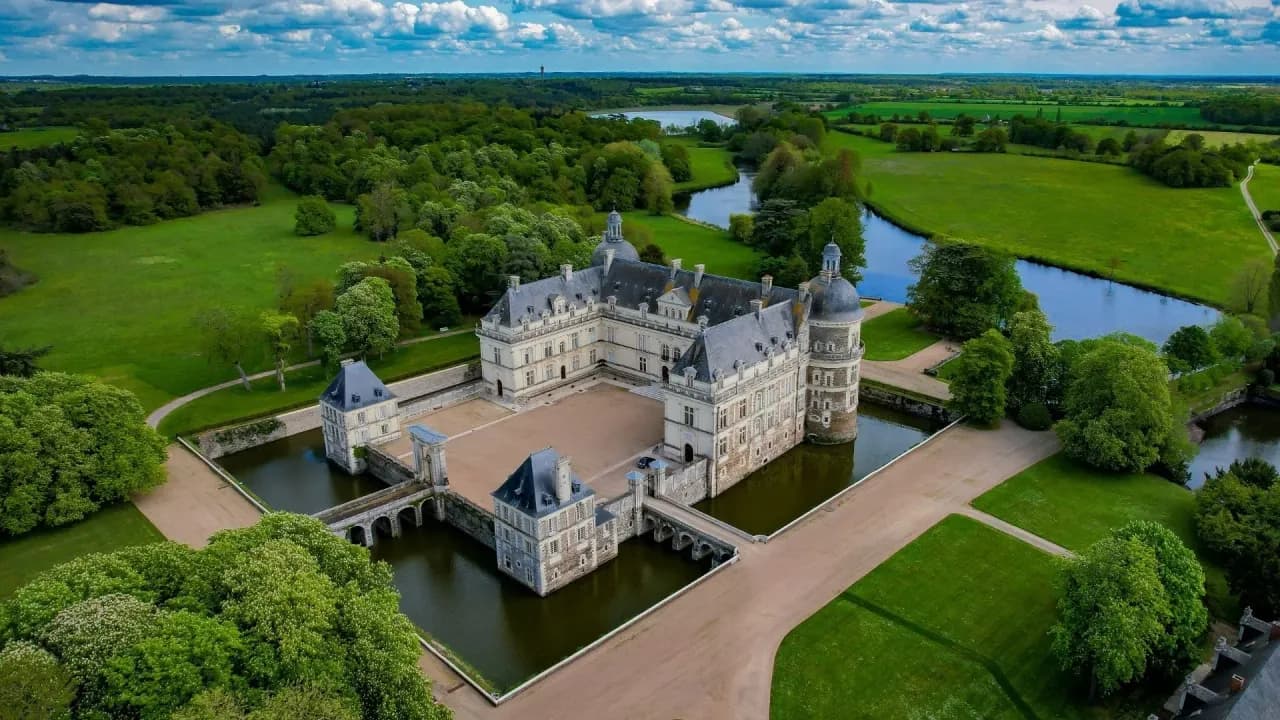
Château de Serrant
Key facts
ProtectionClassé MH
Classé monument historique: the highest level of heritage protection in France, decided by the national government. Any work on the protected parts needs state approval and is supervised by the state heritage services.
About
Two centuries of building, from 1539 to the 1710s, never broke Serrant's unity: the Bautru family faithfully extended the Brie family's Renaissance tufa facades, around medieval moats still in water. Spared by the French Revolution, this château in Anjou keeps the collections of its successive families, including a 12,000-volume library and fully protected furniture. The Prince and Princess de Mérode, descendants of the La Trémoille family, live there and look after it.
Serrant began as a fortified castle, built in the 15th century by the Brie family on their ancestors' land. From that fortress survive the moats, still filled with water, and the underground rooms, home to the old kitchens, under a Gothic ceiling between very thick walls. In the 16th century, Péan de Brie set out to rebuild the château in the Renaissance style. Work began in 1539 with the great central staircase.
Péan de Brie asked an architect from Anjou, Jean Delespine, to design a main building on either side of the Serrant staircase, ending in two corner towers. Only the section between the north tower and the staircase was built. Money troubles halted the work, and the château stood half-finished for about fifty years. The staircase, raised some fifteen years after work began at Chambord, follows the Italian model, with two straight flights under carved coffered vaults. Its loggias, open on every level to the courtyard and the garden, were enclosed only later.
Guillaume de Bautru bought Serrant by a notarial deed dated March 12, 1636, written on parchment and still kept at the château. A founding member of the Académie française, he resumed construction and built the missing part of the central wing and the south tower, following the original Renaissance design. His son added the two perpendicular wings with the same facades. In the late 17th century, his granddaughter built the chapel at the end of the south wing, and the north wing was extended to restore the balance. The chapel holds the mausoleum of the marquis de Vaubrun, designed by Le Brun and carved by Coysevox, two of Louis XIV's leading artists.
The courtyard pavilions and the central gateway, added by the Bautru family in the early 18th century, completed Serrant in the 1710s, nearly two hundred years after the first stone of the staircase was laid.
"But when you see the overall harmony, so balanced, so consistent, it's a remarkable piece of work."
Geoffrey Chevalier, heritage guide, 2022
The finest piece of furniture at Serrant is an ebony cabinet made around 1645-1650 by Pierre Gole, one of the great cabinetmakers of his day, and given to Guillaume de Bautru as a wedding present. A showpiece, it was displayed open during receptions. Its doors, carved with mythological scenes, open onto a stage set: faux rockwork made of cork, mirrors, ivory columns stained red to imitate coral, and an ivory and ebony checkerboard. Thirty-three drawers are hidden inside. About ten such cabinets survive, mostly in public collections.
"It's been at Serrant since it was delivered, starting in 1650-1660, so it has been through everything at Serrant, and you can still see it today in its original setting, in an absolutely fabulous state of preservation."
Geoffrey Chevalier, heritage guide, 2022
The grand salon at Serrant is hung with late 16th-century Brussels tapestries full of animals and plants, without a single human figure. It also holds a late 16th-century chest in gilded brass, set with semiprecious stones and ancient cameos. Pope Paul V, whose arms it bears, gave it to a La Trémoille who was French ambassador to the Holy See. A filing cabinet stores part of the château's archives there, including notebooks recording the menus and guests of each reception, so that the same guests were never served the same meal twice.
In 1749 Serrant was sold with all its collections, furniture and paintings included, to Antoine Walsh, son of an Irish Catholic who had gone into exile in France in the 17th century. Louis XV made the Walsh family counts of Serrant. In the 1780s they turned the old French formal gardens into a large English-style landscape park. Their Irish origins carried them through the French Revolution unharmed, and both the building and its collections were spared.
The Serrant library keeps the memory of their loyalty. Above the fireplace, a painting shows Antoine Walsh beside Charles Edward Stuart, Bonnie Prince Charlie, whose 1745 landing in Scotland to win back the throne he organized. The expedition failed. The fireplace carries the royal arms of Great Britain, those of the pretender, with thistles carved on its capitals.
Under the Empire, Countess Walsh, a lady-in-waiting to Josephine, received a Sèvres tea service from the empress for the baptism of her daughter Valentine, Josephine's goddaughter. For the visit of Napoleon and Josephine to Serrant, she ordered the furniture of the Empire bedroom from Jacob-Desmalter: armchairs with their original Beauvais tapestry upholstery, exceptionally fine bronze mounts and a mahogany secretary commode with a hidden writing shelf. A bust of Empress Marie-Louise by Canova stands on the mantelpiece.
"The bed meant for Napoleon was never actually used by the emperor, because instead of staying two days, he only stayed two hours at Serrant."
Geoffrey Chevalier, heritage guide, 2022
The visit was cut short for diplomatic reasons. The bed went on to serve several Countesses Walsh, whose monogram appears inside the laurel wreath. The dining room keeps the Empire mahogany table the countess ordered, extendable to seat 25, with its centerpiece and gilded bronze candelabra stamped Thomire. A portrait of the countess and her two children in the park, by Louis Hersent, which hung at Serrant in the 19th century, has recently come back.
In 1830 Valentine Walsh de Serrant married the Duke of La Trémoille. Their son, a historian, collector and archivist, settled at Serrant in the late 19th century. He entrusted the château to Lucien Magne, a pupil of Viollet-le-Duc, the great 19th-century restorer, to bring back a Renaissance character that had been toned down in the 18th century. The second-floor balustrade was created, the mullions were restored, and the family's coat of arms and motto were added to the facade. The interior was reorganized and modernized with bathrooms, running water and central heating. The dining room, hung with 17th-century Oudenaarde tapestries on Ovid's Metamorphoses, lost its fireplace.
The Serrant library, fitted out by this book-loving duke, holds 12,000 volumes from the 16th to the early 20th century, arranged by subject. Begun by Guillaume de Bautru and enriched by the Walsh family, it received the duke's books, marked with a cross of four Ts for La Trémoille, Thouars, Talmont and Tarente. Among its treasures are the first complete edition of Diderot and d'Alembert's Encyclopédie, the second edition of the Description de l'Égypte and an atlas of the kingdom of France from 1643. The duchess's dressing room, fitted out in 1894, and a 1740 Berlin tapestry, a gift from the king of Prussia to the king of France, complete the apartments.
In 2022, Serrant still belongs to the descendants of the La Trémoille family: the Prince and Princess de Mérode live there and look after the monument. The château is open to visitors, from the state bedrooms to the late 19th-century kitchens, with their complete set of copper pans and a central range whose smoke runs under the stone floor to the granite chimney. The entire furniture collection has been listed as a historic monument by the French state since 2001, a rare case for a private house, and the library is classified as a historic archive. The second floor and its balustrade, which look out over the village of Saint-Georges-sur-Loire and the Loire Valley, remain closed to the public.
For future owners
Dreaming of a château like this one?
The founder of So Châteaux has visited more than 500 châteaux in France. He takes no commission on château sales, so he can tell you what he really thinks about any property, completely independently.
See how we help buyersDid You Know?
Irish shipowners
In the 18th century, the château belonged to the Walsh family, Irish-born shipowners from Nantes.
Gallery
Frequently Asked Questions
Its construction spanned from 1539 to 1710, in a style dominated by the Renaissance.