
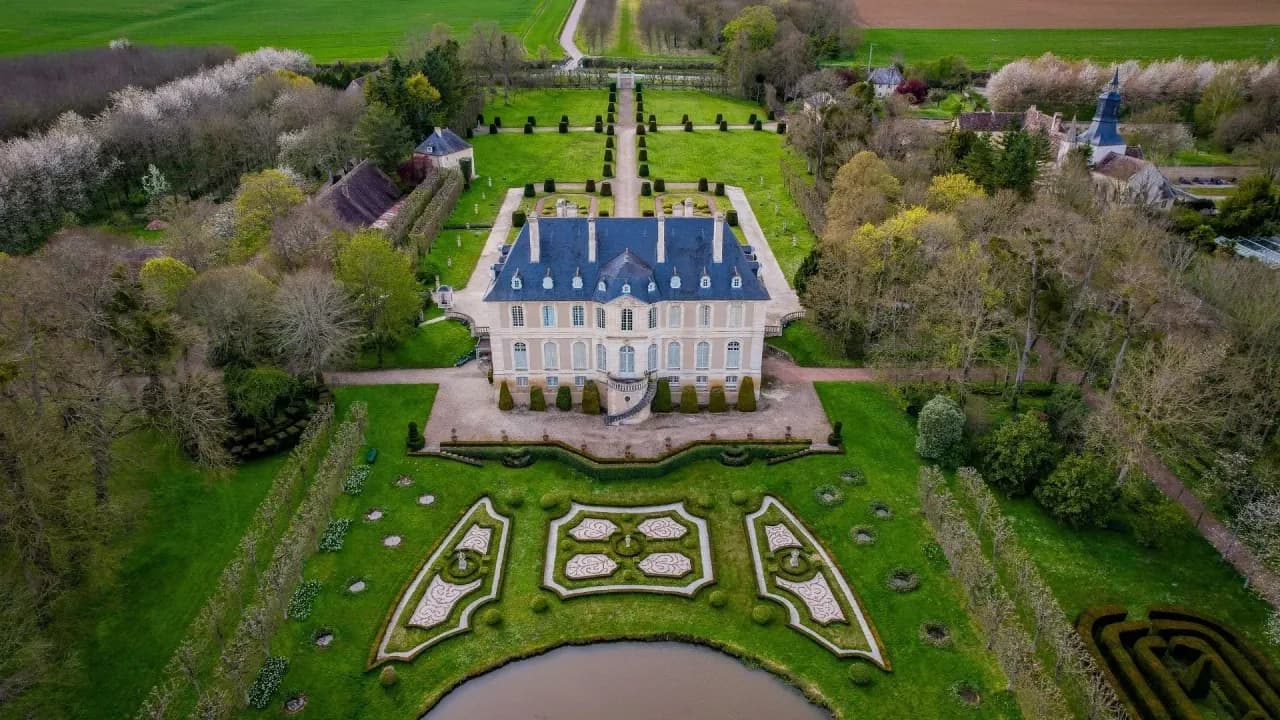
Château de Vendeuvre
Key facts
ProtectionPartiellement classé MH
Only some parts of the château (for example a facade, a roof, a room or the gardens) are classé monument historique, the highest level of heritage protection in France. The other parts have a lower protection or none.
About
Nine generations have handed Vendeuvre down from father to son since Alexandre de Vendeuvre had it built in the 18th century by Jacques-François Blondel, one of the most celebrated architects of his day. A country house in the Normandy countryside, this château in the Calvados has kept its suite of Rococo drawing rooms, its kitchens and gardens of surprises: a shell grotto, mazes and trick fountains. The Vendeuvre family opens it to the public, along with its collections.
Vendeuvre is one of the first buildings by Jacques-François Blondel, who went on to found an architecture school in Paris and became one of the most celebrated architects of the 18th century. He built it for Alexandre de Vendeuvre, whose small portrait as a hunter, with his dog, still hangs at the château. It was a fashionable, well-proportioned house. Yet late in life, Blondel would count it among the mistakes of his youth.
On the garden side, Vendeuvre's facade projects in a three-sided bay, and the window surrounds are very typical of Blondel. The finials on the roof ridge come from the old Renaissance manor, part of which the builder reused. In the central pediment, a daisy recalls the favorite flower of Alexandre de Vendeuvre's wife. Inside, the formal entrance hall takes up the Greco-Roman taste, with six pairs of Ionic columns.
"A small family château that's been passed down from father to son, and I'm the ninth generation. It's a family home and a country house out in the middle of the countryside."
Alexandre de Vendeuvre, owner, 2022
The grand stairwell at Vendeuvre rises 10 meters (33 feet). Its 18th-century wrought-iron railing continues into a trompe-l'oeil decor painted by the present owner's father, a decorative artist by trade, whose trompe-l'oeil work appears in several rooms. A Venetian glass chandelier lights the family portraits, among them Belgian ancestors, the comte de Sprimont and his wife, and a forebear who was a princesse de Mérode. At the foot of the stairs wait a simple country sedan chair and a commode chair.
In the grand drawing room, a portrait of the duc d'Angoulême, son of King Charles X, recalls a chapter of family history: in 1830, when the Bourbons fell, the whole family resigned its offices out of loyalty to them.
Vendeuvre's suite of drawing rooms, listed as a historic monument by the French state, is one of the few 18th-century Rococo interiors that still keep their original spirit. The grand drawing room is oval: its rounded corners spread the light better and avoid dark patches. The door hangings are of the school of Boucher. The room displays the games of the 18th century, which had some two hundred of them, around a trictrac board, a French cousin of backgammon, a five-sided card table lit by its bouillotte lamp, and chairs designed for hooped skirts, such as the voyeuse, on which ladies knelt to follow the game.
Vendeuvre's state bedroom has kept all its decoration, its alcove and the two doors to the dressing room and the wardrobe. Three dressing tables, a new kind of furniture in the 18th century, illustrate the art of getting dressed. The study next door, its paneling painted with birds, recalls the great voyages of exploration of the late 18th century, from Bougainville to La Pérouse. A large portrait there probably shows Queen Marie Leszczynska, wife of Louis XV, painted by Nattier. In the pastel room, whose ceiling was lowered to house the staff upstairs, hangs a goldfish chandelier, one of ten known in the world, beneath a pastel portrait of Jacques-Alexandre de Vendeuvre and his little dog.
At Vendeuvre, the bedroom of Louise-Aimée de Vendeuvre, a young daughter of the family in the late 18th century, brings together the everyday objects of a bedroom of the period: a canopy bed in the Polish style, a hip bath, a chocolate service, and a hot-air-balloon chandelier, a reminder of the ballooning craze launched by the Montgolfier brothers. Her closet-sized dressing room has been left untouched, with its Rouen earthenware fountain, its Alençon lace and the linen labels from before World War I.
Vendeuvre's 18th-century kitchens fill an entire floor, below ground. Until World War I, as many as forty people worked here. The rooms follow one another in the order of the work: butchery, carving room, cooking room, then scullery. Food was cooked two ways, over flames and over embers, with an ember stove and a counterweight spit with its drip pan. A warming oven, where dishes were reheated over embers, was an ancestor of the microwave. All the copper pots and pans are original, and a fountain filtered the poor-quality water through sand.
Dog kennels are everywhere at Vendeuvre, including an entire basement room devoted to a whole collection of them. There are travel kennels, among them a 19th-century English one with a folding hood, a padded 17th-century Venetian kennel, parlor kennels and eccentric ones, one shaped like the Arc de Triomphe, another for taking your dog to the beach. The château also houses a museum of miniature furniture, made as display pieces and to order, and a collection of bourdaloues, the chamber pots that owe their name to the endless sermons of Father Bourdaloue.
"We've had the collecting bug, generation after generation."
Alexandre de Vendeuvre, owner, 2022
The gardens of Vendeuvre are themed gardens. Behind the château, a pond and an Italian-style terrace lead to a grotto covered in 200,000 shells, a cool room to escape the summer heat, then to green rooms that recreate interiors in the middle of the garden, from a Tartar tent to an elephant fountain. Two mazes, one formal, the other wilder, invite you to get lost. The working garden has a fish pond, a rare dovecote standing in the water and a north-facing icehouse, where ice gathered at the end of winter was stored to make summer sorbets.
At the end of Vendeuvre's 18th-century linden avenue, the surprise water gardens carry on a family tradition going back to a distant ancestor, the marquise de Rambouillet, who soaked her friends by turning cranks. A Romantic walk winds through the islands laid out by Augustin de Vendeuvre, who founded a Linnean academy, a natural history society, in Caen in the early 19th century. At the end of the summer, a tropical garden shows off banana trees, Chinese palms and rare plants.
"Above all, you couldn't take yourself too seriously. Visitors get properly soaked by the playful water tricks people loved so much in the 18th century."
Alexandre de Vendeuvre, owner, 2022
In 2022, Vendeuvre still belongs to the Vendeuvre family, the ninth generation to live here, and it is open to visitors. The furnished drawing rooms are set as if for an 18th-century supper, with the dessert course laid out in the great dining room. There are also the kitchens, the collections of dog kennels and miniature furniture, and the gardens, where the tropical garden is best seen in late August and September.
For future owners
Dreaming of a château like this one?
The founder of So Châteaux has visited more than 500 châteaux in France. He takes no commission on château sales, so he can tell you what he really thinks about any property, completely independently.
See how we help buyersDid You Know?
Gardens full of surprises
Vendeuvre's water gardens hide automatons and water features that activate as visitors pass by.
Gallery
Frequently Asked Questions
The world's first museum of miniature furniture, along with surprise water gardens.