
Château du Champ-de-Bataille
Key facts
ProtectionClassé MH
Classé monument historique: the highest level of heritage protection in France, decided by the national government. Any work on the protected parts needs state approval and is supervised by the state heritage services.
About
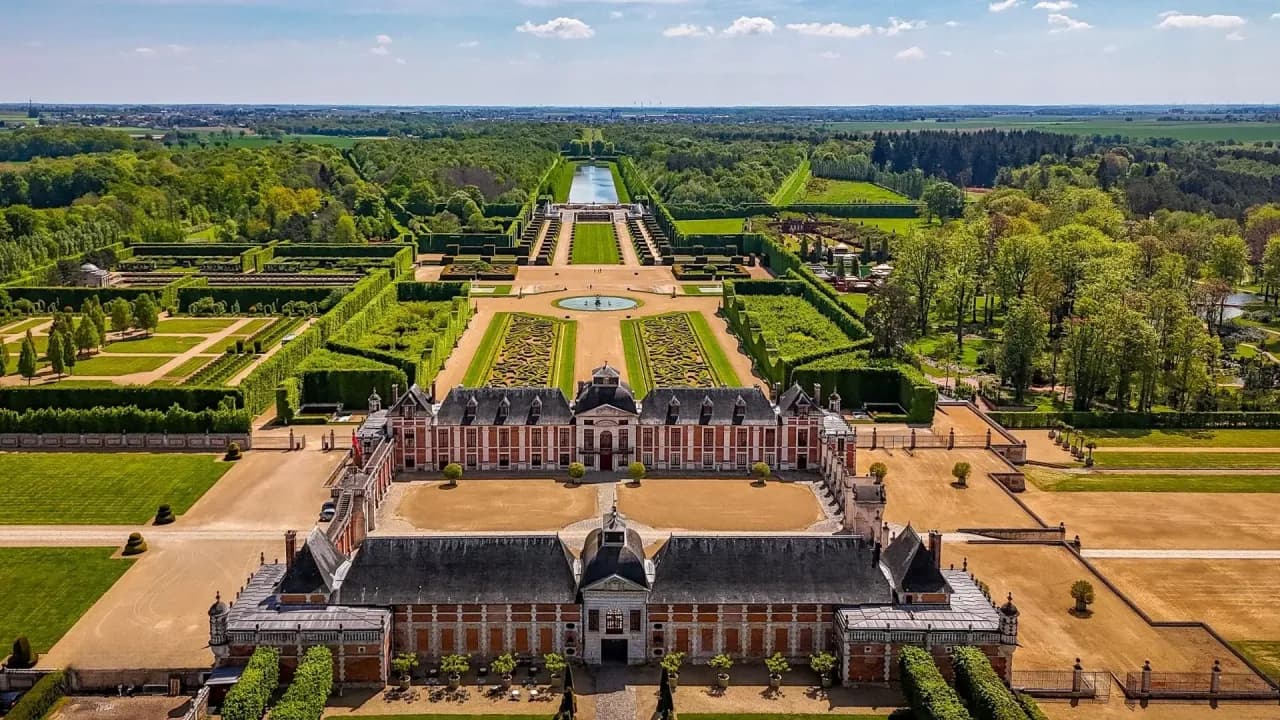
Built by the Comte de Créqui, who hoped Louis XIV would one day visit, Champ-de-Bataille has become the life's work of the interior designer Jacques Garcia. The owner for some thirty years, he lives in this Normandy château, which he restored and furnished with royal pieces from Versailles to the Tuileries, and whose French formal gardens he transformed. Their 1.5-kilometer (one-mile) vista makes them the largest private garden open to visitors in France.
Champ-de-Bataille is the work of the Comte de Créqui. Sentenced to death under Cardinal Mazarin, then pardoned, he built the château in the hope that royal favor would one day return and that Louis XIV would agree to visit. The king never came, but the château still has the state apartment prepared to receive him.
Like every state apartment of the period, the one at Champ-de-Bataille lines up three large rooms: a first antechamber, which served as the guardroom, a second antechamber, then the state bedchamber. The first, under a 17th-century ceiling, recalls the grand interiors of Paris town houses, Versailles or Fontainebleau. In the bedchamber, a balustrade separates the sacred space reserved for the prince or king from the everyday world.
The first salon at Champ-de-Bataille brings together chairs that belonged to the royal family. At the French court, only the king and the princes had the right to an armchair. Everyone else sat on folding stools or plain stools. A gilded wood chair bearing the arms of Philip V, grandson of Louis XIV, was used during the future King of Spain's short stay in the state apartments at Versailles, before he left for Madrid. Another belonged to the Grand Dauphin, Louis XIV's son. A third, scattered with natural-colored fleurs-de-lis and marked with a pearl necklace, the sign of a female owner, may have belonged to Queen Maria Theresa or another woman of the royal family.
The taste of the time ran to porphyry, which evoked ancient Rome: on the console stands a porphyry bust from Mazarin's collections. Further on, a folding stool by Foliot belonged to Louis XV's daughter who became Duchess of Parma, and a small cabinet displays Japanese Imari porcelain mounted in silver between 1715 and 1722. Such pieces were very expensive then, because the ships bringing them back often sank or fell into the hands of pirates.
At Champ-de-Bataille, the second antechamber and the state bedchamber have Louis XV paneling by Verberckt, the sculptor who did much of the carving at Versailles. The second room, more sociable, brings together chairs, a large sofa and a table that partly belonged to Madame de Pompadour, along with an early taste for the Greek style that heralds Louis XVI design. Its walls are covered with paintings hung frame to frame, the way 18th-century collectors hung them, including one of the child Louis XV in his nurse's arms.
The state bedchamber holds a Savonnerie carpet, from the series of 93 woven for the gallery of the Louvre, an early 18th-century bed embroidered with Chinese figures and pagodas, and two 17th-century Japanese cabinets from a set of four made for William III and Mary II of England. They are mounted in silver rather than gilt bronze, and their key bears the monarchs' monogram. The chest of drawers is said to come from the Château de Crécy, owned by Madame de Pompadour and Louis XV and later sold to the Duc de Penthièvre. A 17th-century Lyon silk with fleurs-de-lis was saved from the fire that destroyed the Tuileries palace.
"One thing that really moves me is this bust of Louis XV by Coysevox, which shows the king at the age of seven."
Jacques Garcia, owner, 2021
Three busts of this kind exist, showing the king at five, seven and nine. The one at Champ-de-Bataille once stood on the mantelpiece of the Regent, who governed France while Louis XV was a child.
The other wing of Champ-de-Bataille dates from the end of Louis XV's reign, but it already shows Louis XVI taste. The grand staircase, at the center of the house, is said to have been redone by the architect Gabriel around 1765, at the time of the Petit Trianon. It opens onto a neoclassical dining room, set on the axis of the garden, with a faience stove and a Louis XVI Savonnerie carpet.
On its table, the silver from the end of Louis XVI's reign includes plates belonging to Talleyrand, from the Château de Valençay. On the walls, a Sèvres service ordered for an English lord in the late 18th century has an unusual number of serving dishes: in France, people preferred them in silver, in England in porcelain. The Sèvres painters decorated it with 470 birds based on the drawings of the naturalist Buffon.
The drawing room at Champ-de-Bataille, with its neoclassical cornices and fireplace, captures the sweetness of life that Talleyrand missed after the Revolution. Some of its furniture comes from the great patrons of the late 18th century and the royal family, scattered in the revolutionary sales: a console by Weisweiler, Sèvres vases from Louis XVI's collections at Versailles, and large vases ordered by Louis XVI for the Louvre museum. Never delivered, they were sold during the Revolution to the King of Spain, then to an English lord, and resurfaced at the Hamilton sale in the late 19th century.
Madame du Barry's chairs here are carved with roses, the emblem of the royal favorite, with fleurs-de-lis and, at the center, two birds standing for the union of the king and his mistress. The king paid for them himself rather than through the Garde-Meuble, the office that furnished the royal residences.
"He was crazy about this young woman. And it's not the Garde-Meuble ordering this furniture, it's his own private purse."
Jacques Garcia, owner, 2021
On the walls, portraits tell the end of the old regime: Louis XVI in his glory, then the same man devastated at the Tuileries; Marie-Antoinette at 25, then thirteen years later in the Temple prison; and finally their daughter, the only one to come out of the Temple alive, painted in her mother's clothes. The last salon, more intimate, holds the folding screen from Marie-Antoinette's bedroom at Fontainebleau and chairs by Jacob made for her Turkish boudoir.
The gardens of Champ-de-Bataille, restored and transformed by Jacques Garcia, are meant to be read first from the upper floor, like all 17th-century gardens. Facing the château, on either side of the central axis, lie two parterres of boxwood lacework, attributed to a design by André Le Nôtre, Louis XIV's gardener at Versailles, like the two groves that frame them, Paradise and Hell. A disease has ravaged the boxwood on three-quarters of France's great estates. These were nursed back with great effort and are among the best preserved. Their five kilometers (three miles) of hedging are clipped once a year and surrounded by 3,000 perennials and bulbs, in bloom from late April to November.
"You're in the largest private garden open to the public in France. Now, I'm not saying it's the most beautiful, that's another matter, but it's certainly the biggest. And keeping up something big is extremely complicated."
Jacques Garcia, owner, 2021
The vista stretches for one and a half kilometers (about a mile). The central axis, lined with buttresses of yew clipped into cubes, each planted with 1,300 lavender plants, leads to the great cascades and then to the grand canal, 500 meters (1,640 feet) long and 30 meters (100 feet) wide, which is used to water the park in summer. There are about twenty gardens: the Temple of Leda, edged with a canal, potted fruit trees, 400 rose bushes, hornbeam hedges and grapevines; an Italian garden; and a green theater with tiers of boxwood.
In 2021, Champ-de-Bataille has belonged for some thirty years to the interior designer Jacques Garcia, who restored it, furnished it and lives there. Its state apartments and gardens are open to visitors. The park also has tropical greenhouses: an orchid house holding about 800 species, not yet catalogued in 2021, and a house of Dicksonia antarctica tree ferns, linked by a central lounge.
Keeping them requires a constant temperature, raised at times to trigger certain blooms, controlled humidity and ventilation, and a layer of shrubs overhead that is opened up more or less depending on the season to adjust the light. Visitors can see tillandsias, air plants that live without roots on the moisture in the air, and a Bulbophyllum echinolabium, whose flower smells like rotting meat.
For future owners
Dreaming of a château like this one?
The founder of So Châteaux has visited more than 500 châteaux in France. He takes no commission on château sales, so he can tell you what he really thinks about any property, completely independently.
See how we help buyersGallery
Frequently Asked Questions
Decorator Jacques Garcia, who acquired it in 1992.