
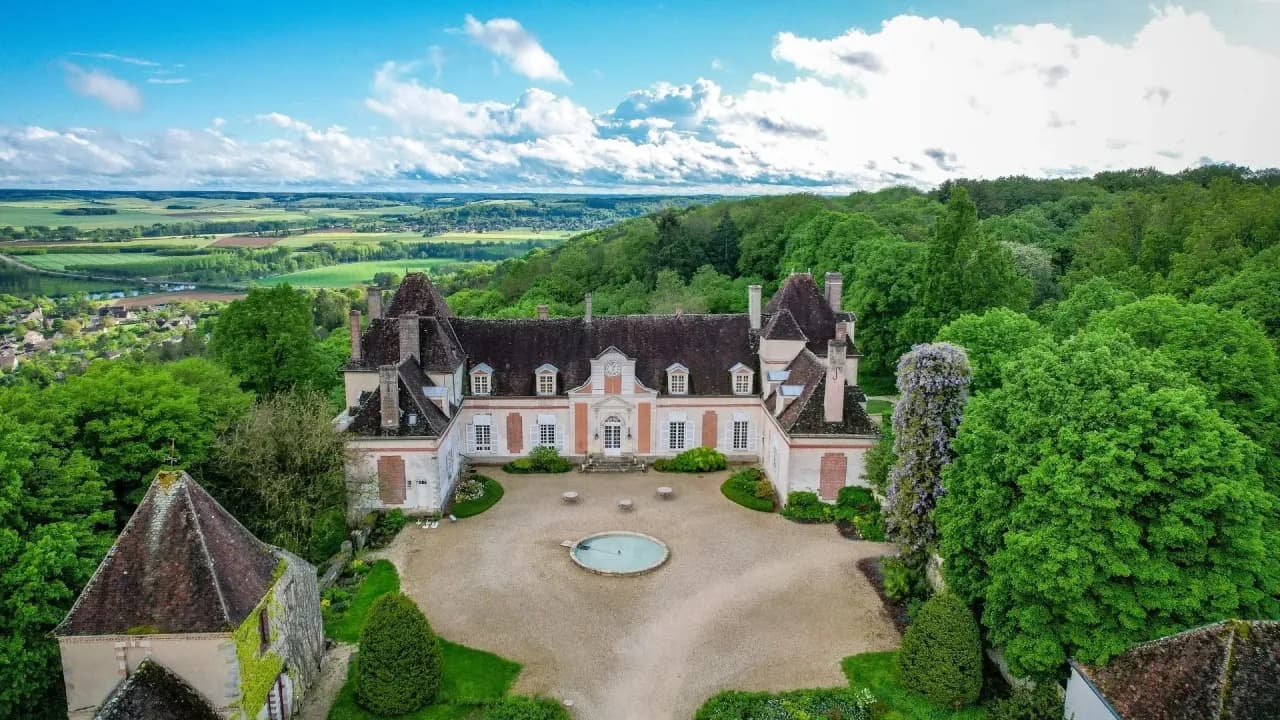
Château du Feÿ
Key facts
ProtectionInscrit MH
Inscrit monument historique: the second level of heritage protection in France, decided by the regional prefect. Owners must notify the state before any work on the protected parts, and the regional heritage authority (the DRAC) reviews it.
About
Home of a councillor to Louis XIII, then a cooking school where Julia Child was a guest in the 1980s, then a "château of possibilities" open to artists and festivities: Le Feÿ has changed lives many times. This large 17th-century house, built on a single level and known for its protected paneling, looks out over the Yonne valley. Since the late 2010s, the architect Jessica Angel has turned it into a place for residencies and a festival, and she is restoring its outbuildings.
The story of Le Feÿ begins in the 16th century with a first château, built for Nicolas Hennequin. Traces of it survive in the outbuildings, near the wine press and in the building the former owners called the bachelor's quarters, now a guesthouse. The old door that once led to the château can still be seen there.
In the 17th century, Nicolas de Baugy, a councillor under Louis XIII, added the present main château at Le Feÿ. It is a large single-level house rather than a tall château, flanked by vast outbuildings: the wine press on one side, on the other the old cowshed that became the farm, and between them a well 100 meters (330 feet) deep. Several owners followed. The 18th-century paneling in the salons is protected as a historic monument by the French state.
The ground floor of Le Feÿ unfolds as an enfilade, rooms opening one into the next in a very symmetrical French layout. A central salon, where the two main axes of the house cross, is framed by two salons on either side. The rooms run the full depth of the château, so light comes in from both sides, especially late in the day. Upstairs, a long corridor serves bedrooms set side by side: downstairs, people meet; upstairs, they retreat.
The central salon keeps an 18th-century map showing the full extent of the old property and every field that belonged to it. In 2023 the estate covers 42 hectares (104 acres), much of it woodland. From the terrace, the view opens onto the Yonne river and its valley.
As a private château, Le Feÿ has few archives recording who passed through. Legend says that Ninon de Lenclos, a lute player and celebrated courtesan of the 17th century, stayed there. The visit of Saint Vincent de Paul, on the other hand, is documented. He preached often at the church of Villecien, below the château, whose owner at the time was one of his great patrons.
In the 1980s, Le Feÿ entered the history of gastronomy. Anne Willan, a brilliant English scholar trained at Cambridge and married to the American Mark Cherniavsky, fell in love with France and its way of life and set up her cooking school, La Varenne, at the château. She invited chefs from around the world, including Julia Child, and Michelin-starred chefs who gave demonstrations for an international audience. The school taught what we now call farm to table, from the kitchen garden to the plate, and it shaped a whole generation of chefs in the United States.
The couple shared a passion for old cookbooks and the history of gastronomy. The demonstration kitchen at Le Feÿ has been kept as it was, with only the equipment needed to make it work. It opens on one side onto the vegetable garden and on the other onto an herb garden designed by an intern at the school, who went on to become a leading figure in American food. Upstairs, the slightly kitschy 1980s wallpapers have been kept: they give each bedroom its character.
The dovecote at Le Feÿ, with its boulins, the niches where the pigeons nested, once showed off the lord's wealth: the bigger it was, the bigger his lands. Pigeons provided meat, eggs and fertilizer for the vegetable garden, but they also raided the peasants' fields, and the grievance books drawn up on the eve of the French Revolution demanded an end to this privilege.
"Back then, having a dovecote was a bit like having a Ferrari today. In other words, the bigger my dovecote, the richer I was and the more land I had."
Jessica Angel, owner, 2023
When Le Feÿ's current owners arrived, the dovecote's lantern was leaning like the Tower of Pisa and threatening to collapse. After emergency work, restoring the roof frame and roofing, a very costly job, took four years. It was funded by four prizes, regional grants, many events and a great deal of support. In 2023 it was nearly finished.
Since the late 2010s, Le Feÿ has belonged to Jessica Angel, an architect who launched the project at 26. She has made it a meeting place between disciplines, from art to ecology, technology and agriculture, and between big cities, New York, Berlin, Los Angeles, and the countryside. The furniture mixes old and contemporary pieces, and the bedrooms are named after aromatic and medicinal plants, such as Primrose and Valerian. People call Le Feÿ the château of Possibilities.
"I often say I'm the guardian of this place, because, as we all know, you don't own a château. A château owns you."
Jessica Angel, owner, 2023
Two pyramidal oaks, Quercus fastigiata, at the center of the estate have been listed as remarkable trees. They guard the entrance to the hortus conclusus, the walled enclosure where a vegetable garden is being created and permaculture workshops are held. The association Les Amis du Feÿ connects built heritage, through training in traditional restoration techniques, with natural heritage: restoring ecosystems and caring for the forest.
"When we started this adventure, everyone told us, but that's impossible, you'll never pull it off. And today, six years later, everyone is really thriving and we're even more motivated to do lots of projects."
Jessica Angel, owner, 2023
In 2023, Le Feÿ lives by the seasons. In winter it hosts Feÿtopia, a residential community run like a shared house, open to artists and others: people stay a week, a month or four months, working remotely. The rest of the year, the château hosts weddings, seminars, micro-festivals and talks on ecology and technology. The Feÿ Arts festival brings together food, architecture, music and performance: about a hundred artists and more than 1,500 people over one weekend. You can also apply for a residency or join the estate's associations, which work with other local groups.
For future owners
Dreaming of a château like this one?
The founder of So Châteaux has visited more than 500 châteaux in France. He takes no commission on château sales, so he can tell you what he really thinks about any property, completely independently.
See how we help buyersGallery
Frequently Asked Questions
The current château was built starting in 1620, under Louis XIII.