
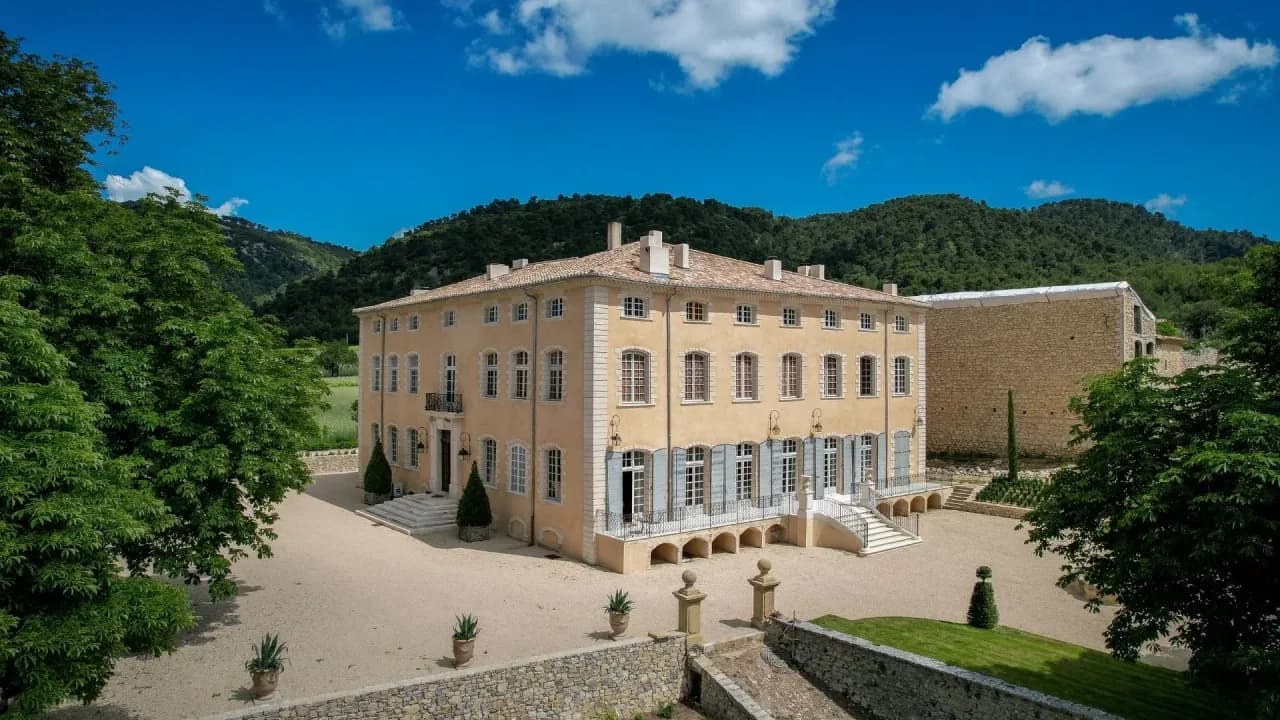
Château du Grand-Pré
Key facts
ProtectionInscrit MH
Inscrit monument historique: the second level of heritage protection in France, decided by the regional prefect. Owners must notify the state before any work on the protected parts, and the regional heritage authority (the DRAC) reviews it.
About
A remedy sold as far as China and America paid for Grand-Pré's decoration. The d'Ailhaud de Castelet family, doctors raised to the nobility, commissioned some of the finest carved plasterwork in Provence here in the 18th century. Built under Louis XIV facing Mont Sainte-Victoire, the Luberon château came through two centuries almost unchanged, until it nearly collapsed. Bought in 2019 by François Niforos, it has been saved, and its water gardens are waiting to be reborn.
Grand-Pré grew up around a building from the late 16th or early 17th century, of which some vaulted rooms survive. The large château that followed was built at the end of the 17th century by Françoise de Cambis, of the Brancas family, descended from the counts of Forcalquier. Its Louis XIV facade bears the date 1678. The great antechamber on the second floor keeps gypseries, the carved plaster decoration typical of Provence, left by the Brancas in the late 17th and early 18th centuries.
In the mid-18th century, the Brancas line died out and Grand-Pré was sold to Dr. Jean d'Ailhaud. In Provence, nobles were allowed to practice a trade. These doctors, whose fortune was recent, became the d'Ailhaud de Castelet family and made a show of it with a title, baron of Vitrolles, Castelet and Montjustin, and with major work inside and out.
The d'Ailhaud de Castelet fortune came from a remedy, presented as a cure-all in a Treatise on the True Cause of Diseases and How to Cure Them. It was made at Grand-Pré and stored in the château's pharmacy. From there it left by the cartload for Marseille, then on to Strasbourg, Avignon and Amsterdam, and from there to China and America. The pharmacy keeps its original paneling and its numbered cupboards in the 18th-century manner, painted in almond green and a red that time has faded to pink.
The château and the remedy works kept the village alive. Vitrolles-en-Luberon had 450 inhabitants in the 18th century, compared with 190 in 2023. The gypseries in the grand salon of Grand-Pré tell the same story. Mercury, god of medicine, with the vase and serpent, writes under the protection of Peace, who masters a lion, and of Justice. Instead of a portrait of the king, as in the age of Louis XIV, the family thus declared its loyalty to Louis XV, under whose reign peace and justice had let it prosper. Opposite, Wealth and Fame give alms to a beggar, in such detail that you can see the coins falling into the bowl. These were the values of the house, put on display the way big companies do today.
The grand salon at Grand-Pré, the last of the ground-floor rooms in a row, is the room that led to the château's listing as a historic monument. Gypserie is not cast plaster. The plasterer fixes a mass of plaster to the wall and carves it on the spot, whereas cast plasterwork, which came along a century later, is molded in a workshop and then glued in place. The panels over the mirrors depict the four seasons, winter to the north, summer to the south. Rosettes show cherubs celebrating the arts, on a sheet of music that can still be read, and maritime trade, around a small globe.
One last scene at Grand-Pré, three angels carrying a graduated protractor, long remained a puzzle. The protractor was the tool of the gardener in the 18th-century sense, the person who designed the landscape. It recalls the angle calculations used to lay out the great garden, which the slope forced off the axis of Mont Sainte-Victoire. In this salon, which in Provence was reserved for the closest visitors, the large panels were never repainted.
"You weren't supposed to repaint the gypseries, you had to save them, restore them. […] Because paint would have clogged the details, would have hidden details, and they're extremely precise."
François Niforos, owner, 2023
The dining room at Grand-Pré, fitted out by the d'Ailhauds around 1760 to 1770, is one of the few in the neo-Greek style in Provence. After the discovery of Pompeii, decorators returned to classical taste, with plain panels and vases above the doors. Its wine cooler, inlaid with Tholonet marble, the stone of Mont Sainte-Victoire, is a fountain fed by a cistern in the cellars: the château had running water as early as the second half of the 18th century. A stove, rare in Provençal châteaux, is a reminder of the windy winters of the Luberon. The revolutionary inventory of 1794 lists two of them.
The château has 300 different kinds of flowers carved in plaster. The plasterer is thought to have been Cauvet, a craftsman from Aix who had worked for the comte d'Artois. In the baron's bedroom, above the bed, two angels carry the initials of Jean-Gaspard d'Ailhaud and a baron's coronet, and his dressing room has kept all its 18th-century cupboards. Every fireplace at Grand-Pré, in black, yellow and white marble inlay typical of the Aix area, has survived the burglaries. Service staircases, under ceilings barely 2 meters (6.5 feet) high, let the servants move around without crossing the main rooms: the family now wanted to live in privacy.
The last d'Ailhaud de Castelets to live at Grand-Pré before the French Revolution were a d'Ailhaud and his wife, Marie-Thérèse de Condorcet, niece of the philosopher. Her bedroom is a manifesto of late 18th-century taste, the taste of Rousseau and a lost Arcadia. Deeply projecting overdoors, one of them after Jean-Baptiste Pillement, show pastoral scenes and, for the first time in the château, children and scenes of motherhood. In her boudoir, children return from the hunt with a horn, a partridge and a dog. Opposite, others give a concert on violin, mandolin and flute.
These gypseries, covered in oil paint in the 20th century, were hard to restore. Their restoration won the Sotheby's prize for the restoration of interior decoration. After the Revolution, the family lost its social standing but kept the château as a shrine to its past splendor, touching nothing until the end of the 20th century. The neoclassical chapel, built into the château during the 18th-century expansion, with Corinthian pilasters and carved garlands of religious objects, was part of the wing still half collapsed in 2023.
"I know one house in Provence where surely more than 80% of it dates from the 18th century. It's Grand-Pré."
François Niforos, owner, 2023
Grand-Pré, "the great meadow," takes its name from its garden. Travelers arriving from Aix or Manosque along parched roads came around a bend and suddenly found pools, fountains and lush growth that announced the importance of the masters of the house. The terraced garden blends Italian and French styles. The Brancas brought water from the slopes of the Luberon through water mines, masonry tunnels still in perfect condition, to feed the fountains, a large scalloped pool with a central jet, and then the orchards. At the end of the 18th century, the d'Ailhauds created a long carriage avenue that became the main approach, replacing the west gate on the village side.
François Niforos bought Grand-Pré in 2019, when it was close to collapse and its doors had been stolen. By 2023, the essentials were saved. The major decorative schemes have been restored with help from the state heritage service and specialist heritage firms, some doors have been found and are being restored or recreated, and the vaults of the old rooms have been rebuilt. The Louis XVI wrought-iron railing of the grand staircase, a marvel of Provençal ironwork that escaped being melted down during the Revolution, is still waiting to be restored. The chapel wing, where water was coming in everywhere, is being stabilized, and the large late 18th-century farm and industrial outbuildings that have collapsed behind the château still need to be secured.
"It was love at first sight, a huge one, that made us commit, buy it in 2019 and launch this major restoration work, titanic, maybe a little bit unreasonable."
François Niforos, owner, 2023
The next project is the garden. The Versailles School of Architecture has mapped the buried water systems and the locations of the fountains, and the outline of the great pool can still be read in the ground. In the dining room hangs a chandelier by Lustrerie Mathieu, a specialist in recreations for historic monuments. It is the one that lit Louis XV's bedroom in Maïwenn's movie Jeanne du Barry.
For future owners
Dreaming of a château like this one?
The founder of So Châteaux has visited more than 500 châteaux in France. He takes no commission on château sales, so he can tell you what he really thinks about any property, completely independently.
See how we help buyersGallery
Frequently Asked Questions
It was built shortly before 1678 and remodeled in the 18th century.