
Château du Lude
Key facts
ProtectionClassé MH
Classé monument historique: the highest level of heritage protection in France, decided by the national government. Any work on the protected parts needs state approval and is supervised by the state heritage services.
About
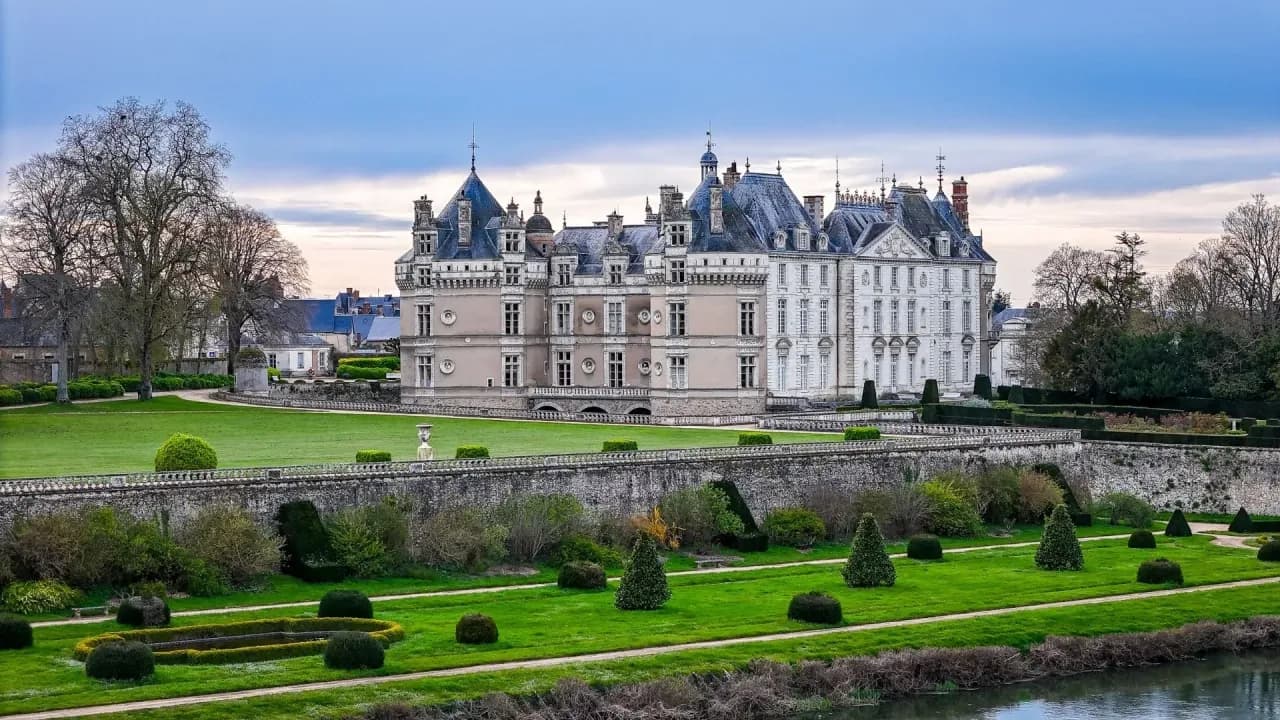
A Hundred Years' War fortress turned pleasure palace by the Daillon family, Le Lude gained a Louis XVI wing and then Renaissance Revival interiors in the 19th century. It towers over the Loir valley in the Sarthe, above its terraced gardens. It is one of the last great châteaux of the Loire still lived in. The Nicolaÿ family, heirs of the Talhouët-Roy family, live there, open it to visitors and have recreated its gardens.
Jean de Daillon, a childhood friend of Louis XI, bought Le Lude in 1457. The Daillons, a military noble family from Poitou, held high posts in the royal army from Louis XI to Louis XIV, some two hundred and fifty years. They settled at Le Lude just after the Hundred Years' War, when Anjou was joining the kingdom of France, and never stopped embellishing the fortress, softening its bulk to turn it into a house built for pleasure.
The work at Le Lude went to the architect Jean Gendrot, who arrived in 1479. Jean de Daillon died before it was finished, and his son Jacques completed it. The so-called François I facade, finished around 1520-1530, is Italian in inspiration and entirely original. The barony became a county in 1545, then a duchy and peerage in 1675 for Henry de Daillon, the first duke of Le Lude, who died without an heir in 1685.
The smallest room at Le Lude is also the most precious. The studiolo, barely eight square meters (86 square feet) on the ground floor, is painted from floor to ceiling. These private studies, an Italian idea, let the lady of the house withdraw alone, away from the courtiers, to meditate. The 16th-century paintings show scenes from the Bible and from Petrarch's Triumphs, a book that was in the Daillon library. The ceiling belongs to the school of Raphael: the same motifs appear in the rooms of the Vatican.
Sometime between the 18th and 19th centuries, Le Lude's studiolo vanished behind a false ceiling and a coat of plaster. The marquis de Talhouët-Roy rediscovered it in perfect condition in 1853, during his renovation work. The find shaped the whole restoration of the château. Without it, the decoration would probably have gone Gothic Revival. Instead, it went Renaissance Revival.
In 1751, Le Lude was bought by Joseph Julien Duvelaër, from a family of privateers based in Saint-Malo and a member of the French East India Company. He had spent ten years in Canton, China, and came back to France with his Chinese wife. Part of the château was badly damaged, so he had half of the old fortress torn down. Its site became a terrace, known as the spur.
When he died in 1785, Le Lude passed to his niece, Françoise Butler, marquise de La Vieuville. In 1787 she commissioned a large Neoclassical wing from the architect Jean-Benoît-Vincent Barré, who also designed the Châteaux de Montgeoffroy and du Marais. Work stopped in 1790 and did not resume for twenty or thirty years. The grand salon, the château's central room, was then decorated in the Louis XVI style, inspired by the city hall of Bordeaux. Its angled corners and mirrors give it great depth.
The suite of three reception rooms, from the billiard room to the small summer salon, is still furnished with the family's own pieces, beneath portraits of the Daillon, Talhouët and Nicolaÿ families. Family gatherings are still sometimes held here, mostly in summer, since the grand salon is hard to heat in winter.
"You get the feeling that great-grandmother […], the marquise de Talhouët-Roy, you get the feeling she's just left the room and came to spend a little time here with her friends."
Barbara de Nicolaÿ, owning family, 2024
Next door, the Altesse bedroom, the room of the lady of the house, still has its Polish-style canopy bed, a fashion that arrived in France with Queen Marie Leszczynska, and its dressing room.
Le Lude came to the Talhouët family when Auguste de Talhouët married the daughter of Antoine Roy. A lawyer who handled the affairs of the last duc de Bouillon, Antoine Roy inherited part of his fortune, came through the Revolution and the Restoration, and became finance minister under Louis XVIII and then Charles X, who ennobled him. His bust, in the robes of a peer of France, presides over the great library, once the marquis's study and completed around 1850. It holds the books of the Talhouëts and those of the La Tour d'Auvergne family, dukes of Bouillon.
In the mid-19th century, the marquis de Talhouët-Roy launched a major restoration of Le Lude with the architects Pierre-Félix Delarue, Henri Darcy, Louis Parent and Alain Lafargue. The great gallery, known as the ballroom, was fully decorated, from the furniture to the paneling, around 16th-century painted ceilings found during the work. Its Renaissance Revival fireplace is modeled on those at Blois, and the ermine recalls the Talhouëts' Breton roots. The entrance hall, Renaissance but remodeled in the 18th century, got back a coffered ceiling, and Louis Parent designed a marble mosaic floor for it, close to the one he created at the Château d'Ancy-le-Franc.
The whole hall leads the eye to the Angel of Le Lude, a bronze statue cast in 1475 by Jean Barbet to crown the Sainte-Chapelle in Paris, which the marquis installed here. In the early 20th century, the family sold it to pay for new roofs throughout. The original is now in the Frick Collection in New York. A bronze replica has taken its place, at the foot of the Renaissance Revival tower and its monumental staircase.
Before World War I, thirty-six people still worked at Le Lude. The vaulted kitchens, almost medieval, were used from the 15th century until World War II. Restored in the 1990s, with their copper pots and utensils found intact, they still work: from June to November, two or three days a month, jam is made here with fruit from the kitchen garden. A hand-cranked lift carried dishes up to the anteroom of the dining room, which the family still uses every day.
"The best way to preserve the rooms and preserve the pieces of furniture is to use them. It's to live in them every day, because you can see every day if there's a problem."
Barbara de Nicolaÿ, owning family, 2024
Le Lude had five linen rooms. The largest fills an entire tower on the fourth floor, with kidney-shaped tables for ironing tablecloths, one of them seventeen meters (56 feet) long, and a coal stove designed to heat the irons. The cupboards hold the trousseau of the marquise de Talhouët, married in 1847, embroidered with the family monogram. They also hold the dust covers laid over the furniture when the family left for Paris, and trunks of costumes for the plays staged in summer with the neighbors. The staff quarters, heated from the early 20th century, have their own billiard room.
The gardens of Le Lude step down in terraces toward the Loir, a tributary of the Loire. They have existed since the 17th century, as the great terrace and its balustrade of more than two hundred meters (650 feet) attest. Around 1880, the landscape designer Édouard André, who worked alongside Alphand, redesigned them entirely for the marquise de Talhouët. As much an engineer as a landscape designer, he installed the whole irrigation system. Water from the Loir, pumped by a hydraulic ram, rose into a thirty-five-meter (115-foot) water tower built on a mound. From there it watered eight hectares (20 acres) of gardens and fed the tanks at the top of the towers, which supplied water taps on every floor.
At the end of the 20th century, the owners of Le Lude created a rose garden and a yew maze on the spur. André's French formal garden by the Loir became a garden of pools and topiaries about twenty years ago. It faces the farmland park planted in the early 19th century in the spirit of the comte de Choulot, a wide open space dotted with clumps of trees. A botanical walk, planted over the last twenty years or so, completes the grounds, which carry the national Jardin remarquable label.
"All these spaces have been rethought, recreated, restored, without betraying the spirit, I think. The spirit of these gardens, the genius of the place that has been here in the gardens of Le Lude since the 17th century."
Barbara de Nicolaÿ, owning family, 2024
Le Lude belongs to the Nicolaÿ family: the last marquis de Talhouët-Roy to live there had only two daughters, and the elder married the marquis de Nicolaÿ. A private château that is still lived in, it is open to visitors and hosts events. In 2024, the private apartments, such as the small library and the dining room, could be seen on request with a guided tour, and a few tours a year went up to the attics, the wall walk and the dome over the staircase. A few historic bedrooms are rented to guests from time to time. Two old rooms were being restored at the time, to be added to the tour. Every June since 1994, the Fête des Jardiniers, a garden festival, has been held in the park.
For future owners
Dreaming of a château like this one?
The founder of So Châteaux has visited more than 500 châteaux in France. He takes no commission on château sales, so he can tell you what he really thinks about any property, completely independently.
See how we help buyersDid You Know?
An Italian-style studiolo
The château preserves a rare painted study, or studiolo, decorated with murals attributed to the school of Raphael.
Gallery
Frequently Asked Questions
Because it was remodeled from the Middle Ages to the 18th century, with each façade reflecting a different era.