
Château de Tiregand
Key facts
ProtectionInscrit MH
Inscrit monument historique: the second level of heritage protection in France, decided by the regional prefect. Owners must notify the state before any work on the protected parts, and the regional heritage authority (the DRAC) reviews it.
About
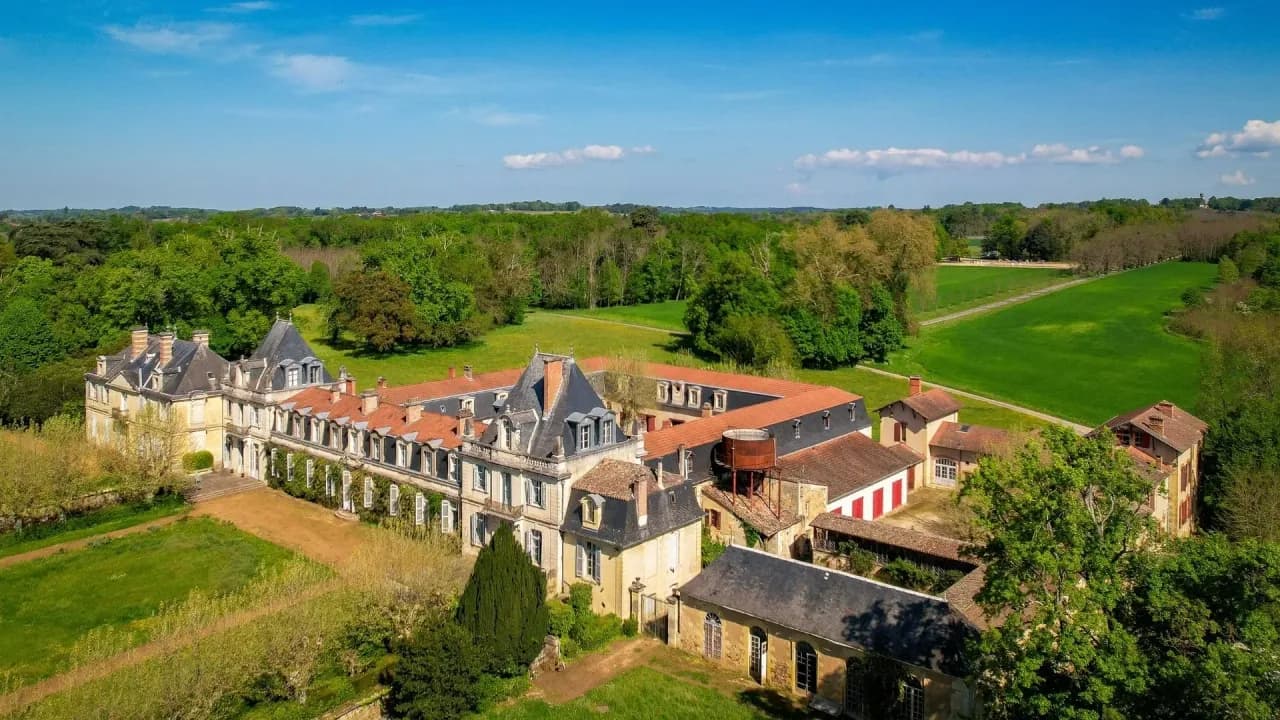
Nearly two centuries of life in one family, from the La Panouses to the Saint-Exupérys, left Tiregand with wallpapers from every period, Beethoven scores and a workshop whose machines still run. An 18th-century house largely rebuilt in the 19th century in an English Gothic Revival style, it overlooks the Dordogne valley from the Pécharmant wine area near Bergerac. Louis Guyot, who took it over in 2022, chose to open it to the public for the first time in its history.
The oldest part of Tiregand is an 18th-century pavilion, which holds the largest rooms, those meant for entertaining. It opens onto the oldest of the estate's three terraces. Originally a second pavilion stood opposite it as its match. It was destroyed during the Revolution.
In 1826 the La Panouse family bought Tiregand. The property then passed by marriage to the Saint-Exupéry family, and the same line lived here for nearly two hundred years. The estate sits in the middle of wine country. Tiregand lies in the Pécharmant, a wine-growing area a few kilometers from Bergerac and Monbazillac, and looks down on the Dordogne valley. From the lookout in the park, the view reaches the Château de Piles, which belonged to the same family at the time.
In the 19th century, Tiregand was heavily rebuilt by the architect Louis Garros, who worked widely around Bordeaux and drew on English Gothic Revival. The domed entrance porch sets the tone and makes an immediate impression on visitors, with forms more familiar in England than in the Périgord.
In the middle of the century, a staircase pavilion was built to link the new buildings to the 18th-century part. On the ground floor come the dining room, the small music room, then a series of small rooms served by a long service corridor. Tiregand was designed for entertaining: counting the servants' rooms, the château had nearly 45 bedrooms. Six of them, the finest, line up upstairs along a long corridor on the main facade.
The 18th-century great drawing room is the largest room at Tiregand. In the 19th century it had been given a plaster ceiling on lath. When termites attacked it, it was broken out, and just above it was found an 18th-century ceiling of exposed painted beams, a plafond à la française. The decision was made to leave it visible and to paper the walls all the way up, to give the room back its full ceiling height.
Further on, a small library, probably from the 19th century, has been redone in the spirit of the century before, with moldings in that style and an 18th-century gray.
The dining room at Tiregand is in the Napoleon III spirit: black furniture, red tones, painted garlands of flowers above the paneled doors. A faience stove would have heated it, as in many 19th-century dining rooms. A statue of Athena has taken its place. On the wall hangs a portrait of Athanase de La Panouse, brother-in-law of the owners of the time.
The 19th-century owners were great music lovers, and their taste for the arts runs all through Tiregand. They left a collection of scores that includes Beethoven and Massenet. In the small music room, 25 numbered false books, marked with the T of Tiregand beneath a count's coronet, hold hundreds of plays.
What makes Tiregand unusual is the tangle of periods, which shows especially in its wallpapers. In 2022, several bedrooms were being redone. The largest, whose paper had faded, was rehung in a burgundy red. The old curtains, stored since the 19th century, came out of the closets, and the aim was to find each one's original place and give the house back its late 19th-century atmosphere.
On the second floor of the 18th-century pavilion, an apartment fitted out in the late 19th century has not been lived in since the late 1930s. Run-down and left exactly as it was, it has a man's bedroom and a woman's bedroom hung with religious paintings. That atmosphere is what the tour was meant to bring out, with the shutters closed and the light low, using furniture from the château and pieces found at flea markets.
"And the idea is that they actually walk into an apartment as if nothing had moved in 50 years."
Louis Guyot, owner, 2022
The gardens at Tiregand step down over three terraces. The second, now the main one, runs along a facade covered in roses. The third, more practical, holds the vegetable garden. An 18th-century lookout, also called the bandstand, with faces carved on every frame, looks out over the Dordogne valley.
The orangery at Tiregand, from the 18th century, has kept its tall French doors. In the 19th century its last bay was turned into a chapel. Wires strung beneath its ceiling long puzzled people: the owners dried tobacco on them for their own use. Next door, a workshop from the early 20th century has survived intact, with its forge, its workbench and belt-driven machines that still work.
"It's pretty amazing to see all that running. When it's more than 100 years old. It still does something to you, seeing these machines working again."
Louis Guyot, owner, 2022
A small flowered courtyard at Tiregand is called the ostrich courtyard. According to the former owners, two or three ostriches lived there in the 19th century, when ostrich feathers were all the rage in home decor. There is also a 19th-century cistern, fed by a well from the same period that draws on groundwater 326 meters (1,070 feet) down.
The main courtyard at Tiregand, planted with three plane trees, is shared between the main house and the outbuildings: stables, carriage house, garage, tack room and woodshed, with the servants' quarters above. The stable had four stalls and a box on each side. The fittings disappeared when it fell out of use, but the horses' nameplates, Émir, Mandarin, Bonhomme, are still there.
In spring 2022, Louis Guyot took over Tiregand with one goal: to open it to the public on July 1, for the first time in its history. It was a tall order, with two months to get the rooms ready, buy new maintenance equipment and bring an overgrown garden back into shape.
"And I just took over this château, a little over a month ago, to open it to the public for the first time in its history."
Louis Guyot, owner, 2022
The tour planned in 2022 set out to be innovative: a chambermaid leads visitors into the 19th-century world that is so present at Tiregand, all the way to the apartment closed since the 1930s. In time, the stables are to be restored.
For future owners
Dreaming of a château like this one?
The founder of So Châteaux has visited more than 500 châteaux in France. He takes no commission on château sales, so he can tell you what he really thinks about any property, completely independently.
See how we help buyersGallery
Frequently Asked Questions
The current residence dates from the 18th and 19th centuries.