
Manoir d'Eyrignac
Key facts
ProtectionInscrit MH
Inscrit monument historique: the second level of heritage protection in France, decided by the regional prefect. Owners must notify the state before any work on the protected parts, and the regional heritage authority (the DRAC) reviews it.
About
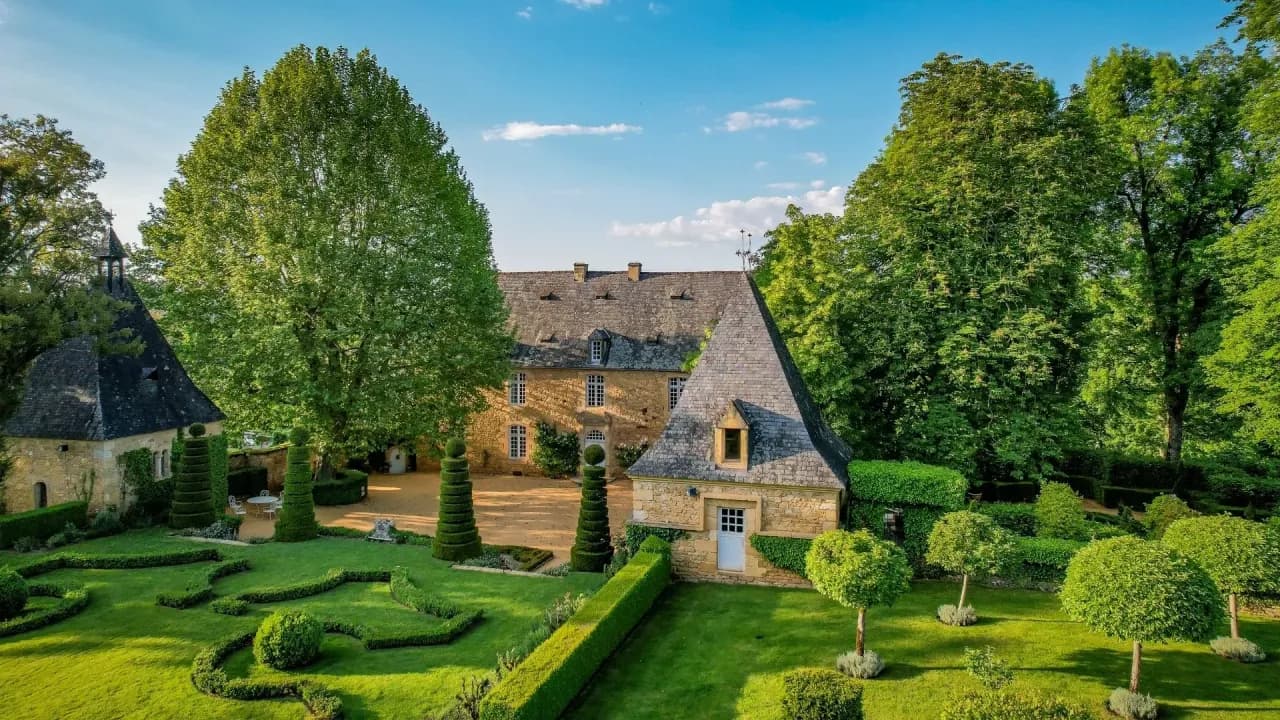
For three centuries, nothing has been sold or bought in this 1667 manor house: furniture, portraits, tapestries and old books have stayed where the ancestors left them. Built without towers in the golden stone of Sarlat, flanked by a chapel and a dovecote, Eyrignac is a plain Périgord house ringed by gardens, the heart of the estate. The family of the writer La Calprenède has lived there for five hundred years and brought the gardens back to life.
Eyrignac is dated 1667, the year carved on the fireplace in the salon. By the 17th century, people no longer built towers: the manor is a single main house without frills, whose beauty lies in its simplicity. It is built of the golden stone of Sarlat, the nearby town about ten kilometers (six miles) away, in the heart of the Périgord Noir, the wooded southeastern part of the Dordogne. Sarlat is now one of the most visited towns in the Dordogne.
Two small pavilions stand on either side of the courtyard at Eyrignac, without touching the house: the chapel and the dovecote. They are freestanding buildings set in the courtyard, not towers attached to the house as in older manors. The whole place has stayed untouched, which is rare, and the property has belonged to the same family for five hundred years, handed down from generation to generation and never sold.
Above the fireplace in Eyrignac's dining room hangs a portrait of Gautier de Costes de La Calprenède, a writer by trade, whom the family regards as the builder of the manor. His novels were a sensation in the 17th century, and one of their heroes, Artaban, left the French a lasting expression: "proud as Artaban."
Born around 1609 at the Château de Toulgou, in Salignac, a few kilometers from Eyrignac, La Calprenède made his career in Paris, first writing tragedies, then long heroic novels, Cassandre, Cléopâtre and Faramond. Artaban, a Parthian prince of unmatched pride, is one of the heroes of Cléopâtre, published in several volumes between 1646 and 1658. The writer died in 1663, four years before the date carved on the salon fireplace.
Another portrait at Eyrignac, in the salon, shows Antoine de La Calprenède, lord of Eyrignac and Morival, a member of the Grand Conseil, one of the king's high courts, and director of the Royal Mint under Louis XVI. He created the gardens in the 18th century. The family also had a bishop, who gave his name to one of the bedrooms.
Eyrignac's salon is arranged around a large fireplace, still in use, which bears the date of construction and the unicorn, the family emblem. On the walls hang a 17th-century Aubusson tapestry and portraits of the ancestors. In the room stand Louis XIV armchairs that still have their original tapestry upholstery.
Eyrignac's library holds old books in early French, original to the house, which have never left it. The same goes for all the furniture, in place for three hundred years.
"All the furniture is here, it's always been here for 300 years, nothing's been sold or bought, except the TV and the couch, everything's stayed just as it was."
Patrick Sermadiras, owner, 2022
Eyrignac's dining room is furnished in the Louis XIII style, with 17th-century pewter. Its rammed-earth floor is typical of the Périgord, and its windows open onto the garden. Next door, a small room is used for watching TV or playing cards, and a small, fully paneled dining room is where breakfast is served.
Eyrignac's main kitchen has been fitted for modern life, with ovens and a washing machine, but it has kept its paneling and its many windows, set the way they were cut in the 17th century. Meals are still eaten there.
A 17th-century staircase leads to the upper floor of Eyrignac, where every bedroom has a working fireplace. The owner's bedroom is the very room where he was born. It holds photographs of his parents, his wife and his son, who is set to succeed him.
"I was born in this room, and I'll die in this room, I hope. So I have memories of my whole life in this house."
Patrick Sermadiras, owner, 2022
The bishop's bedroom at Eyrignac has a canopy bed and opens onto a paneled bathroom. Another bedroom mixes family portraits with a contemporary painting, and it too has a wood-paneled bathroom.
In 2022, Eyrignac is still the family's home, and the owner's 25-year-old son is his chosen successor. The manor is not a house museum: the family furniture is used every day, the fireplaces work, and meals are sometimes taken in the kitchen. The gardens Antoine de La Calprenède created in the 18th century were re-created some fifty years earlier by the current owner's father. They have become the heart of the estate, and they are where the owner spends most of his time.
"All my passion, my whole life, goes into the garden."
Patrick Sermadiras, owner, 2022
For future owners
Dreaming of a château like this one?
The founder of So Châteaux has visited more than 500 châteaux in France. He takes no commission on château sales, so he can tell you what he really thinks about any property, completely independently.
See how we help buyersGallery
Frequently Asked Questions
Its French-style gardens, with three hundred yew and boxwood topiaries, designated a Jardin remarquable.