
Château de Digoine

Key facts
ProtectionClassé MH
Classé monument historique: the highest level of heritage protection in France, decided by the national government. Any work on the protected parts needs state approval and is supervised by the state heritage services.
About
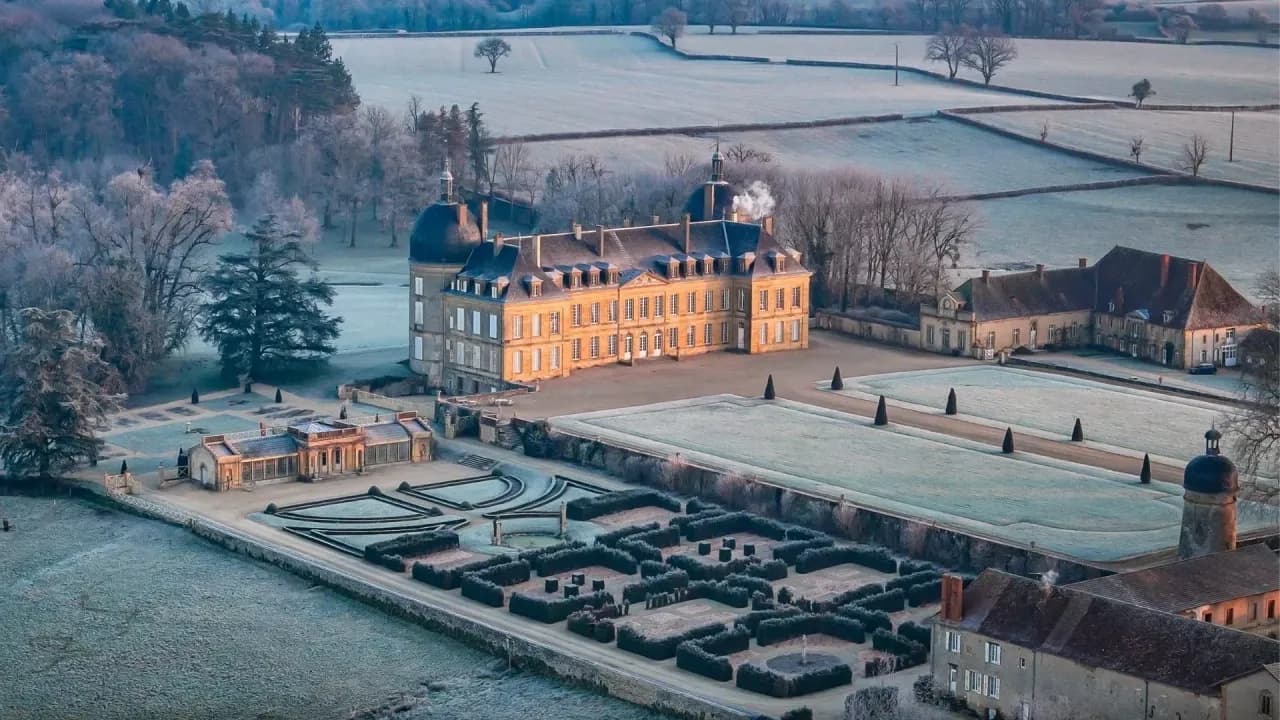
A neoclassical facade to the south, an English-style park to the north: Digoine has two faces. The Reclesne family built it in the 18th century on a medieval castle's towers in Burgundy's Charolais area. Napoleon's aide the Count of Chabrillan added a Gothic Revival library, a greenhouse and a private theater that drew Sarah Bernhardt and Offenbach. Jean-Louis Remilleux bought it empty in the early 2010s, lives there, fills it with his collections and opens it to visitors.
The Digoine estate belonged to the Damas de Digoine family as early as the 10th and 11th centuries, and their story has its bloody moments: one of the heirs was beheaded for betraying the king of France to the Burgundians. Of the medieval fortress, two large towers survive, along with the two dovecotes in front of the south facade and the outbuildings that housed the old kitchens.
In the early 18th century, the Reclesne family wanted a modern château at Digoine. They built it on the remains of the medieval castle, keeping the towers, dovecotes and service buildings. The portraits of Monsieur and Madame de Reclesne, the founder of 18th-century Digoine, painted by François de Troy, have come back to the château. Through inheritance, the Chabrillans, cousins of the Reclesnes, then took over, and the house stayed in the same family until the early 20th century.
The architect Edme Verniquet gave Digoine its south facade, neoclassical and very Louis XVI in style, opening onto a formal French garden. To the north, the château looks out on an English-style landscape park and its pond, and the R of the Reclesnes is worked into the wrought iron of the balconies. So the château has two faces, depending on which side you approach it from.
Two records of the building work have resurfaced. Verniquet's cork model of the house, a common practice in Burgundy, turned up in a gallery in Munich. A drawing signed by him shows the south facade, the dovecotes, the medieval outbuildings and the Reclesne family arriving by carriage. It was one of a pair, with a drawing of the other facade.
Digoine's great entrance hall owes its character to decoration that came from Paris: consoles on huge lion's paws and mythological water scenes in high relief. The baron de Besenval, a friend of Marie Antoinette, had commissioned them from the sculptor Clodion for the basement bathhouse of his Paris mansion. The Hôtel de Besenval is now the residence of the Swiss ambassador.
Toward the end of the Chabrillan era, the originals were sold to the Louvre and replaced at Digoine with plaster copies. One original stayed, though, above the staircase: a large Toilette of Venus, probably in three parts, which historians attribute to Clodion or one of his contemporaries. Books on the sculptor and histories of Paris mansions record it.
Digoine's 19th century belongs to the Count of Moreton de Chabrillan, an aide-de-camp to Napoleon who served in every campaign of the Empire, and to his son. Fashionable men, often in Paris, they made the château a sought-after destination. They are behind almost everything original about the house: the small theater, fitted into the medieval annexes, the Gothic Revival chapel built in the old kitchens when the count's wife died in 1830, the library and the greenhouse. An Empire-period fireplace recalls the count's campaigns.
Digoine's library, designed around 1840 in the Troubadour style, the French romantic take on Gothic Revival, under a bust of Charles X, has not changed. The Chabrillan arms, a tower and a bear's paw, are everywhere, on the fireplace and in the stained glass. It is the only room in the château that has never been heated: the architects advised against radiators for fear the paneling would split. The portrait of the Countess of Chabrillan, born Zéphyrine Olympe de Choiseul-Gouffier, was bought back at auction.
"I'm very happy to see this countess come back to her home, which she never should have left."
Jean-Louis Remilleux, owner, 2021
The theater at Digoine, built around 1830-1840, is a private society theater, the kind many great châteaux had. Guests came to stay for three to eight weeks, with servants and trunks, and put on improvised shows to entertain themselves, please their hostess or gently tease the other guests. Sarah Bernhardt and Offenbach came at the invitation of the Countess of Chabrillan. Surviving programs show Offenbach playing a comic valet.
The house seats one hundred, sixty in the orchestra and forty in the first balcony, beneath the crests of cousin families, with the Chabrillan arms above the stage. Its curtain, by Ciceri, set designer for the Comédie-Française and the Paris Opera, was restored at the initiative of the previous owners. In 2021, the rest of the theater was still waiting for its restoration, delayed first by studies and then by Covid, and scheduled for spring 2022. The plan: clean the gilding without redoing it, repair plaster and wallpaper, reupholster the benches and boxes. The project included concerts and readings, and a box dedicated to Sarah Bernhardt.
"There's no way we're regilding all of this. And turning it into some kind of meringue. No, no, you have to clean what can be cleaned."
Jean-Louis Remilleux, owner, 2021
Digoine's drawing rooms open one into the next, as in the great châteaux of the 18th century, and the grisaille paintings above the doors are just as they were when the château was built, only cleaned. The house has two dining rooms, one facing north for summer and one facing south for winter, each with its original warming and cooling cabinets. Sold empty, the château was refurnished by its current owner. At an auction held before he bought it, he was able to acquire objects tied to the history of the house, including portraits and beds by Jacob, the great Paris cabinetmaking family.
The rest comes from his own collections. In the winter dining room, an ostrich and a cassowary painted in the 17th century by Francis Barlow, illustrator of Aesop's fables, come from the hall of Longleat, in England. The drawing rooms bring together a painting by Pierre Gobert of the daughters of Louis XIV and Madame de Montespan, several portraits of Cardinal Richelieu, a 17th-century marble bust of Louis XIV shown face on, a pair of Spanish cabinets telling the story of the fall of Granada, and a jardiniere by the Scottish designer Adam. In a medieval tower, the game and hunting room opens straight onto the park.
Digoine has belonged since the early 2010s to Jean-Louis Remilleux, who bought it after a long period of joint ownership among heirs. At the time the château was lived in only in spring and summer and had no heating. On his first night there, in February 2012, it was minus 17 degrees Celsius (1 degree Fahrenheit). The first work installed 120 to 130 radiators, with care for the walls and decor, then rewired the house and redid the bedrooms and bathrooms. In 2021, the owner lives at Digoine almost year-round, and the château is open to the public.
Facing the Count of Chabrillan's restored greenhouse, the garden at Digoine has been extended with a rose garden of 3,000 old, English and contemporary roses, set in rooms of clipped yew. In spring, forget-me-nots, black and pink tulips and peonies bloom before them. The greenhouse faces due south and is barely heated in winter. It shelters plants from Sicily, bougainvillea, palms, jasmine, agaves, orange and lemon trees, and in summer it is used for candlelit dinners.
"I decided to keep it simple. And make a greenhouse of Mediterranean plants, from Sicily. That way I can cross the main courtyard and go to Sicily whenever I miss Sicily."
Jean-Louis Remilleux, owner, 2021
For future owners
Dreaming of a château like this one?
The founder of So Châteaux has visited more than 500 châteaux in France. He takes no commission on château sales, so he can tell you what he really thinks about any property, completely independently.
See how we help buyersDid You Know?
A theater for stars
The château's private theater, decorated by Ciceri, hosted Jacques Offenbach and Sarah Bernhardt.
Gallery
Frequently Asked Questions
The current château was built in the 18th century.